Crab Macaque [1] ( lat. Macaca fascicularis ) or Javanese macaque is a species from the monkey family ( Cercopithecidae ).
| Crab-eater |
 |
| Scientific classification |
|---|
| {{{{{{{{{{{{{{{{{{{{{{{{{{{{{{{{{{{{{{{{{{{| 1}} | 1}} | 1}} | 1}} | 1}} | 1}} | 1}} | 1}} | 1}} | 1}} | 1}} | 1}} | 1}} | 1}} | 1 }} | 1}} | 1}} | 1}} | 1}} | 1}} | 4}} : | Eumetazoi |
| No rank : | Bilateral symmetrical |
| Squadron : | Euarchontoglires |
| Grand detachment : | Euarchonta |
| Parvotryad : | Narrow-nosed monkey |
|
| International scientific name |
|---|
Macaca fascicularis Raffles , 1821 |
| Subspecies |
|---|
- M. f. atriceps Kloss, 1919
- M. f. aureus I. Geoffroy Saint-Hilaire, 1831
- M. f. condorensis Kloss, 1926
- M. f. fascicularis (Raffles, 1821)
- M. f. fuscus Miller, 1903
- M. f. karimondjawae sody, 1949
- M. f. lasiae (Lyon, 1916)
- M. f. philippinensis I. Geoffroy Saint-Hilaire, 1843
- M. f. tua Kellogg, 1944
- M. f. umbrosus (Miller, 1902)
|
| Area |
|---|
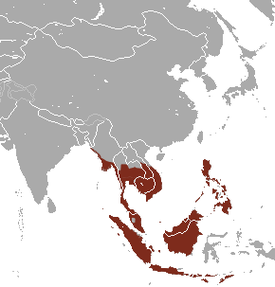
|
| Security status |
|---|
Least ConcernedIUCN 3.1 Least Concern : 12551 |
|
Content
The monkey is medium in size, body length from 40 to 60–65 cm. The mass of an adult male is 4–8.5 kg, and females 2.5–3.8 kg. The tail is long about half a meter, the limbs are short. The coat is gray with a greenish tint, there is a dark tuft on the head, light mustache and whiskers are characteristic.
A cynomolgus monkey occupies a wide range from eastern Bangladesh through Burma , Thailand , Indochina , the islands of the Malay archipelago to the Philippines . It is a rare example of a land mammal breaching the Wallace Line . Lives in tropical flat forests , both primary and disturbed and secondary , including near human settlements, as well as mangrove forests, knows how to swim well.
Acclimatized in several areas outside the natural range, in particular in the western part of New Guinea , on the island of Anggaur of the Palau archipelago and in Mauritius . On islands where the local fauna has formed in the absence of large predators, it poses a threat to biodiversity .
The cynomolgus is omnivorous. Although it can get food from water, crabs are not its main food. It eats fruits, berries, leaves, nuts, insects, snails and crustaceans.
Crabeater macaques breed year round. In natural habitats, the maximum birth rate falls in the spring and early summer, but in other climatic zones, these periods may shift.
Cloning
In 2018, two macaques [2] [3] [4] [5] were successfully cloned by Chinese scientists.
- ↑ Sokolov V.E. The pagan dictionary of animal names. Mammals Latin, Russian, English, German, French. / edited by Acad. V. E. Sokolova. - M .: Rus. lang., 1984. - S. 91. - 10,000 copies.
- ↑ Liu, Zhen et al. Cloning of Macaque Monkeys by Somatic Cell Nuclear Transfer (English) // Cell : journal. - Cell Press , 2018 .-- 24 January. - DOI : 10.1016 / j.cell.2018.01.020 .
- ↑ Briggs, Helen . First monkey clones created in Chinese laboratory , BBC News (January 24, 2018). Date of treatment January 24, 2018.
- ↑ Associated Press . Scientists Successfully Clone Monkeys; Are Humans Up Next? , The New York Times (January 24, 2018). Date of treatment January 24, 2018.
- ↑ Chinese Scientists Clone Monkeys Using Method That Created Dolly The Sheep (Neopr.) NPR (January 24, 2018).