Myrmekiaphila (lat.) Is a genus of migalomorphic spiders from the Euctenizidae family . There are 11 species living in the southeastern United States [1] . The length of the cephalothorax of different representatives of the genus is from 2.8 to 8 mm with a width of 2.2 to 6.8 mm [2] . Body color varies from yellowish red to reddish brown [2] . Spiders live in cobwebbed minks covered with “hatches” from soil bonded with cobwebs [2] . A unique feature of Myrmekiaphila is the presence of side chambers in the hole, which are often closed by additional hatches [2] .
| Myrmekiaphila |
|---|

Myrmekiaphila tigris , female |
|
| No rank : | Bilateral symmetrical |
| Infrastructure : | Megalomorphic spiders |
| Superfamily : | Cyrtauchenioidea |
|
|
Myrmekiaphila GFAtk. , 1886 |
|
|
|
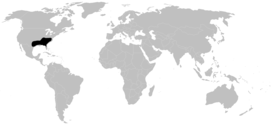
Representatives are common in the southeastern states of the United States: found in Virginia , Kentucky , North and South Carolina , Tennessee , Georgia , Alabama , Mississippi , Florida and Texas [2] .
The genus was identified in 1886 by George Francis Atkinson , giving it the name Myrmekiaphila due to the fact that he observed the hunt of these spiders for ants ( Greek. Μυρμήγκι - ant). For a long time, Myrmekiaphila were considered as part of the Ctenizidae family, until in 1985 the Australian arachnologist Robert Raven transferred them to another family - Cyrtaucheniidae , where they are now considered in the Euctenizinae subfamily [2] .
Currently, the species includes 11 species, which are combined into three groups [2] :
- Group of species "foliata"
- Myrmekiaphila comstocki Bishop et Crosby, 1926
- Myrmekiaphila coreyi Bond et Platnick, 2007
- Myrmekiaphila foliata Atkinson, 1886
- The group of species "fluviatilis"
- Myrmekiaphila fluviatilis (Hentz, 1850)
- Myrmekiaphila howelli Bond et Platnick, 2007
- Myrmekiaphila jenkinsi Bond et Platnick, 2007
- Myrmekiaphila millerae Bond et Platnick, 2007
- Myrmekiaphila neilyoungi Bond et Platnick, 2007
- Myrmekiaphila torreya Gertsch et Wallace, 1936
- Group of species "minuta"
- Myrmekiaphila minuta Bond et Platnick, 2007
- incertae sedis
- Myrmekiaphila flavipes (Petrunkevitch, 1925) - are known only from females, and therefore assignment to groups of species is impossible.

