Actin is a globular protein from which microfilaments are formed - one of the main components of the cytoskeleton of eukaryotic cells . Actin consists of 376 amino acid residues, with a molecular weight of about 42-kDa with a diameter of 4-9 nm. It has 2 forms: monomeric G-actin and polymerized form (F-actin). Together with the protein myosin, it forms the main contractile elements of muscles - actomyosin complexes of sarcomeres . It is present mainly in the cytoplasm, but in a small amount it is also found in the cell nucleus [1] [2] .
| Actin | |
|---|---|
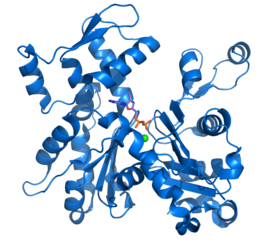 G-actin. The associated ADP molecule and divalent cation are shown. | |
| Identifiers | |
| Symbol | Actin |
| Pfam | PF00022 |
| Interpro | IPR004000 |
| PROSITE | PDOC00340 |
| SCOP | 2btf |
| SUPERFAMILY | 2btf |
| Available protein structures | |
| Pfam | the structure |
| PDB | RCSB PDB ; PDBe ; PDBj |
| PDBsum | 3D model |
Classes
- α-actinin isoform
- β-actinin isoform
- γ-actinin isoform
Functions
- Cell cytoskeleton is formed, creating mechanical support.
- Involved in myosin-independent cell shape changes and cell movement.
- In muscle cells, actin together with myosin creates a complex involved in muscle contraction .
- In non-muscle cells, it participates in the transport of vesicles and organelles by myosin [1]
- Cell division and cytokinesis
G-actin
Electron microscope images showed that G-actin has a spherical structure; however, x-ray crystallography showed that each of these globules consists of two lobes separated by a groove. This structure is an “ATPase fold,” which is the center of enzymatic catalysis, which binds ATP and Mg 2+ , and hydrolyzes the former to ADP and organic phosphate. This fold is a conservative structure, which is also found in other proteins [3] . G-actin only functions when it contains either ADP or ATP in its groove, but the form associated with ATP prevails in cells when actin is present in monomeric form [4] .
Primary Structure
Contains 374 amino acid residues. Its N-terminus is strongly acidic and begins with acetylated aspartate in its amino group. Although its C-terminus is alkaline and is formed by phenylalanine , which is preceded by cysteine [5] .
Tertiary Structure - Domains
The tertiary structure is formed by two domains, known as large and small, which are separated from each other by a groove. Below this is a deeper notch called the “groove”. Both structures have comparable depth [6] .
Topological studies have shown that a protein with the largest domain on the left side and the smallest domain on the right side. In this position, the smaller domain, in turn, is divided into two: subdomain I (lower position, residues 1-32, 70-144 and 338-374) and subdomain II (upper position, residues 33-69). The larger domain is also divided into two: subdomain III (lower, residues 145–180 and 270–337) and subdomain IV (higher, residues 181–269). Open areas of subdomains I and III are called “jagged” ends, and exposed areas of domains II and IV are called “pointed” ends.
F-Actin
The classical description of F-actin states that it has a filamentous structure, which can be considered either as a single-chain left spiral with a rotation of 166 ° around the spiral axis and an axial shift of 27.5 Å , or as a single-chain right spiral with a cross spacing of 350-380 Å, moreover each actin molecule is surrounded by 4 others. The symmetry of the actin polymer at 2.17 subunits per helix revolution is incompatible with the formation of crystals, which is possible only with symmetry of exactly 2, 3, 4, or 6 subunits per revolution [7] [8] .
It is believed that the F-actin polymer has a structural polarity due to the fact that all microfilament subunits point to the same end. This leads to a naming convention: the end that has an actin subunit that has an ATP binding site is called the “(-) end”, while the opposite end, where the cleft is directed to another adjacent monomer, is called the “(+) end "The terms" pointed "and" jagged ", referring to the two ends of microfilaments, derive from their appearance by transmission electron microscopy when the samples are examined using a preparation method called" decoration. "This myosin forms polar bonds with actin mon measures, which leads to a configuration that looks like arrows with perforations along its shaft, where the shaft is actin and flatching is myosin. Following this logic, the end of a microfilament that does not have protruding myosin is called the arrow point (- end), and the other the end is called the prickly end (+ end) [9] . The S1 fragment consists of the domains of the head and neck of myosin II. Under physiological conditions, G-actin (monomeric form) is transformed into F-actin (polymer form) using ATP, where the role of ATP is substantial.
The process of forming a polymer actin called F-actin involves the binding of monomeric G-actin to the ATP molecule in the presence of Mg 2+ , Ca 2+ ions , the formation of stable actin oligomers and globules, the formation of individual actin polymer filaments and their branching. As a result, organic phosphate and an ADP molecule are formed. Actin microfilaments are formed by spiral twisting of 2 F-actin filaments, inside which actin molecules are linked together by non-covalent bonds [10]
Each such microfilament has two ends that differ in their properties: actin monomers are attached to one (it is called the plus-end), and dissociate from the other (minus-end). The ratio of the rates of addition and dissociation of actin monomers determines whether the filament lengthens or shortens [10] .
Notes
- ↑ 1 2 N.V. Bochkareva, I.V. Kondakova, L.A. Kolomiyets. The role of actin-binding proteins in cell movement in normal and with tumor growth // Molecular Medicine. - 2011. - Issue. 6 . - S. 14–18 . - ISSN 1728-2918 .
- ↑ CG Dos Remedios, D. Chhabra, M. Kekic, IV Dedova, M. Tsubakihara. Actin Binding Proteins: Regulation of Cytoskeletal Microfilaments (Eng.) // Physiological Reviews. - 2003-04-01. - Vol. 83 , iss. 2 . - P. 433–473 . - ISSN 1522-1210 0031-9333, 1522-1210 . - DOI : 10.1152 / physrev.00026.2002 .
- ↑ NIH / NLM / NCBI / IEB / CDD group. NCBI CDD Conserved Protein Domain ACTIN . www.ncbi.nlm.nih.gov. Date of treatment November 22, 2017.
- ↑ Philip Graceffa, Roberto Dominguez. Crystal Structure of Monomeric Actin in the ATP State STRUCTURAL BASIS OF NUCLEOTIDE-DEPENDENT ACTIN DYNAMICS (English) // Journal of Biological Chemistry. - 2003-09-05. - Vol. 278 , iss. 36 . - P. 34172–34180 . - ISSN 1083-351X 0021-9258, 1083-351X . - DOI : 10.1074 / jbc.M303689200 .
- ↑ JH Collins, M. Elzinga. The primary structure of actin from rabbit skeletal muscle. Completion and analysis of the amino acid sequence // The Journal of Biological Chemistry. - 1975-08-10. - T. 250 , no. 15 . - S. 5915-5920 . - ISSN 0021-9258 .
- ↑ Marshall Elzinga, John H. Collins, W. Michael Kuehl, Robert S. Adelstein. Complete Amino-Acid Sequence of Actin of Rabbit Skeletal Muscle // Proceedings of the National Academy of Sciences of the United States of America. - September 1973. - T. 70 , no. 9 . - S. 2687–2691 . - ISSN 0027-8424 .
- ↑ Toshiro Oda, Mitsusada Iwasa, Tomoki Aihara, Yuichiro Maéda, Akihiro Narita. The nature of the globular- to fibrous-actin transition // Nature. - 2009-01-22. - T. 457 , no. 7228 . - S. 441-445 . - ISSN 1476-4687 . - DOI : 10.1038 / nature07685 .
- ↑ Julian von der Ecken, Mirco Müller, William Lehman, Dietmar J. Manstein, Pawel A. Penczek. Structure of the F-actin-tropomyosin complex // Nature. - 2015-03-05. - T. 519 , no. 7541 . - S. 114–117 . - ISSN 1476-4687 . - DOI : 10.1038 / nature14033 .
- ↑ DA Begg, R. Rodewald, LI Rebhun. The visualization of actin filament polarity in thin sections. Evidence for the uniform polarity of membrane-associated filaments // The Journal of Cell Biology. - December 1978. - T. 79 , no. 3 . - S. 846–852 . - ISSN 0021-9525 .
- ↑ 1 2 Roberto Dominguez, Kenneth C. Holmes. Actin Structure and Function // Annual review of biophysics. - 2011-06-09. - T. 40 . - S. 169–186 . - ISSN 1936-122X . - DOI : 10.1146 / annurev-biophys-042910-155359 .