Peter the Venerable , Peter of Montbucier ( lat. Petrus Venerabilis , fr. Pierre le Vénérable ; c. 1094 - December 25, 1156 ) - Catholic saint, monk - Benedictine , ninth Abbot Cluny .
| Peter the Hon. | |
|---|---|
| Pierre le Vénérable | |
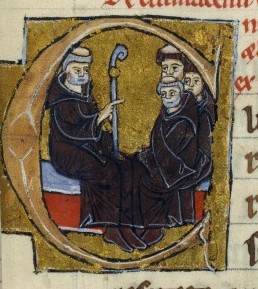 Peter the Venerable and his monks. Illuminated manuscript of the 13th century. | |
| Name in the world | Pierre Maurice de Montboisse |
| Birth | OK. 1094 |
| Death | December 25, 1156 |
| In the face | |
| Day of Remembrance | May 11 |
Biography
Born in the province of Auvergne in an aristocratic family, where religious traditions were strong - his mother became a nun, four brothers became priests, one of them later became the Archbishop of Lyon . At the age of 17 he joined the Cluny Congregation , around 1120 he became the prior of the monastery. August 22, 1122 Peter was elected abbot of the Monastery of Cluny , receiving at a very young age, the highest post of the congregation.
The Cluny movement during this period experienced a certain crisis, after the abbot Hugo of Cluny (1049-1109), during which the congregation first crossed the borders of France, the Clunyans were led by the abbot Pontius (1109-1122), accused of waste and embezzlement. Clunyans were heavily criticized by many Catholics, including Bernard Klervosky , the spiritual leader of the rapidly growing and gaining prestige of the Order of Cistercians . Under Peter the Honorable, the Cluny reform of Benedictine monasticism gained new strength, on the one hand he defended the congregation, arguing with Bernard Klervosky and other critics, on the other hand was active in correcting the real shortcomings of the Cluny monasteries. One of the main measures to combat the decline of the monastic mores, he saw as often as possible visits , and he spent a lot of time personally inspecting the monasteries of the Cluny congregation in different countries of Europe. He firmly defended the right granted to Cluny to deduce the monasteries of the congregation from under the authority of the local bishops , confidently suppressed attempts to split the order. In the end, his activity led to the restoration of the wide authority of Cluny and brought him the honorable nickname “Hon.”
Peter strongly supported Pope Innocent II in his fight against the anti-papa Anaclete II . He played an important role in the fate of the theologian Pierre Abelard , whom he patronized. When Abelard’s opponents, led by Bernard Klervosky and Norbert Xantensky, condemned his teachings, including from the Pope, Peter the Venerable first gave Abelard refuge in Cluny, and then gradually achieved his reconciliation with the Pope and Saint Bernard.
The extensive literary heritage of Peter the Hon. Of particular importance for European theological thought was the translation of the Quran into Latin, which was carried out at his request by Robert Ketton . [1]
Despite a number of inaccuracies, this translation was used in Europe until the 17th century . Peru Peter the Honorable belongs apologetic essay "Summula quaedam brevis" , where he defends the basic principles of Christianity from Islamic criticism. Author of a number of sermons, hymns and verses of Christian content.
Notes
- ↑ Gusterin P. V. The Koran as an object of study. - Saarbrucken: LAP LAMBERT Academic Publishing . - 2014. - p. 17, 61. - ISBN 978-3-659-51259-9 .
Links and Sources
- Peter the Honorable // The Catholic Encyclopedia . - V. 3. - M .: Izd. Franciscans, 2007.
- Fournet, PA Blessed Peter of Montboissier // The Catholic Encyclopedia . - Vol. 10. - New York: Robert Appleton Company, 1911.