Hans Jost ( German: Hanns Johst ; July 8, 1890 - November 23, 1978 ) - German prose writer, playwright, poet, president of the Imperial Chamber of Literature ( German Reichsschrifttumskammer ) (1935–1945), SS gruppenführer (1942 ), the author of the aphorism “When I hear about culture, I take my Browning off the guard” ( German: Wenn ich Kultur höre ... entsichere ich meinen Browning ).
| Hans Jost | ||||||
|---|---|---|---|---|---|---|
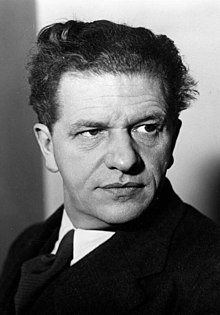 Hans Jost in 1933 | ||||||
| Date of Birth | July 8, 1890 | |||||
| Place of Birth | Seehausen near Riesa , Kingdom of Saxony , German Empire | |||||
| Date of death | November 23, 1978 (88 years old) | |||||
| Place of death | Ruhpolding , Bavaria , Germany | |||||
| Affiliation |  German Empire German Empire Weimar Republic Weimar Republic Third Reich Third Reich Germany Germany | |||||
| Type of army | Common SS ( Allgemeine-SS ) | |||||
| Years of service | 1914-1945 | |||||
| Rank | Gruppenfuhrer SS | |||||
| Commanded | President of the Academy of German Poetry (Präsident der Akademie für Deutsche Dichtung ) Chairman of the Imperial Chamber of Literature (Präsident der Reichsschriftumskammer ) Reichsführer SS headquarters (Stab Reichsführer-SS ) | |||||
| Battles / wars | World War I , World War II | |||||
| Awards and prizes |
| |||||


Content
Biography
Born in the family of an elementary school teacher. Grew up in Oshac and Leipzig . In childhood, I wanted to become a missionary . At the age of 17, he worked as a nurse at the Bethel Catholic Psychiatric Clinic, which later became famous for its resistance to the T-4 killing program . In 1910, having received a matriculation certificate in Leipzig, he began to study medicine, philosophy, and later the history of art.
In 1914 he joined the army as a volunteer. In 1918, he settled in the Almanshausen district of Berg , Bavaria .
Early Works
His early writings were influenced by expressionism . Examples are Der Anfang (The Beginning) (1917) and Der König (The King) (1920). Subsequently, he turned to naturalistic philosophy in plays such as Wechsler und Händler (“Changed and the Merchant”) (1923) and Thomas Paine (“Thomas Payne”) (1927). A sharp rejection of bourgeois reality was reflected in Jost's play Young Man. Ecstatic scenario ”(1916). Her hero exclaims: "What a frantic pleasure - to be ecstatic from the desire for death!".
Later, in books, the writer condemned capitalist society, pursuing profit, and proletarian collectivism, as a phenomenon alien to the German worker. Essays on “Knowledge and Consciousness” (1924). So he went to the "German direction in poetry" and to the national-socialist worldview.
Baal, the first play by Bertolt Brecht , was written in response to the play by Jost Der Einsame (The Lone), a dramatization of the biography of the anti-Semitic Grabbe playwright. In 1928, Jost headed the poetry department in the Kampfbund für deutsche Kultur , founded by Rosenberg , the Combat Alliance for German Culture, which proclaimed the fight against “Jewish influence” in German culture. In 1932, he joined the NSDAP , explaining his agreement with Hitler in the work Standpunkt und Fortschritt (Point of Stillness and Progress), published in 1933.
Schlageter
In 1933, shortly after the Nazis came to power , Jost wrote the play Schlageter, dedicated to Hitler's birthday, dedicated to Adolf Hitler in Love and Unshakable Fidelity ( Für Adolf Hitler in liebender Verehrung und unwandelbarer Treue ). The play praised the feat of Albert Leo Schlageter , who was shot in 1923 because he derailed French trains during the French occupation of the Ruhr , and became one of the main "martyrs" in the Nazi martyrology .
The phrase that became famous in the original sounds like “When I hear the word“ culture ”... I take my Browning off the guard!” (“Wenn ich Kultur höre ... entsichere ich meinen Browning”) (ellipsis in the text) and is pronounced by Schlageter’s comrade Frederick Timann. In preparation for the exams, they begin to discuss whether it is worth spending time studying when the country is not free. Timann declares that he prefers to fight [1] .
The phrase “When I hear the word culture, my hand reaches for a gun” is often attributed to various people. Historian David Starkey in December 2007 attributed it to Goebbels [2] .
Nazi German posts
In 1933, Goering appointed Jost the first playwright and artistic director of the Prussian State Theater. He then became the head of the Academy of German Poetry (Deutsche Akademie für Dichtung), the Prussian State Councilor and President of the Imperial Chamber of Literature, replacing G. Blunk in 1935 . Jost also led the literary section of the Prussian Academy of Arts instead of Heinrich Mann . Together with Goebbels, the writer used the unique opportunity to shape art, especially theater, in the direction of national socialist ideology in order to "save Germany from the complete materialism of the modern world." He received numerous awards and distinctions, including the NSDAP Grand Prize for Art, the Goethe Medal.
In 1935, the last of the famous Jewish writers, such as Martin Buber , were expelled from the Writers' Union. At the same time, membership in these organizations was allowed only to those writers and poets who were clearly pro-Nazi or, at least, their work was approved by the Nazis as not "degenerative." Jost also received many other important posts in the nomenclature of the Third Reich, and in September 1944 was included in the list of talents as one of the most important artists in the Reich. Hans Jost participated in the military programs of the National Socialists, distributing his materials, wrote the anthem of the German settlers in the occupied eastern territories. As a member of the NSDAP , SS gruppenführer and Himmler's personal friend, Jost, according to the testimony of an impartial Gottfried Benn, remained a “decent man.”
After the war
In May 1945, Jost was interned, and in 1947 appeared in court as part of a denazification program. In 1949, the Munich Chamber of Criminal Cases assigned him to the category of "fellow travelers" (group 4), fined 500 marks. A few weeks later, the appellate court reclassified Jost as the “main culprit” (group 1) and sent him to a labor camp. In 1951, Jost was retrained as an “activist” (group 2), and finally, in 1952 , after three and a half years in prison, he was released. Legal costs were assigned to the treasury. [3]
In 1955, Jost published his latest book, Gesegnete Vergänglichkeit (The Blessed Fathom). Existing in the galleys as far back as 1944, the book was shortened, pro-Nazi passages were edited, and “Blessed frailty” was presented to the public as a later “apolitical” work. The book has not gained fame; those few critics who drew attention to her exit responded with destructive criticism. [3]
Rewards
- Honorary Cross of a War Veteran
- Chevron of the old fighter
- 1st degree military merit cross without swords
- 2nd degree military merit cross without swords
- Golden Badge of the NSDAP
- Medal of Merit in the NSDAP in bronze
- Ring "Dead Head"
- Reichsfuhrer SS Honor Saber
Links
Notes
- ↑ Hans Johst's Nazi Drama Schlageter. Translated with an introduction by Ford B. Parkes-Perret. Akademischer Verlag Hans-Dieter Heinz, Stuttgart, 1984.
- ↑ Queen is poorly educated and philistine, says Starkey | UK news | The guardian
- ↑ 1 2 Hanns Johst, 1890-1978. Biographie Rolf Düsterberg