Mi Fei ( Chinese 米 黻 , 1051–1107, also known as Mi Fu ) [5] is a Chinese artist, poet, and calligrapher .
| Mi Fei | |
|---|---|
| Date of Birth | |
| Place of Birth | |
| Date of death | |
| Place of death | |
| A country | |

Mi Fei's ancestors came from the city of Taiyuan . Since his mother was the breadwinner of Emperor Yingzong , Mi Fei grew up in the imperial palace and communicated freely with the nobility, which served as an impetus for the development of his talents in calligraphy and painting.
The main occupation is a civil servant. Throughout his life, he held positions in the Imperial Library, the military governor of Wuwei in Anhui, the secretary in the Ritual Council and the governor of Huaiyang in Jiangsu [6] . Mi Fu was married and had five sons, of whom only two elders survived, and eight daughters.
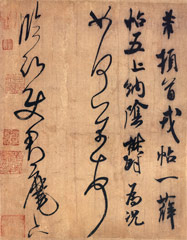
In painting, he became famous for his foggy, poetically free landscapes, in which the spots of the carcass, applied with a flat brush, could have a greater expressiveness than lines and contours. Most of all, in painting, Mi Fei valued self-expression, which corresponded to his freedom-loving and individualistic disposition. In poetry, he was a follower of the style of Li Bai , and in calligraphy, Wang Xizhi . As a calligrapher, he became most famous and was considered one of the four best calligraphers of the Song empire.
Mi Fei was considered by contemporaries to be a very eccentric person and for his antics got the nickname Mi Crazy . So, one day he collected stones and declared one of them his older brother, worshiping him as the eldest member of the family. It is also known that Mi Fei abused alcohol.
His son Mi Youzhen also became a famous painter, but he lived, unlike his father, until his advanced years.
Literature
- Zavadskaya E.V. Wise Inspiration: Mi Fu, 1052-1107. M., Science, 1983.
Notes
- ↑ 1 2 Union List of Artist Names
- ↑ 1 2 National Library of Australia - 1960.
- ↑ 1 2 Swartz A. Open Library - 2005.
- ↑ China Biographical Database
- ↑ Barnhart: 373. Mi Fu's style name was Yuanzhang (元 章) with several sobriquets: Nangong (南宫), Lumen Jushi (鹿门 居士), Xiangyang Manshi (襄阳 漫 士), and Haiyue Waishi (海岳 外史)
- ↑ Mi Fu: Calligraphy | China Online Museum - Chinese Art Galleries . www.chinaonlinemuseum.com. Date of treatment June 18, 2018.
Links
- Mi Fei Calligraphy Collection at China Online Museum
- Mi Fei Calligraphy Collection at ChinaPage.com