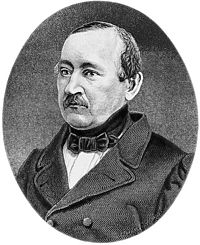
Osip Maximovich Bodyansky ( Russian doref .: Joseph [3] , later - Osip Maximovich Bodyansky [4] ; Ukrainian Osip (Joseph, Josip) Maximovich Bodyansky [5] ; October 31 ( November 12 ) 1808 (also found - 3 [ November 15, 1808 [6] ), Varva , Lokhvitsky district , Poltava province , Russian Empire - September 6 (18), 1877 [6] , Moscow , Russian Empire ) - Russian and Ukrainian [7] [8] scientist : philologist , historian , archaeographer [9] , one of the first Slavic in Russia [6] [10] , writer , translator , editor , publisher of ancient, ancient Slavic literary and historical memorable s [11] , in folklore , poet -romantik [12] .
| Osip Maksimovich Bodyansky | |
|---|---|
 | |
| Date of Birth | or |
| Place of Birth | Varva market town, Lokhvitsky district , Poltava province , Russia |
| Date of death | |
| Place of death | Moscow , Russian Empire |
| A country | |
| Scientific field | philology , Slavic studies |
| Place of work | University of Moscow |
| Alma mater | University of Moscow |
| Academic degree | Doctor of Literature |
| Academic rank | Corresponding Member of SPbAN |
| supervisor | M.T. Kachenovsky |
| Famous students | Alexander Hilferding , Marine Drinov , Alexander Kotlyarevsky , Alexandre Duvernois , Apollo Mike |
Biography
Years of study
Born in the family of a village priest [6] [11] [12] .

He received secondary education in 1825-1831 [13] at the Poltava Theological Seminary , located in Pereyaslav , where he mastered modern and Old Slavonic languages, learned the Serbian language [12] . The young man was greatly impressed by the collection of Serbian songs by Vuk Karadzic , under the influence of which he began to collect Ukrainian songs [12] . During his studies, he discovered in the library of the Pereyaslavsky Cathedral a 16th-century literary monument, the Peresopnytsia Gospel , which he transferred to the seminary library [12] .
At the end of the seminar course in 1831 , having received his dismissal from the clergy, he entered the Imperial University of Moscow - the department of verbal sciences of the Faculty of Philosophy . At the university, Bodyansky became close to Nikolai Stankevich , participated in his philosophical and literary circle [6] [11] [12] . S. M. Stroyev , I. A. Goncharov and others studied with Bodyansky. At the university, Bodyansky met the support and patronage of Professor M. T. Kachenovsky and his opponent M. P. Pogodin . [13] . Under the influence of M. A. Maksimovich , through whom in October 1832 he met with Nikolai Gogol , he began to collect and study Ukrainian songs [12] . With Gogol, he developed close friendly relations, maintained until the death of Nikolai Vasilyevich.
In the journal " Moscow Observer " in 1831 (No. 15-16) published his first printed works. Among them was a very informative review of the collection of J. Kollar - "Folk vaults, or Songs of Slovaks in Ugria [14] ."
In 1833, in the “Molva” of Nadezhdin, the early poems of Bodyansky in Ukrainian were published (“Cossack Song”, “Epitaph to Bogdan Khmelnitsky”, etc.). Not differing (in the opinion of critics) of poetic perfection, they did not bring him much fame.
Under the leadership of Kachenovsky, he publishes his first scientific work, “On Opinions Regarding the Origin of Russia,” in which he disputes the hypothesis of the Norman origin of Russia . For this work, he received a Ph.D. in verbal sciences after graduating from the university in 1834 [6] [12] (in 1835 this work was published in “The Son of the Fatherland and the Northern Archive” [12] ).
In the same year he published two reviews in the Telescope and an article on the works of G. F. Kvitka-Osnovyanenko in "Scientific notes of Moscow University."
From an early age, he was closely associated with Ukrainian culture, for which he did a lot by collecting Ukrainian songs, his collection totaled about 8 thousand songs. In 1835, Bodyansky published two collections dedicated to Ukrainian folklore: Little Russian Verses (under the pseudonym Boda-Varvynets) and a collection of Ukrainian folk tales in his own poetic arrangement, Naski Ukrayasky Kazki (under the pseudonym Zaporozzya Iska Matyrki [16]] . In the same year, Bodyansky leaves classes in fiction and concentrates exclusively on scientific works.
Scientific and teaching activities
Throughout 1835-1837, Bodiansky taught Latin and history [9] at the Second Moscow Gymnasium .
Having defended his master's thesis “On Folk Poetry of Slavic Tribes”, he became in 1837 the first Russian master of verbal sciences [6] [12] (Slavic dialects) [9] [11] . The dissertation was translated into Czech, Serbian, German and Italian [12] .
Since 1837, a member of the Moscow Society of History and Antiquities (OIDR) [11] [12] .
After this, Bodyansky went on a scientific mission abroad to prepare for a professorship [9] and spent 1837 - 1842 mainly in the Slavic territories of the then Prussia , Austria , as well as in Italy , worked for a long time in Vienna , Pest and Prague . During the trip, he was engaged in research both in secular and monastery meetings [15] . Establishes personal contacts with modern figures of Slavic science and culture ( Lyudevit Gai , Vaclav Ganka , Vuk Karadzic , Yernei Kopitar , Jan Kollar , Josef Jungman and others) [15] .
Abroad in Prague , on the recommendation of MP P. Pogodin , Bodyansky meets P. Y. Shafarik , works under his leadership [6] . Returning to Russia, publishes the works of Shafarik in his own translation into Russian [15] .
The report on the trip abroad was drawn up in the “Report to Mr. Minister of Education, Master of the Moscow University Joseph Bodiansky from Prague” ( Journal of the Ministry of Education , 1838. T. 18. P. 392-404), and was also reflected in the article “About the oldest evidence that the church-book language is Slavic-Bulgarian ”(Ibid. 1843. T. 38. P. 130-168), the application of which contained the list of the 16th century found by Wodyansky in Wroclaw . Tales of the Brave Chernorozets [15] .
During his stay abroad Bodyansky collected a significant library of manuscripts and prints of the 13th - 19th centuries , numbering nearly 3 thousand items. In particular, it contained the works of Czech scientist Josef Dobrovsky , Slovak philologist Anton Burnolak , Serbian linguist Vuk Karadzic , as well as dictionaries, anthology, primers, Slavic languages, collections, periodicals, works on history, geography and Slavography [12] . In 1843, part of this library was acquired by Moscow University and is currently stored in the Rare Books Department of the Scientific Library of Moscow State University named after MV Lomonosov [17] . The catalog of this collection has been published - Slavic training library of O. M. Bodyansky: Cat. / Comp. L. Yu. Aristova. M .: Publishing house of Moscow State University, 2000.336 s.
Upon returning to Moscow in 1842, he occupied the department of history and literature of Slavic dialects at Moscow University [6] [9] . Becomes an extraordinary professor at Moscow University, and since 1847 - an ordinary professor [11] . Even before leaving abroad, Bodyansky was engaged in teaching Latin. Having mastered Czech, Polish and Slovak languages abroad, he taught them upon returning to his homeland students of Moscow University [11] [12] , supplementing practical studies of the general history of Slavic peoples, Slavic archeology (course "Slavic antiquities").
In 1844, Bodiansky met Taras Shevchenko [15] . Subsequently, Osip Maksimovich always supported Taras Grigorievich and highly appreciated his work, defending, among other things, before Gogol.
Since 1845 he became secretary of the Imperial Moscow Society for the History and Antiquities of Russia at Moscow University [9] [12] . In this title he published ( 1846 - 1848 and 1858 - 1877 ) "Readings" of this society, which under his editorship became a periodical publication that had a significant impact on Russian historical linguistics.
In 23 books “Readings” published by him from 1846 to 1848, Bodyansky published many ancient monuments of Russian and Slavic writing, such as “The Debate of Metropolitan Daniel with Maxim the Greek ”, “The Debate of Daniel with the Elder Vassian”, “Grammar Study of the Russian Language " Yuri Krizhanich ," Chronicle of the Gustyn Monastery ", as well as many of his original and translated articles.
In the June book “Readings” of 1848, Bodiansky printed a translation of the work of the English ambassador in Moscow, Gils Fletcher, “On the Russian State” ( 1591 ), which spoke about Russia at the end of the 16th century during the time of Ivan IV the Terrible [9] [11] [12] . Emperor Nicholas I saw in this book “insulting reviews for Russia, the Russian monarchs and the Russian church,” for which he ordered Bodyansky removed from secretarial duties [11] . The scientist was supposed to leave Moscow and go to teach at Kazan University ( 1848 ). The Readings edition was also discontinued. Instead, “The Temporary of the Imperial Moscow Society of Russian History and Antiquities” began to appear ... Butyansky refused to move to Kazan , his reluctance to take a place at Kazan University led to his dismissal on January 2, 1849 [10] .
Maturity years
Almost a year later, on December 22 [10], 1849, Bodyansky was again determined to be a professor at Moscow University [9] [12] . During these years he became close to the circle of Moscow Slavophiles and S.T. Aksakov , many interests unite him with his countrymen: N.V. Gogol , T.G. Shevchenko and M.A. Maksimovich .
After his removal and until 1855, Bodyansky did not publish anything, focusing on professors [10] , and only this year his doctoral dissertation “On the time of origin of Slavic writings” [6] [9] [12] , which has still been preserved, was published value of the reference publication [6] .
In 1854, Bodyansky became a corresponding member of the St. Petersburg Academy of Sciences [11] [12] .
In 1857, he appeared with articles in the Slavophile newspaper of the Aksakov brothers «Rumor’ [11] .
Since 1858, he was again elected secretary of the Moscow Society of History and Antiquities and editor of the Readings OIDR [11] . They still published many materials and studies on Russian history, for example, The Life of Boris and Gleb [11] , The Life of Theodosius of the Caves [11] , materials on the activities of Cyril and Methodius [11] , and the Collection of Great Russian Songs I.V. Kireevsky .
From 1859 to the transition to M. N. Katkov in 1861, Bodyansky also headed the printing house of Moscow University [11] .
In 1864 he made a second trip abroad, during which he visited the Croatian Dubrovnik , Czech Prague, multinational Vienna , Luzhichansky Bautzen (Budyshyn) [12] . In the 1860s, in the Readings of the Society of the History and Antiquities of Russia, the primary sources of the 17th - 18th centuries were published, relating to the history of Southern Russia and Little Russia. In particular:
- "Gustynsky Chronicle."
- "Chronicles of Little Russia and its people and Cossacks in general" by Alexander Rigelman.
- "The Story of the Don Cossacks" by Alexander Rigelman.
- "Chronicle of the Seer."
- "Sources of Little Russian History" by Dmitry Bantysh-Kamensky.
- "Diariush" by Nikolai Khanenko.
- "Register of the Zaporizhzhya Army in 1649."
Other invaluable works and documents were published in the Readings.
| I decided at all costs not to publish Little Russian annals; I have gathered many of them and am constantly collecting them. I hope ... to be in time, and not to chase anyone after me, even if on a Ukrainian horse. I’m a Cossack myself. After the annals, I will also accept official papers, in which there is no shortage and cannot be. |
- Bodyansky wrote to M. A. Maksimovich.
In 1868, the professorship of Bodyansky was discontinued [11] . The reason for this was the speech of Bodyansky in defense of the University Charter of 1863 and university autonomy, directed against Mikhail Katkov and Pavel Leontyev . There is a report that he retired with the title of Honored Professor [12] .
Having left the department, Bodyansky continues his scientific work, collects and publishes monuments of Slavic writing ("Cyril and Methodius. A collection of monuments, before the activities of the Holy Primary Teachers and enlighteners of the Slavic tribes related", v. 1-2, 1863-1866; "Pannonian life of Cyril. Lists 13-16 ", 1873; and others) [9] .
Not a lot, says I. I. Sreznevsky , “we had such selfless figures as Bodyansky was; one cannot but recognize his merits as important merits worthy of general gratitude .
Among his other merits, it should be recognized the establishment of relations between Russian Slavists and West Slavic Slavists ( F. Palacki , L. Surovetsky, Shafarik) and cultural figures (L. Gai, V. Ganka , Vuk Karadzic , E. Kopitar , J. Collard , J. Jungman).
Among the disadvantages of Bodyansky is the not always verified attitude to published texts. So, he became the initiator of the publication of the 18th century chronicle “ History of the Rus ”, the factual reliability of which is still in doubt in the scientific community. At first, its author was considered to be Archbishop George (Konissky) , then - G. A. Poletika .
Bodyansky was a member of the Yugoslav History and Antiquities Society in Zagreb ( 1850 ) [12] , the Society of Serbian Literature ( 1855 ) [12] , and the Society of Russian Literature Lovers ( 1858 ).
Bodiansky died in Moscow on September 6 ( 18 ), 1877 and was buried in the Novodevichy Moscow Convent, next to Duvernois, M.P. Pogodin, F.I. Buslaev and other colleagues.
Contribution to Ukrainian Philology
Bodyanskiy is the founder of a comparative study of Ukrainian and other Slavic languages. In his works, the rationale for the identity of the Ukrainian language is given, its history, phonetics and grammar are studied. Bodyansky defended the phonetic principles of constructing Ukrainian spelling, and advocated the normalization of the Ukrainian literary language based on the Poltava dialect [18] .
Memory
- March 2, 2009 by decree of the President of Ukraine Viktor Yushchenko to Vladimir Melnichenko [19] for the book “To the glory of our glorious Ukraine. Taras Shevchenko and Osip Bodyansky ” [20] was awarded the Taras Shevchenko National Prize of Ukraine [21] .
Aliases
In his literary and scientific activities, Bodyansky used the following pseudonyms [22] : Boda-Varvynets; Boda-Varvynets, A .; Boda-Varvynets, A .; Dalberg O. Varvinsky; Zaporozets Isko Matyrynka; Mastak, I .; Mucius Stcevola; O. B .; Radushin, E .; * N.
Artwork
Author
- 1833 - Little Russian verses. Moscow. [15]
- 1835 - Nasky Ukrainian Cossacks. Moscow. [15]
- 1835 - On opinions regarding the origin of Russia. // “Son of the Fatherland”. No. 37-39 [15]
- 1835 - Consideration of various opinions on the ancient language of the northern and southern Russes. Moscow. [15]
- 1837 - On the folk poetry of the Slavic tribes . Moscow [15] .
- 1855 - On the time of origin of Slavic writings . Composition by O. Bodyansky. Moscow, at a university printing house. Reprinted in 2007 . [15]
- 1856 - New discoveries in the field of the Glagolitic. Moscow. [15]
- 1857 - Cyril and Methodius. Moscow. [15]
- 1865 - Lomonosov, as Professor-Academician. // Sat Celebrating the centennial of Lomonosov. Moscow. [15]
- 1891 - Excerpts from the diary of O. M. Bodyansky // Sat. OLRS. Moscow. [15]
- 1892 - Letters to the Machine Directly to Zagreb. // Sat "Living Old Man." SPb. [15]
- 1897 - My memories. Moscow. [15]
- 1905 - Letters to Vyacheslav Gank from the Slavic lands. Warsaw [15]
- 1905 - From the papers of O. M. Bodyansky // CHOIDR. No. 2. [15]
- 2006 - O. M. Bodyansky. Diary 1852-1857.
Translator
Source - MFN Electronic Catalogs
- The Vinodol law of 1280, written in a Glagolian letter / Per. from the Serbian O. Bodyansky. - M .: Univ. typ., 1864. - 42 p. - (From: Readings in the Imperial Island of Russian History and Antiquities. - 1864. - No. 4).
- Zubritsky D. I. Critical and historical tale of the time years of Chervona or Galician Rus: From the installation of Christianity under the princes of the generation of Vladimir the Great to the end of the XV century / Per. with the floor. O. Bodyansky. - M .: Imp. The island of history and antiquities grew. at Moscow. Univ., 1845. - 420 p.
- Palacki F. About the Russian prince Rostislav, the father of the Czech queen, Kungurta, and his kind: Crete. Issled / Transl. from Czech O. Bodyansky. - M .: Univ. typ., 1846. - 17 p. - (Ott. From: Readings in the Island of History and Antiquities grew up at the Moscow University. - 1846. - No. 3).
- Shafarik P. Y. About ancient Slavic, namely Cyril printing houses in the South Slavic lands and their environs, i.e. in Serbia, Bosnia, Herzegovina, Black Mountain, Venice, Wallachia and Sedmigradiya, in the XV, XVI and XVII table. : [Cheat. to Filol. Chesh. queens. Islands of Sciences Oct. 14 1841 g. count.] / Per. from Czech [and note.] O. Bodyansky. - M .: Univ. typ., 1846. - 11 p. - (Ott. From: Readings in the Island of History and Antiquities grew. - 1846. - No. 3).
- Shafarik P.Y. On the name and position of the city of Vineta, aka Yumin, Yulin, Iomsburg: [Chit. in meeting East. Chesh. royal. Society of Sciences in Prague, October 10 1844 g. count.] / Per. from Czech O. Bodyansky. - M .: The island of history and antiquities grew., 1847. - 20 p. - (Ott. From: Readings in the Island of History and Antiquities grew. - 1847. - No. 7).
- Shafarik P. Y. Slavic writing / Per. from Czech [and foreword] I. Bodyansky. - M .: Univ. typ., 1843. - 174 p.
- Shafarik P. Y. Slavic antiquities: historical part / Per. from Czech [and foreword] by O. Bodyansky. - 2nd ed., Rev. - M .: ed. M. Pogodin, 1837-1848. - T. 1, Book. 1-3; T. 2, Book. 1-3. - 319 + 331 + 302 + 454 + 361 + 276 s. ( Slavic antiquities. - 2nd ed., Rev. - M .: Univ. Typ., 1848. - T. 1, Book 1-2; T. 2, Book 1-3. )
Publisher
- 1846 - History of Rus or Little Russia. The work of George Konissky, Archbishop of Belarus . Moscow, at a university printing house.
- 1858 - Sources of Little Russian history collected by D.N. Bantysh-Kamensky and published by O. Bodyansky . Moscow, at a university printing house.
- 1863-1866 - Cyril and Methodius. Collection of monuments, before the activities of the holy primary teachers and enlighteners of the Slavic tribes belonging ", v. 1-2.
- 1873 - Pannonian life of Cyril. Lists 13-16.
- Life of Boris and Gleb
- The Life of Theodosius of the Caves
Notes
- ↑ 1 2 Bodyansky, Osip Maksimovich // Encyclopedic Dictionary / ed. I.E. Andreevsky - St. Petersburg. : Brockhaus - Efron , 1891. - T. IV. - S. 223–224.
- ↑ 1 2 A. Borozdin Bodyansky, Osip Maksimovich // Russian Biographical Dictionary - St. Petersburg. : 1908. - T. 3. - S. 161–166.
- ↑ Bodyanskii I. About the folk poetry of the Slavic tribe. M., 1837
- ↑ Cyril and Method: a collection of monuments. M., 1863
- ↑ See, for example, Іska Bodianskyi ( Letter to T. Shevchenko dated July 9, 1844. Moscow ), І. Bodyansky ”(Letter to T. Shevchenko dated October 25, 1844, ibid.),“ Osip Maksimovich ”and“ Yogi Osib Maksimovich Bodyansky ”( Collective letter from T. Shevchenko and P. Kulish ).
- ↑ 1 2 3 4 5 6 7 8 9 10 11 Bodyansky Osip Maksimovich // Great Soviet Encyclopedia : [in 30 vol.] / Ch. ed. A.M. Prokhorov . - 3rd ed. - M .: Soviet Encyclopedia, 1969-1978.
- ↑ Ukrainian English. Encyclopedia. Kiev, view of the Ukrainian Encyclopedia im. Bazhana, 2004, ISBN 966-7492-19-2 . Page 57: "... Ukrainian I grew up. philologist, folklorist, historical, oversubscription, ... " .
- ↑ Borozdina P. A. (Dean of the Faculty of Philology of Voronezh State University ) Nikolai Ilyich Storozhenko: On the Question of Russian-Ukrainian Cultural Relations // Bulletin of Voronezh State University. Series Humanities. - 2002. - No. 2. P. 54.
- ↑ 1 2 3 4 5 6 7 8 9 10 Kondrashov N.A. O.M. Bodyanskii. - M., 1956.
- ↑ 1 2 3 4 Small Encyclopedic Dictionary of Brockhaus and Efron. 1907-1909 Second edition in 4 volumes.
- ↑ 1 2 3 4 5 6 7 8 9 10 11 12 13 14 15 16 17 Kotlyarevsky A.A.O.M. Bodyanskii. Op. T. 2. - SPb., 1889; Kondrashov N.A. O. M. Bodyanskii. - M., 1956; Bulakhov M.G. East Slavic linguists. Bibliographic Dictionary T. 1. - Minsk, 1976.
- ↑ 1 2 3 4 5 6 7 8 9 10 11 12 13 14 15 16 17 18 19 20 21 22 23 Calendar of memorable and memorable dates. 12 Leaf fall. Nevtomni ratai ukrainskoi NIVI. Until the 200th day of the day of the birth of O. M. Bodyansky. On the official website of the parliamentary library of Ukraine. (Ukrainian)
- ↑ 1 2 Volkov V.A., Kulikova M.V., Loginov V.S., 2006 , p. 32.
- ↑ Ugria - Hungary . At that time, Slovakia was part of the Kingdom of Hungary .
- ↑ 1 2 3 4 5 6 7 8 9 10 11 12 13 14 15 16 17 18 19 20 Article by Bodyansky in the "Orthodox Encyclopedia edited by the Patriarch of Moscow and All Russia Kirill (electronic version)"
- ↑ Vissarion Belinsky in “bibliographic news” praised “Naski Ukrainskiy kazki” with the following words: “The second of these works is distinguished by the purest Little Russian language, which is completely inaccessible to us Muscovites, and therefore deprives us of the opportunity to appreciate it. We heard that this work is the fruit of the relaxation of a person who has devoted himself to science, and is written without any copyright claims, as the epigraph attached to it proves:
Yak with us, yak with us - songs and Cossacks:
Listen, good people, and your affection ...
there is, finally, a zealous and feasible offering to one’s homeland, as evidenced by a simple but poetic dedication: “Mother of My Mother, Nenets of Old, Cohan, Loved Ukraine” ”(cited from the Works of Osnovyanenko, Belinsky Vissarion Grigorievich, 1840). - ↑ Scientific library of Moscow State University Rare books and manuscripts Archived on October 20, 2013.
- ↑ Bodyanskiy Osip (Yosip) Maksimovich // Ukrainian Move. Encyclopedia. - Kyiv: view of the Ukrainian Encyclopedia im. Bazhana, 2004 .-- ISBN 966-7492-19-2 . - S. 57.
- ↑ Ukrainian Prospect in Moscow: Presentation of a book (inaccessible link) . Date of treatment January 18, 2011. Archived March 4, 2016.
- ↑ Ukrainian “To the glory of our glorious Ukraine: Taras Shevchenko and Osip Bodiansky . ” - M .: OLMA Media Group, 2008 .-- 560 p. (inaccessible link)
- ↑ Decree of the President of Ukraine No. 117/2009. On awarding the Taras Shevchenko National Prize of Ukraine. Archived March 9, 2009 on Wayback Machine
- ↑ Masanov I. F , "Dictionary of pseudonyms of Russian writers, scientists and public figures." In 4 volumes. - M., All-Union Book Chamber, 1956-1960.
Sources
- Borozdin A. Bodyansky, Osip Maksimovich // Russian Biographical Dictionary : in 25 volumes. - SPb. - M. , 1896-1918.
- Bodyanskiy, Osip Maksimovich // Brockhaus and Efron Encyclopedic Dictionary : 86 volumes (82 volumes and 4 additional). - SPb. , 1890-1907.
- Volkov V.A., Kulikova M.V., Loginov V.S. Moscow professors of the 18th - early 20th centuries. Humanities and social sciences. - M .: Janus-K, 2006 .-- S. 32—34. - 300 s. - 2000 copies. - ISBN 5-8037-0318-4.
- Sekacheva E.R., Turilov A.A. Bodyansky // Orthodox Encyclopedia . - M .: Church and Scientific Center "Orthodox Encyclopedia" , 2002. - V. V. - P. 562-564. - 752 s. - 39,000 copies. - ISBN 5-89572-010-2 .
Literature
- The Diary of 1852-1857. - Russian World, 2006
- Pichet V. On the history of Slavic studies in the USSR // Marxist historian . - 1941. - No. 3
- Vasilenko N.P. O. M. Bodyanskii and his merits for the study of Little Russia. - Kiev, 1904;
- Kondrashov N.A. O. M. Bodyanskii. - M., 1956;
- Bulakhov M.G. East Slavic linguists. Bibliographic Dictionary, T. 1. - Minsk, 1976.
- Aleksashkina L.N. O. M. Bodyansky and his role in the development of Russian-Czech relations (40-70s of the XIX century). The dissertation ... candidate ist. sciences. - M., 1973;
- Minkova L.O. M. Bodyansky and Bulgarian protest. - Sofia, 1978; Svdr. - S. 78-81;
- Gudkov V.P. To the characteristic of the Slavic school of O. M. Bodyansky // Vopr. historiography and the history of foreign glories. peoples. - M., 1987;
- Pashaev N.M. Bk O. M. Bodyansky // From the collection of rare books and manuscripts of the National Bank of Moscow. un-that. - M., 1993.
- Aristova L. Yu. Osip Maksimovich Bodyanskii as a source and researcher of Slavic languages. (inaccessible link)
- Melnichenko V. “To the glory of our glorious Ukraine” (Taras Shevchenko i Osip Bodiansky) ". - M.: OLMA Media Group, 2008. - 560 p.
Links
- Bodyanskiy Osip Maksimovich . Chronicle of Moscow University . Date of treatment October 1, 2017.