Grishino ( Ukrainian Grishin ) - a village in the Pokrovsky district of Donetsk region of Ukraine .
| Village | |||||
| Grishino | |||||
|---|---|---|---|---|---|
| Ukrainian Grishin | |||||
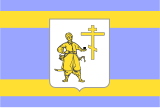
| |||||
| A country |  Ukraine Ukraine | ||||
| Region | Donetsk | ||||
| Area | Pokrovsky | ||||
| History and Geography | |||||
| Founded | 1585 | ||||
| Timezone | UTC + 2 , in summer UTC + 3 | ||||
| Population | |||||
| Population | 2,259 people ( 2001 ) | ||||
| Nationalities | Ukrainians, Russians, Belarusians, Armenians | ||||
| Digital identifiers | |||||
| Telephone code | +380 623539 | ||||
| Postcode | 85330 | ||||
| Car code | AH, KN / 05 | ||||
| KOATUU | 1422781101 | ||||

Zip code - 85330. Phone code - +380 623539.
Content
- 1 Geography
- 2 History
- 3 Demographics
- 4 Attractions
- 5 Religion [28]
- 6 famous people
- 7 notes
- 8 References
Geography
The village is located on the banks of the Grishinka River, in the southeast it borders on Pokrovsky , is 65 kilometers from Donetsk .
History
During archaeological excavations in the village, a Sarmatian sword and stone sculptures of nomads of the 9th-13th centuries were discovered. [one]
In the XVI century, Zaporizhzhya Cossacks, waging wars with the Crimean Tatars, gradually delved into the left-bank steppes and advancing to the upper reaches of the Samara and Volchya rivers, founded a number of winter-houses there . [2] The settlement was part of the Samara Palanca . In the second half of the XVIII century, after the liquidation of the Crimean Khanate and the annexation of these lands to the Russian Empire , an intensive settlement of the region began. [one]
Between 1780 and 1790, a state-owned settlement Grishino was founded on the site of a former winter hut by Cossacks and peasant migrants from the north of Ukraine. Later, several dozen Polish families were resettled here. [1] In 1799, in the settlement there were about 100 yards, 250 men lived. [3]
Since 1802, Grishino entered the Bakhmut district of the Yekaterinoslav province . During this period, the settlement and the surrounding lands were actively settled by immigrants. Around Grishino appeared the German colonies of Shidlovo and Vasilyevka, the estates of the landowners Vins, Gekker, Rogovsky. [1] In 1804, the Intercession Church was built in the settlement, which was rebuilt in 1884 and 1908. [four]
In accordance with the existing legislation, state-owned peasants of Grishino received plots of 30 acres for land and hereditary land use. In addition, for some time they were exempted from paying taxes, but later they began to levy a land tax on them. Since 1818, an annual dues fee of 3 rubles per audit soul was established , which was subsequently replaced by land dues and by 1855 increased to 5 rubles, as well as the requirement to serve various state duties. The main occupations of the settlement's inhabitants were agriculture and cattle breeding, as well as hunting, fishing, and the manufacture of some goods to the market. Since a large highway passed through Grishino from Yekaterinoslav to Bakhmut , the locals were also engaged in the Chumatsky craft . [5] In December 1830, 971 men resided in Grishino. The inhabitants of the settlement used 14008.5 tithes of convenient land, 9.5 tithes of forest and 1001 tithes of uncomfortable land, and the average allotment for one revision soul was 14.4 tithes. [6]
In 1843, a school of the Ministry of State Property for 50 students with one teacher, which was located in the premises of a former wine warehouse, began to work in the settlement. In the settlement there was a post station. [1] In the second half of the 19th century, a hospital with 10 beds was opened in the village, with one doctor and two paramedics. The hospital served the villages of four volosts of the Bakhmut district, scattered in a radius of 41 versts. [7]
In 1860, there were 435 yards and 3,016 inhabitants in Grishino. Since 1860, three three-day fairs were organized annually in Grishino, where residents of the surrounding settlements and villages traded linen, cattle, horses, bread, and various handicrafts. In addition to farming, the residents of Grishino made sickles, scythes, shovels, shavers, wheels, barrels, stone skating rinks for sale, sewed clothes, shoes, made sheepskins, and made linen from hemp and linen. [8] In 1863, goods for 25,600 rubles were brought to such fairs for the year, and sold for 16 thousand rubles. [9]
After the reform of 1861, Grishino became the volost center of Bakhmut district . [one]
In 1886, on the basis of the old school, a zemstvo school for 40 students was opened, and in 1891, a parish church classroom. The school building has not been repaired for many years and resembled itself, as the local teacher told the zemstvo, "the old neglected inn." [10] According to Zemstvo statistics for 1887 in Grishino, which totaled 998 yards, there were a total of 745 oxen, 590 cows, 243 heads of spring young animals, 742 horses, 887 pigs, 135 goats, 3852 sheep, 227 calves, 106 foals. [11] Livestock was generally absent in many households. [10] After the introduction of the obligatory purchase of land in 1886–1887, only 1,618 out of 6,124 people in the village received allotments. The total amount of allotment land was 14133 tithes, and the average allotted on the revision soul - 8.7 tithes. [12] In the village, social stratification intensified. Ruined peasants were forced to either hijack the local kulaks and neighboring landowners, or go to work, in particular for the construction of the Catherine Railway and the Taburnaya mine of the West Donetsk Coal Society, which was opened near the village in 1901. [10]
According to the Brockhaus and Efron Encyclopedic Dictionary, at the end of the 19th century, Grishino was a village of the Bakhmut district of the Yekaterinoslav province with 6,100 inhabitants. There was a school in the village, 3 fairs a year, a postal station, and up to 20 commercial and industrial institutions were held. [13] According to the 1897 census , 7,148 people lived in the village, which was a volost center, of which 5,453 people (75%) were illiterate. At the beginning of the 20th century, a steam mill and more than 10 trading establishments worked here. [10]
As a result of the economic crisis at the beginning of the 20th century, the situation of peasants worsened. As a result of the agitation of the social-democratic organization of the Grishino station, the distribution of the Iskra newspaper in the village between 1901 and 03, and in July 1905 of the revolutionary leaflets sent by the Yekaterinoslav Committee of the RSDLP, [14] the villagers took an active part in the speeches of the station’s railway workers Grishino during the December armed uprising of 1905, as well as in rallies organized by the strike committee at the station. [15] On December 10, 1905, the villagers attacked the economies of the landowners Vins and Rogovsky, seized agricultural equipment and livestock there and distributed them among themselves. A part of the peasants of the village joined the Grishinsky fighting squad and went to Gorlovka , where they took part in battles with the tsarist troops . Two of the villagers (locksmith S.I. Anikeev and locksmith apprentice I.A. Ponomarev) were convicted of participating in these events by the court. [16]
As a result of the Stolypin agrarian reform , class stratification of the countryside intensified. On January 1, 1908, 8033 inhabitants lived in the village, there were 14,589 acres of communal land, 1,345 heads of cattle and 1,135 heads of small livestock, 2,862 horses. Moreover, out of 1227 yards, 247 (20%) each had 1–5 acres of land, 656 (54%) –– from 5 to 10 acres and only 324 yards (26%) –– more than 10 acres. The kulak farms began to introduce a four- field crop rotation and apply fertilizers in their fields, as a result of which the yield of spring crops reached 100-120 pounds, and on the fields of poor peasants and middle peasants it did not exceed 25-30 pounds. Many impoverished peasants either became farm laborers , either went to work or moved to Siberia . So, by April 1, 1910, 177 families from Grishino appealed to the authorities of the Bakhmut district with a request to allocate 481 allotments of land to them in Siberia . [17] In July 1908, the peasants of Grishino refused to pay salaries and arrears , attacked the apartment of the bailiff , [18] and in the spring of 1911 massively protested against going to the cut . [10]
In 1913 in the village there were about 1300 yards and 11951 inhabitants, there were two steam mills, a church. 3 fairs were held annually in Grishino. The village itself was a long chain of monotonous huts stretching across the valley. On June 13, 1914, a fire devastated part of the buildings, causing, according to the calculations of the Zemstvo, local peasants losses of 1248 rubles. [10] In 1915, 765 farms owned land in Grishino, of which 712 owned it in bran sections with a total area of 6,602 tithes, where 48 small farms arose. [19]
In 1914, the volost hospital, where a doctor, a midwife and two paramedics worked, served 35 thousand people, for the year 13,148 patients received medical care with a modest annual budget of 247 rubles 32 kopecks. Every 25th sick person died, more than half of them were children. [20] In 1914, a two-year mixed Zemstvo school with a handicraft department, four one-class Zemstvo schools (two of which were opened in 1912–13), and a parochial and one-class female school worked in the village. [21]
During World War I, about 50% of the adult male population of the village was mobilized into the army, and farmers and horses were requisitioned more than once. Crop area has been significantly reduced. In connection with the release of 700 householders to the cut and the farm, the population of the village was reduced to 8000 people by 1916. [10]
After the February Revolution in May 1917, the Council of Peasant Deputies began to operate in the village. [22] After the decision of the Bakhmut district council of peasant deputies, to limit the annual rent for tithes of land to 4 rubles (bypassing the decision of the Provisional Government , proposing to pay 10-15 rubles) and spend the funds received to help war invalids, orphans and educational needs, in Grishino With these funds, a people's house and a school were organized. [23]
After the October Revolution, in December 1917, with the support of the armed detachments of the Red Guard [24] , the Bolsheviks established control over the territory of the Grishinsky volost.
In early January 1918, Soviet power was proclaimed in Grishino, a revolutionary committee was created and a communist cell led by D. Ya. Vorobyov, whose activists were F. T. Tyshenko, M. Anikeev, M. P. Zavgorodniy, M. Naumenko, I Khodyka, [25] also A.Luchaninov [26]
On April 21, 1918, during the military operation of the AUNR special group led by Colonel Vladimir Sinkevich, power in Grishino passed to the UNR .
In May 1918, an underground cell was organized by local Bolsheviks under the leadership of D. Ya. Vorobyov, which included MP P. Zavgorodniy, V. D. Korovnikov and others. By the autumn of 1918, several partisan detachments were operating in the Grishinsky volost under the leadership of T.V. Kishkan, F.T. Tyschenko, D. Ya. Vorobyov, I.I. Tyutyunnik, P.S. Rokotyansky. In November 1918, armed partisan units re-seized control of the Grishinsky volost.
On January 2, 1919, power in Grishino passed to the RPAU anarchists. At the head of the Grishinsky group of the Makhnovists was Peter Petrenko (Platonov) . On January 8, 1919, units of the 3rd division of the Volunteer Army of the White Guards led by Vladimir May-Mayevsky drove the RPAU out of Grishino and pushed them west.
In 1919, military operations took place on the territory of the Grishinsky volost with the participation of the RPAU , which received the same name Grishinsky operation . On January 20, the White Guards of the All-Union Socialist Liberation Union were knocked out by RPAU groups together with partisan detachments of the Bolsheviks. On February 18, following the order of the RPAU leadership, Petrenko left his position in Grishino, losing them to a group of Soviet troops of the Yekaterinoslav direction under the command of Pavel Dybenko . On February 21, RPAU became part of the 1st Zadniprovsk Ukrainian Soviet division under the command of Dybenko . On May 29, the White Guards Cavalry Division of the All-Union Socialist League of Ukraine , led by General Andrei Shkuro, drove the Bolsheviks out of Grishino. On December 30, during the military operation of the 8th cavalry division of the Red Cossacks under the leadership of V. M. Primakov , the White Guards were knocked out of their positions.
In 1920, with the support of Soviet troops, the local Bolsheviks resumed party and administrative activities under the leadership of D. Ya. Vorobyov.
Already in 1921-1922, anti-Bolshevik sentiments and inadequate funding forced local authorities to take extreme measures, to forcibly seize the harvest collected by local residents. This became the main cause of famine among the population and the breakdown of the sowing season [1] of 1923.
In the spring of 1924, the Soviet government created an agricultural partnership, which transferred grain under credit obligations and allocated agricultural equipment for temporary use to begin sowing. From 1925 to 1930, more than 100 private farms were created in the village by local residents. [one]
From 1930 to 1932, the Soviet government in the person of the head of the village council M. Lantsov and local communists organized the collectivization of private property in the village. [1] Having mobilized the loyal part of the local population, they began to carry out measures to forcibly seize property from private households and wealthy villagers. The process of collectivization was accompanied by voluntary damage to their own property, arson and even armed skirmishes. [1] Due to a tough policy towards the population and systematic requisitions of local authorities, from 1932 to 1933, part of the villagers was put on the brink of survival .
In 1932, on the basis of the Decree of the All-Russian Central Executive Committee on the Establishment of the Donetsk Region [27] , the Grishinsky district was created, which included the territories of the former Grishinsky, Krivorozhsky, Svyatogorovsky and Sergeevsky volosts.
In 1934, the district center was moved to the station settlement of the Grishino railway station (modern Pokrovsk ), which, together with the Grishinsky district, was renamed [27] to Postyshevo (later in 1938 to Krasnoarmeyskoye, in 1962 to Krasnoarmeysk and in 2016 to Pokrovsk) .
In 1941, during the Second World War , most of the men in the village were mobilized to the front, and those who remained participated in the construction of defensive structures. Since October 21, 1941, Grishino was under the occupation of German troops, in 1943 the front line passed here and fierce battles were fought. September 8, 1943, by forces of the 3rd Guards Army under the command of Lieutenant General D. D. Lelyushenko, Grishino was freed from the occupying forces. [one]
In total, during the Second World War, 463 residents of the village of Grishino were called up to the ranks of the Soviet Army, 288 of them died, 142 were awarded orders and medals for courage and heroism [1] .
Demographics
According to the 2001 census, the population is 2,259 (1779 - 250 males, 1913 - 11,951) of which 92.56% indicated Ukrainian as their native language, 7.13% - Russian, 0.18% - Belarusian and 0 , 09% - Armenian.
Attractions
In 1956, a monument was erected on the site of the mass grave of the fallen soldiers of the South-Western Front.
In 1983, the monument was reconstructed, the monument “Glory” by Leonid Artyomovich Brin was erected. The height of the monument is 6.5 meters. Made of granite and forged aluminum.
Religion [28]
In 1804, the Orthodox Church of the Intercession was built in Grishino.
In 1957, representatives of the Soviet government destroyed the church, plundered it and turned it into a granary.
In 1989, by the decision of the Donetsk Regional Council of July 12, 1989, No. 222, the dilapidated church was registered with the state as a monument of architecture.
In the period from 2001 to 2003, the church was restored by the efforts of Archpriest Vasily Kiyko and local residents.
In 2005, the Holy Protection Church of the village of Grishino was consecrated by Metropolitan of Donetsk and Mariupol Hilarion [29] .
At the moment, the temple is fully operational. В нём представлены иконы, написанные в Киево-Печерской лавре , на горе Афон и черниговскими мастерами. Церковный иконостас храма изготовлен в Почаевской лавре .
Famous People
- Москаленко Кирилл Семёнович (1902—1985) — Маршал Советского Союза (1955), дважды Герой Советского Союза (1943, 1978).
- Соловьёва Наталья Петровна (1927—2017) — Герой Социалистического Труда (1950) [30] .
- Щепенко Николай Назарович (1915—1995) — украинский писатель, член Национального союза писателей Украины .
- Биленко Николай Назарович — кавалер ордена Ленина .
- Макаров Василий Макарович — кавалер ордена Знак Почёта .
- Лазник Виктор Гаврилович — кавалер ордена Знак Почёта .
- Воробьёв В. М. — кавалер ордена Трудового Красного Знамени .
- Руденко А. Н. — кавалер ордена Знак Почёта .
- Лазник Виктор Трифонович — кавалер ордена Ленина .
- Бондаренко Екатерина Николаевна — заслуженный деятель искусств Украины .
- Ивлев Юрий Васильевич — лауреат Государственной премии Украины в области науки и техники (2014).
- Белицкий Леон Валерьевич — украинский спортсмен-гиревик, многократный победитель международных соревнований.
Notes
- ↑ 1 2 3 4 5 6 7 8 9 10 11 12 История городов и сел Украинской ССР: Донецкая область. — Ин.-т истории АН УССР-К.: Глав.ред. Украинской Сов. Энциклопедии. стр. 456
- ↑ Россия. Полное географическое описание нашего отечества, т. 14, стр. 149, 150
- ↑ Сборник статистических сведений по Екатеринославской губернии, т. 2. Бахмутский уезд, стр. 37
- ↑ Донбасс Православный :: История Епархии :: Тернистый путь церкви Архивная копия от 12 мая 2014 на Wayback Machine
- ↑ Памятная книжка Екатеринославской губернии на 1864 год, стр. 44
- ↑ ЦГИА СССР, ф. 379, оп. 2, д. 242, л. 13.
- ↑ Труды VII съезда земских врачей и представителей земств Екатеринославской губернии (26 сентября — 4 октября 1897 г.), вып. 2. Екатеринослав, 1898, стр. 47.
- ↑ Отчет Бахмутской уездной земской управы за 1914 год. Бахмут, 1915, стр. 82
- ↑ Памятная книжка Екатеринославской губернии на 1864 год, стр. 138—141
- ↑ 1 2 3 4 5 6 7 История городов и сел Украинской ССР: Донецкая область. — Ин.-т истории АН УССР-К.: Глав.ред. Украинской Сов. Энциклопедии. стр. 457
- ↑ Отчет Бахмутской уездной земской управы за 1887 год. Бахмут, 1888, стр. 162, 163
- ↑ Список населенных мест Бахмутского уезда на 1902 год. Екатеринослав, 1903, стр. 14, 15
- ↑ Гришино // Энциклопедический словарь Брокгауза и Ефрона : в 86 т. (82 т. и 4 доп.). - SPb. , 1890-1907.
- ↑ Революция 1905—1907 гг. на Украине. Сборник документов и материалов, т. 2, ч. 1, стр. 200.
- ↑ ЦГИА УССР в Киеве, ф. 347. оп. 1, д. 298, л. 13.
- ↑ Донецкий облпартархив, ф. 7, оп. 1, д. 9, лл. 84, 85.
- ↑ «Народная газета Бахмутского земства», 1910, М 1, стр. 3, 4, 5.
- ↑ Крестьянское движение в России. Июнь 1907 г. — июль 1914 г. Сборник документов. М.—Л., 1966, стр. 498, 528.
- ↑ ЦГИА СССР, ф. 129, оп. 31, д. 426, лл. 131—134.
- ↑ Отчет Бахмутской уездной земской управы за 1914 год, стр. 10, 11.
- ↑ Public education in the Ekaterinoslav province for the 1913-1914 academic year, pp. 10, 11, 65, 88, 89.
- ↑ Donetsk Regional State Archives, f. R-1475, op. 1, d. 1, l. 7.
- ↑ O. M. Maksimov. The settlement of Donbas in 1917 Rotsі. Stalino, 1961, p. 25, 36, 59.
- ↑ X. Lukyanov. The Red Guard of Donbass, p. 37.
- ↑ Donetsk Regional Party Archive, f. 16, op. 19, d. 50, p. 17, 18.
- ↑ The struggle for October in the Artemovshchina. 1929. P.238.
- ↑ 1 2 CHRONOGRAPH of the administrative-territorial division of the Donetsk region (1932-2016) .
- ↑ Holy Protection Church with. Grishino | Site of the Red Army Deanery of the Donetsk Diocese of the UOC . www.krasnoblago.dn.ua. Date of treatment October 7, 2017.
- ↑ TEMPLE OF THE COVER OF THE Blessed Virgin Mary . church-site.kiev.ua . Date of appeal September 21, 2017.
- ↑ Pokrovsky district said goodbye to the last Hero of Socialist Labor | TV company "Orbit"
Links
- Grishino // Brockhaus and Efron Encyclopedic Dictionary : in 86 volumes (82 volumes and 4 additional). - SPb. , 1890-1907.
- Grishino on the website of the Verkhovna Rada of Ukraine (Ukrainian)
- Grishino (Donetsk region) on the site "History of cities and villages"
- Grishino on the site "Information and portal portal. Donetsk region at the warehouse of URSR ". Based on an encyclopedic publication about the history of cities and villages of Ukraine. Volume - History of Ukraine and the RSR. Donetsk region. - K .: Head editors of the URE AN URSR, 1970. - 992 p.