Alberto Sotio ( Italian. Alberto Sotio , also sometimes Alberto Sozio ; 2nd half. XII century. - beginning of XIII century.) - Italian artist.
| Alberto sotio | |
|---|---|
| Date of Birth | |
| Place of Birth | |
| Date of death | |


The name of the master was found on a painted cross from the Cathedral of Spoleto . At the bottom of the crucifix under the image of Adam's skull, the date is preserved - 1187 AD and a fragment of the signature “OPUS ALBERTO SO”, that is, “the work of Alberto So ...”. In the signature you can see the remains of the third letter of the last name; some scientists interpreted it as "T", others as "Z". In the end, “Sotio” or “Sotius” was accepted by the art history community as the artist’s last name, but apart from this inscription, no other written evidence about the artist has been preserved.
The cross depicts Christ in the pose of Christus Triumphans, that is, the triumphant Christ who conquered death. At the top of the cross is Christ in the mandorla and four angels, on the table to the right and left of the body of Christ is the Virgin and John the Baptist, at the base of the cross rests the skull of Adam, personifying the original sin that Jesus Christ redeemed by his death. All images are written on parchment pasted on a wooden base. The cross is the second, after the cross of the master Guglielmo, exactly dated by a crucifix in Italian painting of the XII century.
Based on the stylistic and technological features of this work, the researchers now assign several different works to Alberto Satio. Before his famous cross, he created frescoes in the church of San Giovanni e Paolo (c. Saints John and Paul, Spoleto), which in all likelihood were executed before 1174. The famous connoisseur of medieval Italian painting Miklos Boskovitz believes that Alberto Sátio could have authored the frescoes in the church of Santa Maria infra Portas in Foligno (it depicts the “noble robber” Dismas leaning on the cross and the cherub), because they are stylistically close to his works. Federico Dzeri, a major Italian art expert, attributes three more crosses to Sátio: from the Victoria and Albert Museum, London; from the Treasury of the Cathedral of St. Francis, Assisi; from c. Santa Maria in Vallo di Nera (the cross is in very poor condition, attributed by E. B. Garrison). In addition to these frescoes and crosses, the master is credited with three easel paintings. In the Brera Gallery, Milan, there is a board with the image of the head of the “Queen’s Madonna”, formerly in the Lamberto Vitali collection, therefore it is sometimes called Madonna Regina Vitali. The restoration work carried out in 2004 confirmed the validity of its attribution to master Alberto. The head of the Madonna is also written on parchment pasted on a tree; it once belonged to the large icon of the “Queen’s Madonna”, the remaining parts of which were not preserved.
How this icon could look like - can be presented thanks to another work attributed to Alberto - “Madonna di Ambro”, originating from the church of Santa Maria a Graiano in San Pio near the town of Fontecchio, Prov. Aquila. In the lower part of the icon there are remnants of the inscription “MA DI AM ... O”, which are not amenable to accurate decoding, the name “di Ambro” comes from this inscription. The image of the Madonna is of the type “Mother of God the Mammalian” (Latin Virgo lactans), that is, Mary is breastfeeding the infant Christ. This type of icon was popular with young women and newlyweds who sought protection from Madonna for their offspring. Maria, who is wearing a crown and royal clothes, is both solemn and touching. The work is kept in the National Museum of Abruzzo. Among the supporters of his affiliation are Alberto Sotio - famous experts in medieval Italian painting Ferdinando Bologna and Miklos Boskovitz, who date the Madonna d'Ambro to the beginning of the 13th century.
Another Alberto part-time job is the picture of Our Lady located in the Walters Gallery, Baltimore. Our Lady is depicted in sorrow; in all likelihood, her figure was once the left part of a tabellone painted cross. It is also written on parchment pasted on wood, and dates from 1180-90 years. In the elegantly flowing folds of the garments of the Virgin Mary, researchers see the influence of Byzantine painting, and the confident hand of a master associated with the art of miniature . However, today there is no exact information about the work of Alberto in the field of book miniatures.
Alberto Sotio is considered the conductor of Byzantine artistic techniques in the Romanesque painting of Italy of the XII century. In that period, which accounts for the master's work, in Umbrian painting merged the traditionally Romanesque features with innovations, drawn from the Byzantine painting of the late period of the reign of the Comneni dynasty. This is especially noticeable in a miniature book. This process served as a rather radical renewal of the artistic language, and the Alberto cross became the prototype for the many XIII century crosses created in central Italy - Umbria, Marche, Lazio and Abruzzo.
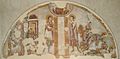
Alberto Sotio. The martyrdom of Saints John and Paul. Mural of c. Saints John and Paul. Spoleto, a museum.

Alberto Sotio. Cross from the Victoria and Albert Museum, London

Alberto Sotio. Madonna Regina. con.12v. Milan, Brera Gallery

Alberto Sotio. Madonna di Ambro. beginning 13c. C. Santa Maria a Graiano, San Pio

Alberto Sotio. Grieving Mother of God. 1180-90gg. Walters Gallery, Baltimore


Bibliography
- F. BOLOGNA, Pittura italiana delle origini, Roma 1962
- M. BOSKOVITZ, Gli affreschi del Duomo di Anagni: un capitolo di pittura romana, in Paragone, XXX, 1979.
- ALBERTO SOTIO A SPOLETO SUL FINIRE DEL SECOLO XII, Brerai vista, Electa, 2005