James Getton (Hatton) ( Eng. James Hutton , June 3, 1726 , Edinburgh - March 26, 1797 in the same place) - Scottish naturalist , geologist , physicist and chemist . He is considered the father of modern geology and geochronology . He belongs to the theory of geological actualism and plutonism [1] [2] . The Hatton mineral is named after Hatton.
| James hatton | |
|---|---|
| James hutton | |
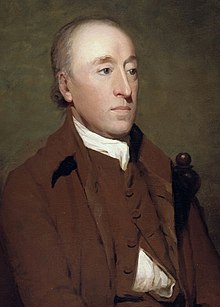 James Hatton C portrait of the artist G. Reborn | |
| Date of Birth | June 3, 1726 |
| Place of Birth | Edinburgh |
| Date of death | March 26, 1797 (aged 70) |
| Place of death | Edinburgh |
| A country | |
| Scientific field | geology |
| Alma mater | University of Edinburgh |
| Known as | One of the founders of modern geology |
Content
Biography
James Hatton was born June 3, 1726 in a large family of a businessman and treasurer of Edinburgh . James's father died early. Hatton graduated from the Royal School in Edinburgh, where he was mainly interested in mathematics and chemistry, and at the age of 14 he entered the University of Edinburgh at the Law School, but he was more interested in chemical experiments than legal proceedings.
At 18, he became an assistant in a physical laboratory, while attending lectures on medicine at the university. Hatton then left for Paris and, after spending three years there, in 1749 received a doctorate in medicine from the University of Leiden in the theory of blood circulation. After that, Hatton returned to London, and then in 1750 to Edinburgh and resumed chemical experiments with his friend James Davie. Their joint work on the production of ammonium chloride from soot has grown into a successful business of producing crystalline salt used for painting and metalworking, and snuff , which until then was known only in its natural form and was brought from Egypt.
Farming and geology classes
Hatton inherited two farms in Berwickshire . He moved to one of them, Slyhauses, owned by the family since 1713 in early 1750, and began conducting experiments on plant growing and cattle breeding there, introducing innovations from other parts of the UK and writing down his ideas and innovations, the result of which was his unpublished work “The Elements of Agriculture. "
Agriculture drew his attention to meteorology and geology, and by 1753 he was seriously interested in studying the surface of the earth, examining pits, ditches, and the bottom of rivers with curiosity. Cleaning and land reclamation of the farm provided a lot of opportunities for this. Hatton noted that a significant part of the mountains is composed of minerals and substances formed by the remains of animals, plants of more ancient times. By 1760, his observations formed the theory. In 1764, he went on a geological expedition to the north of Scotland together with George Clerk Maxwell.
Edinburgh and Canal Construction
In 1768, Hatton returned to Edinburgh, having leased the farm, but continuing to be interested in her life. He also improved the way to get red paint from the roots of madder .
James Hatton was one of Scotland's most influential enlighteners and was friends with many scholars, including John Playfair , philosopher David Hume , economist Adam Smith and James Watt .
He was a close friend of Joseph Black , and they, together with Adam Smith, founded the gentleman Oyster Club for weekly meetings.
In 1767-1774, Hatton took an active part in the design of the Fort and Clyde Canal using his knowledge of geology and being a shareholder and member of the board, as well as inspecting ongoing work.
Scientific contribution
After 25 years of careful study of the erosion of river valleys and the formation of sedimentary deposits at the mouths of the rivers, Hatton wrote a two-volume treatise entitled Theory of the Earth. “Earth Theory” was read in two lectures at the Royal Society of Edinburgh, first by his friend Joseph Black on March 7, 1785 (due to Hatton’s disease), and then by Hatton on April 4, 1785 . At a meeting of the company on July 4, 1785, Hatton briefly reviewed his dissertation, "Concerning the System of the Earth, its Duration and Stability . "
Hatton's new theories ran counter to Abraham Werner 's popular theory of Neptunism , which considered the formation of all mountains to be a consequence of the great flood. Hatton suggested that the interior of the Earth is red-hot, and that this red-hot lava became the engine that caused the formation of new mountains: the Earth undergoes erosion under the influence of wind and water and is deposited by layers on the bottom of the sea, then the red-hot lava merges the settled layers into stones and lifts them into the form of new land. This theory is called plutonism .
Hatton also developed the concept of " dark time " as opposed to catastrophe theory . The opinion that existed up to that time was based on visual observations: motionless-looking mountains, as well as gorges and volcanoes, due to their often gigantic dimensions, should have arisen as a result of sudden catastrophes. For the first time, Hutton hypothesized that there is a geological time that does not coincide with the age of human civilization and is not related to the biblical creation of the world. Based on his observations that sedimentary deposits are probably accumulating at only one inch per year, Hatton concluded that it took hundreds of thousands of years to accumulate enough sedimentary rocks. Thus, Hatton argued that the Earth is not several thousand, but several million years and the exact date of its creation is impossible to determine. Hutton’s main argument was that the results of geological shifts and changes that he observed could not have occurred in such a short time, and that processes that took place in the past occur in the present, slowly and constantly. Hutton put forward the concept of actualism , according to which the geological processes that are in place today are no different from processes in the past and formulated the principle of actualism with the phrase "Present is the key to the future."
The Theory of the Earth was first published in 1788. In 1795, Hatton published a revised edition, the two-volume Theory of the Earth . Hatton paid his attention not only to the earth, but also to the atmosphere. Earth Theory was continued by Rain Theory. He argued that the amount of moisture that air can hold increases with temperature and, therefore, when two air masses are mixed at different temperatures, part of the moisture must condense in visible form. Hatton collected information on the amount of precipitation and climate in different regions of the world and came to the conclusion that the amount of precipitation is regulated by the degree of air humidity on the one hand and the mixing of air flows in higher layers of the atmosphere on the other hand.
Hatton also supported the idea of the evolution of living things and even suggested the existence of a mechanism of natural selection .
Hatton's theories were reiterated by John Playfair in 1802 , and then developed in the books of Charles Lyell . Darwin read books with enthusiasm during his journey on the Beagle, and Hatton's theories prompted him to develop the idea of natural selection to explain the origin of species. D.Repchek in his book “The Man Who Discovered Time: James Hutton and the Discovery of Antiquity of the Earth” writes: “Hutton“ took away their divine origin from things, ”and Darwin“ directly took away the concept of the divine principle from man ””.
Finding Evidence
In an area called Glen Tilt in the Cairngorm Mountains , near the town of Dundee , Hatton and his friends first discovered how veins of pink granite pass through black mica slate . This indicated that granite was younger than shale and formed when it fell into the shale in a molten state and then cooled.
Likewise, white quartz veins in the gray granite boulders of the Scottish valleys indicated that molten quartz paved the way inside granite under tremendous pressure.
Hatton found a similar penetration of volcanic rocks into sedimentary rock and near Edinburgh in the Salisbury Rocks adjacent to Arthur's Throne Hill. Then there are other examples in Galloway in 1786 and on the island of Arran in 1787 .
The existence of dissenting strata was noticed even by Nicholas Steno and the French geologist Horace de Saussure , who gave them the name "initial formations" in the framework of the theory of Neptunism. Hatton himself wanted to explore such formations in order to see the specific signs of the relationship between the rock strata.
In 1787, during an expedition to Arran, he found the first example of the so-called dissenting stratum of Hatton north of Cape Newton (Newton Point).
Hatton then found a second example of dissenting bedding near the city of Jedborough , in a sedimentary rock layer.
In the spring of 1788, he traveled with John Playfer to the coast of Berikshire and found several more examples in the valleys of Tour and Pease Burns near Cockburnspath. They then sailed in boats along the east coast of the North Sea along with geologist James Hall to explore open rock formations.
Not far from Cape Point Point on the east coast of Scotland, he found an example of dissenting stratification: a two-colored cliff whose lower, darker part was composed of slate. Its layers were located almost vertically, while the layers of sandstone located in the upper part lay horizontally. According to Hatton's hypothesis, the shale initially cracked, and subsequently sand was deposited on it.
Then they found several boulders consisting of vertical strata with wave-like markings, which confirmed the version of Hatton that they lay in the sea horizontally before the shift of geological strata.
Hatton suggested that several cycles had to go through, each of which included the deposition of rocks to the bottom of the sea, then their elevation at an angle, subsequent erosion and again deposition to the seabed. In his report to the Royal Society, Hatton said: "We do not find traces of the beginning, and we have no hope of the end." These simple words by Hutton were featured on Greg Graffin 's No Control album .
Works
- 1785. Abstract of a dissertation read in the Royal Society of Edinburgh, upon the seventh of March, and fourth of April, MDCCLXXXV, Concerning the System of the Earth, Its Duration, and Stability . Edinburgh. 30pp.
- 1788. The theory of rain . Transactions of the Royal Society of Edinburgh, vol. 1, Part 2, pp. 41-86.
- 1788. Theory of the Earth; or an investigation of the laws observable in the composition, dissolution, and restoration of land upon the Globe . Transactions of the Royal Society of Edinburgh, vol. 1, Part 2, pp. 209-304.
- 1792. Dissertations on different subjects in natural philosophy. Edinburgh & London: Strahan & Cadell.
- 1794. Observations on granite . Transactions of the Royal Society of Edinburgh, vol. 3, pp. 77-81.
- 1794. A dissertation upon the philosophy of light, heat, and fire. Edinburgh: Cadell, Junior, Davies.
- 1794. An investigation of the principles of knowledge and of the progress of reason, from sense to science and philosophy . Edinburgh: Strahan & Cadell.
- 1795. Theory of the Earth; with proofs and illustrations . Edinburgh: Creech. 2 vols.
- 1797. Elements of Agriculture . Unpublished.
- 1899. Theory of the Earth; with proofs and illustrations, vol III , Edited by Sir Archibald Geikie. Geological Society, Burlington House, London.
Memory
In 1970, the International Astronomical Union named Hatton the crater on the far side of the moon .
Notes
- ↑ Getton, James - article from the encyclopedia "Around the World"
- ↑ Getton, James // Great Soviet Encyclopedia : [in 30 vol.] / Ch. ed. A. M. Prokhorov . - 3rd ed. - M .: Soviet Encyclopedia, 1969-1978.
Literature
- “ The Man Who Discovered Time: James Hutton and the Discovery of Antiquity of the Earth,” Jack Repcheck: The Man Who Found Time: James Hutton and the Discovery of the Earth's Antiquity. London and Cambridge, Massachusetts: Simon & Schuster (2003) .
- Stephen Baxter: Ages in Chaos: James Hutton and the Discovery of Deep Time. New York: Tor Books (Forge imprint). Published in the UK as Revolutions in the Earth: James Hutton and the True Age of the World. London: Weidenfeld & Nicolson, 2003.
- S. Warren Carey, Theories of the Earth and Universe. , Stanford University Press, Kalifornien 1988.
- Jonathan Weiner, Planet Erde (p.14-19), Droemer-Verlag 1987.
Links
- Wikimedia Commons has James Hutton related media
- Geologie und Evolution (J. Hutton, W. Smith and L. Cuvier)
- James Hutton.org.uk
- James Hutton and Uniformitarianism
- James Hutton's memorial in Greyfriars Kirkyard, Edinburgh
- First publication of theory of the earth
- Glossary - Definition and examples of dissenting bedding
- James Hutton works in the Gutenberg project