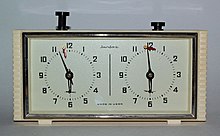


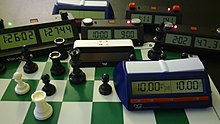
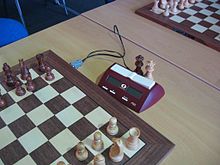
A chess clock is a device for controlling time in chess . For other board games, such as checkers , backgammon , go , renju , xiangqi , shogi and others, similar devices may be called differently: control clocks , checkers (in checkers), game clocks .
Content
Definitions
According to one rule
A “checkered watch" refers to a watch with two time displays connected to each other in such a way that only one of them can work at the same time. “Clock” in the Rules of the game of checkers means one of two time indication devices. [one]
In other rules
The control clock can be electronic or mechanical and must meet the following requirements: - both clock mechanisms must be accurate; - both clock mechanisms should not go at the same time; - watch mechanisms must work alternately, stopping one immediately leads to another; - clearly show the amount of time remaining; - in a mechanical watch, the passage of a large (minute) hand through 12 should be marked with a flag; - the flag should begin to rise no later than 58 minutes and fall exactly 60 minutes. [2]
History
The first attempts to establish time control were carried out in the chess-like game of shatrange in the ancient Arab East.
In Europe, chess games were played without time control. It happened that a player, having a deliberately losing position or simply from “strategic” considerations, took his opponent “to starving”. Sometimes it succeeded. Parties lasted many hours in a row, for days. At the first international tournament of 1851, the assistant referee, who recorded the moves in the Williams-Maclow game, made a historical record: “The game remained unfinished because both opponents fell asleep ...” Another example: in the same year, Staunton , unable to withstand the slowness of his opponent Williams , passed the match with the score + 6−2 = 3 in their favor, despite the fact that according to the regulations the match was played up to 7 wins.
Two years later, in the match Harvitz - Leventhal, for the first time, opponents were limited by a time limit of 10 minutes to think about the move. The hourglass was used, each has its own, and for exceeding the time a fine was exacted. In 1866, in the Andersen-Steinitz match, the hourglass was replaced with a mechanical one, although it was not a chess clock with two buttons, but a regular one.
For the first time, a special chess clock was designed by an amateur English chess player, Thomas Bright Wilson (TB Wilson), an engineer from Lancashire, and used at a tournament in London in 1883 . A year later, Amandus Schierwater received the first patent for the industrial production of chess watches, and in 1886 they already appeared on sale in Liverpool stores. In 1899, for the first time, a “flag” appeared on a chess clock, indicating a three-minute interval before the end of the time limit. The idea of a “flag” was proposed by DB Meijer. The prototype of the current mechanical chess clock with two push-button switches was created in 1900, through the efforts of Veenhoff. The first electric chess clock appeared in the 1920s. The first electronic chess clock was made in Kiev in 1964. After receiving a patent for electronic chess clocks in 1989 by Bobby Fisher, the latter became one of the most used.
In the USSR / Russia, chess clocks were produced and are produced at only one enterprise (the Yantar plant in the city of Oryol ). Currently (2008), technologies and rights for the production of chess watches have been sold to Azerbaijan, where the production of watches that are similar in appearance has been established, whose mechanisms are made of plastic (and not metal, like Amber).
Functions
A chess clock is used to record the time spent by players thinking about moves and to signal when one of the players has run out of the time limit given to him by the rules of the competition.
Any chess clock has two clock mechanisms (possibly with common elements), which are switched on alternately: when one works, the other is idle. On each of the mechanisms a time limit is set aside for the player. When this limit comes to an end, the watch visually signals that the limit has expired. Historically, the role of the signaling device was performed by the small red arrow-flag fixed on the axis, which, when the minute hand approached the “12” mark, first rose and then fell sharply, indicating that the time was up.
There are also at least two control buttons (one per player). The clock is set next to the playing field, configured and launched at the beginning of the game. Initially, the mechanism is turned on by the player who must go first. Having made a move, the player presses a button on his side of the watch, after which his clockwork stops and the opponent’s mechanism turns on. The opponent, having made his move, in turn, switches the clock again. Thus, each of the clock mechanisms only works when the corresponding player is considering his move.
Types of Chess Clock
Mechanical
Classic chess clocks are two conventional mechanical or electromechanical clock mechanisms, each with its own dial, mounted in one case and equipped with a mechanical switching system consisting of two buttons and several levers. A check mark is an ordinary small hand fixed on an axis on the dial of each of the clock mechanisms, in the usual position hanging on the axis under its own weight vertically down. When the player’s time approaches the “zero mark” (the position of which is “6:00” on such a watch), the minute hand raises the flag. After the arrow passes the extreme upper position, it goes out from under the flag, and the flag “falls” (returns to the vertical position). There is a design in which the arrows go in the opposite direction (“counterclockwise”) so that the position of the arrows on the dial at any time correctly shows the player’s remaining time, but usually the clock mechanism is quite traditional.
This type of chess clock was adopted in 1900. Over the course of a century, they changed only materials and appearance, the principle of operation remained unchanged. They use this watch to this day, although in serious competitions electronic watches are increasingly being used that provide automation of more complex time control systems.
Electronic Chess Clock
After the advent of electronic clocks , naturally, an electronic modification of a chess clock also appeared. The simplest version of such watches differs from mechanical ones only in the principle of operation of clock mechanisms and a switch, that is, it is simply two alternately countdown counters. This watch is not of special interest.
However, the use of new technologies has allowed not only to change the appearance and principle of operation of a chess clock, but also to give them new functions. Modern electronic watches, unlike their mechanical ancestors, can:
- independently consider the moves made by players;
- track several consecutive batch periods, moving from one to the other at specified times and automatically transferring the accumulated time to a new period;
- support a variety of time control schemes , including Bronstein ’s Clock, Fischer ’s Clock , Chess Hourglass , and others;
- to signal the delay of time by one of the players and stop at the same time automatically (according to the current chess rules, the responsibility for monitoring the time of the opponents lies with the players themselves).
Watch Game Rules
General principles for using the watch are as follows.
- A clock with a time limit for each player is located next to the game board. The watch does not start before the start of the batch (on the mechanical watch, both buttons are in a half-pressed state - in this position, none of the mechanisms works).
- At the moment of the start of the game, the judge starts the clock or one of the players who goes second. An electronic watch may have a separate start / stop button, while a mechanical one simply presses a button from the side of the second player.
- Having made a move, the player presses the toggle button on his side of the watch, stopping his timer and starting the opponent’s timer. Wherein:
- Switching the clock can be performed only after completion of all actions related to the move (rearrangement of your pieces, removal of broken ones, etc.).
- Usually it is required that the player switch the clock with the same hand that makes the move (in order to exclude disputes about whether the previous condition was met).
- If a mechanical watch is used and the time limit consists of several periods, then at the end of the next period the watch is reconfigured by the judge or under his control.
- If the clock “dropped the flag”, that is, the expiration of time of one of the players is recorded, this player is considered to be the loser.
Special rules can regulate various ambiguous moments in the use of watches. They are different in different games and, moreover, may vary depending on the rules of a particular tournament. For example, in chess, according to FIDE rules, if the expiration of time of one of the players is detected after the checkmate is placed on the board, then the checkmate is declared the winner regardless of whose time has expired; Loss for time delay is awarded only in a position where a player who has expired time, in principle, could get a checkmate (at least in the worst, cooperative game). If the checkmate cannot be put in any sequence of legal moves (for example, the opponent has a naked king) then a draw is declared.
See also
- Fisher Watch
- Bronstein Watch
- Time control in go and shogi
Notes
Literature
- Yudovich M. One Hundred Years of a Chess Clock. // 64 - Chess review . - 1983. - No. 9. - S. 20-21.