Wide tape ( lat. Diphyllobothrium latum ) is a type of tapeworm from the order Pseudophyllidea . Mature stages inhabit the small intestine of humans and, according to some sources, other mammals that feed on fish [2] [3] . The length of the body of individual individuals can reach several meters [2] . The life cycle includes a free-floating coracidium larva and two parasitic stages — the procercoid (localized in the body of the copepod cancer ) and the plerocercoid (penetrates the muscles or liver of the fish) [2] . A broad tapeworm causes a parasitic disease in humans - diphyllobotriosis , getting into the body when eating infected fish, not subjected to heat treatment, or raw pike roe [4] .
| Wide ribbon |
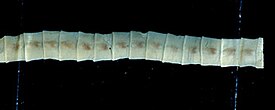
Mature worm body fragment |
| Scientific classification |
|---|
| No rank : | Bilateral symmetric |
|
| International Scientific Name |
|---|
Diphyllobothrium latum ( Linnaeus , 1758) [1] |
|
Content
The structure of the strobila; view in increase: a scolex, proglottids and eggs of a wide tapeworm
Egg wide tapeworm (under the
microscope )
The length of the strobila , consisting of a significant number of segments (up to 4000), can reach a length of 2 to 15 meters. The scolex , 3-5 mm long, has an oblong-oval shape, flattened laterally. On the sides there are 2 slits (bothria), through which the worm is attached to the intestinal mucosa.
Eggs are yellowish, oval, of relatively large size (on average 70 by 45 micrometers). At one end of the egg is a lid, on the other - a little bump. Immature eggs (up to 1.000.000 per day) are excreted from the organism of the final host. Sometimes in the feces there are also posterior segments ( proglottids ) of the strobila.
Life cycle on the example of the final owner - the person. 1, 2 - the release of eggs from the body of the final owner and getting it into the water; 3 - coracidium; 4 - procercoid; 5 - plerocercoid; 6 - infection of predatory fish; 7 - infection of the final host; 8 - Mature worm; 9 - proglottid
The development of eggs occurs in freshwater bodies of water. Ciliated larva (coracidia) emerges from the egg at 6-16 days after entering the favorable environment. When the water temperature is below + 15 ° C, the embryo does not develop, but it remains viable for 6 months. After swallowing copepods living in freshwater, coracidia in 2-3 weeks turns into a procercoid.
In the body of fish that eat crustaceans, the procercoids penetrate into the internal organs and muscles, and after 3-4 weeks they turn into plerocercoids, reaching a length of 4 cm and having a formed scolex. In a mature worm, the plerocercoid is transformed already in the organism of the final host. When eating smaller fish with larger predatory fish, the plerocercoids are able to penetrate through the intestinal wall into the muscles and internal organs and continue to develop.
A great contribution to the study of Lentac was made by the German helminthologist Max Brown . At the end of the 19th and the beginning of the 20th century, the works of the scientist Brockhaus and Efron were given the following assessment of the scientist’s works: “ science owes it to the discovery of the development cycle of the broad tape-reader (Bothriocephalus latus) and the method of human infection with this dangerous parasite ” [5] .
- ↑ View Wide ribbon (English) in the World Register of Marine Species . (Checked December 22, 2011)
- ↑ 1 2 3 Westheide V. , Rieger R. From protozoa to mollusks and arthropods // Invertebrate Zoology. = Spezielle Zoology. Teil 1: Einzeller und Wirbellose Tiere / per. with him. O. N. Bölling, S. M. Lyapkova, A. V. Mikheev, O. G. Manylov, A. A. Oskolsky, A. V. Filippova, A. V. Chesunov; by ed. A.V. Chesunova. - M .: Fellowship of scientific publications KMK, 2008. - T. 1. - p. 266. - iv + 512 + iv p. - 1000 copies - ISBN 978-5-87317-491-1 .
- ↑ Dick, TA, Nelson, PA, Choudhury, A. (2001). Diphyllobothriasis: Update on the human body. Southeastern Asian Journal of Medicine and Public Health 32 (Suppl. 2): 59–76. Text (English) (Verified December 22, 2011)
- ↑ §14. The diversity of parasitic worms and the fight against them // Biology: Animals: A textbook for grades 7-8 of secondary school / B. E. Bykhovsky , E. V. Kozlova , A. S. Monchadsky and others; Edited by M. A. Kozlov . - 23rd ed. - M .: Enlightenment , 1993. - P. 41-43. - ISBN 5090043884 .
- ↑ Brown, Max / / Brockhaus and Efron Encyclopedic Dictionary : 86 tons. (82 tons and 4 extra.). - SPb. , 1890-1907.
