Japanese sable [1] ( lat. Martes melampus ) is a species of carnivorous mammal from the family of mustelids ( Mustelidae ).
| Japanese sable |
|
| Scientific classification |
|---|
| No rank : | Bilateral symmetrical |
|
| International scientific name |
|---|
Martes melampus ( Wagner , 1840) |
| Area |
|---|
|
| Security status |
|---|
Least ConcernedIUCN 3.1 Least Concern : 41650 |
|
Content
The color of the fur of Japanese sable varies from yellow-brown to dark brown, there is a whitish spot on the back of the head. It has a typical elongated physique typical of many martens, short limbs, and a fluffy tail. The body length of these animals reaches from 47 to 54 cm, and the tail length from 17 to 23 cm. Males are much heavier than females and weigh on average 1.6 kg, while females only about 1.0 kg.
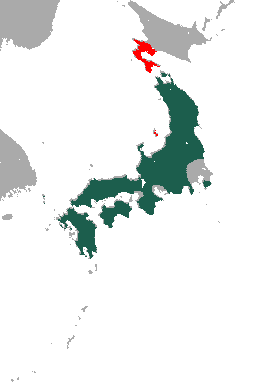
Japanese sables originally inhabited the three main southern Japanese islands ( Honshu , Shikoku , Kyushu , Tsushima ). To get furs, they were also brought to the islands of Hokkaido and Sado . Its natural range is mainly forests, but sometimes they are found in more open areas.
Little is known about the lifestyle of Japanese sables. They build nests in earthen burrows, as well as on trees. There they hide during the day to go out in search of food at night. These are territorial animals that mark their site with the secret of odorous glands. Excluding the mating period, they live alone. Like most martens, they are omnivorous animals that feed on small mammals and other vertebrate animals such as birds and frogs, as well as crustaceans, insects, berries and seeds.
Mating begins in March – May; in July – August, the female brings from 1 to 5 cubs. After 4 months, they become independent.
Japanese sables are hunted because of their fur, however, some populations (in Hokkaido and Tsushima) are fully protected. Common in Tsushima subspecies M. m. tsuensis is endangered by the WSOP .
- Martes melampus melampus (Wagner, 1840)
- Martes melampus tsuensis (Thomas, 1897)
- Martes melampus coreensis (Kuroda & Mori, 1923)
- ↑ Sokolov V.E. The pagan dictionary of animal names. Mammals Latin, Russian, English, German, French. / edited by Acad. V. E. Sokolova. - M .: Rus. lang., 1984. - S. 99. - 10,000 copies.
- Ronald M. Nowak: Walker's Mammals of the World . Johns Hopkins University Press, 1999 ISBN 0-8018-5789-9