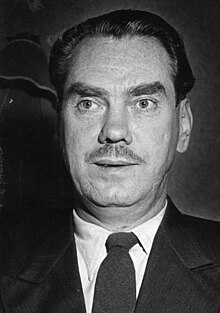
Arthur Nils Lundkvist ( Swede. Artur Nils Lundkvist ; 1906 - 1991 ) - Swedish poet , prose writer and essayist . Member of the Swedish Academy of Language and Literature (since 1968 ), laureate of the 1957 International Lenin Prize " For the consolidation of peace between peoples ", author of more than 100 books - collections of poems, lyric prose, short stories, literary essays , translations of lyrics, novels, travel essays and books on cinema art.
| Arthur Lundquist | |
|---|---|
| Artur lundkvist | |
 | |
| Date of Birth | |
| Place of Birth | Uberyunga, Kristianstad , Sweden |
| Date of death | |
| Place of death | |
| Citizenship (citizenship) | |
| Occupation | poet |
| Direction | primitivism |
| Genre | poems |
| Language of Works | Swedish |
| Awards |  |
| Awards | Litteris et artibus |
Content
Biography
Born March 3, 1906 in the town of Uberyung ( flax Kristiastad , Sweden) in a family of horse peasants. The first collection of poems is “Heat” (1928). Member of the poetic group " Five Young ", which proclaimed the principles of " primitivism ", in the tradition of which the verses of the collections "Black City" (1930), "White Man" (1932) and others were written.
In the 1950s and early 1960s, the writer sided with the left Swedish public circles, in 1957 he was awarded the International Lenin Prize for Strengthening Peace between Peoples, which, however, did not affect the independence of his opinions on various political issues: in particular, he condemned the entry of troops of the Warsaw Pact countries into Czechoslovakia in 1968 . In the same year he became an Honorary Doctor of Philosophy at Stockholm University and was elected to the Swedish Academy of Language and Literature, in which, until his death on November 11, 1991, remained one of the most influential and active members.
An indefatigable traveler, he traveled almost the entire globe: he visited Africa and India , the USA and Latin America , the Soviet Union and China . Each of his journey gave him material for a new book, imbued with a sincere desire to understand and deeply comprehend the new that is happening in the life of various peoples. “The sad optimist” called the Swedish writer I. G. Ehrenburg .
Creativity
The works of Lundqvist are characterized by the interweaving of realistic and modernist features.
Lundqvist’s poetic work is characterized by a tendency to vivid, often surreal metaphoricality, faith in man and the creative forces of the culture that he generates, which are opposed by no less powerful chaotic forces of nature. In prose, the writer repeatedly turned to the genre of a historical novel ("The Will of Heaven" about Genghis Khan , "Poetry of a Warrior" about Alexander the Great). In the late 1970s and 80s. Lundqvist prefers the synthesis of poetry and prose - books consisting of philosophical and lyrical fragments.
- Volcanic continent / Per. K. Telyatnikova; Foreword I. Ehrenburg. M .: Geografgiz, 1961.368 s;
- Talking tree: fav. verses / Comp. V. Morozova; After N. Krymova. M .: Progress, 1964.126 s;
- Life and death of a free shooter: Ballad in prose / Transl. L. Gorlina; Foreword A. Kahn. M .: Progress, 1972.239 s;
- [Poems] // Modern Swedish poetry. M., 1979. S. 113-135.
Notes
- ↑ Find a Grave - 1995. - ed. size: 165000000
- ↑ 1 2 Internet Speculative Fiction Database - 1995.
- ↑ 1 2 3 Swedish death index
Links
- https://archive.is/20130417032607/litknigi.ru/lundkvist-artur
- Great Soviet Encyclopedia : [in 30 vol.] / Ch. ed. A.M. Prokhorov . - 3rd ed. - M .: Soviet Encyclopedia, 1969-1978.
- http://www.dict.t-mm.ru/all/lundkvict_artur.html
- http://www.vokrugsveta.ru/vs/article/6422/
- https://web.archive.org/web/20090324092955/http://bibliograph.ru/Biblio/L/Lundkvist_A/Lundkvist_A.html