Medium harmonic is one of the ways in which the “average” value of a certain set of numbers can be understood. It can be defined as follows: let positive numbers be given , then their average harmonic will be such a number , what
- .
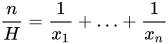
You can get an explicit formula for the harmonic mean:
- ,

that is, the harmonic average is the reciprocal of the average of the inverse of the numbers .
Properties
- The harmonic mean is indeed “mean,” in the sense that
.
- In general, the harmonic average is the average degree of -1.
- Harmonic mean is dual to arithmetic mean in the following sense:
-
and
(when the latter is determined).
-
- The inequality of averages states that the harmonic mean of the numbers does not exceed the geometric mean, the arithmetic mean and the mean square , and all the averages are equal only if all numbers are equal
i.e:
- Where
- harmonic mean;
- geometric mean;
- average;
- mean square.
-

Weighted harmonic mean
Let there be a set of non-negative numbers 


-
.
-
It is easy to notice that when (that is, when all values are “equal”) the usual harmonic average is obtained.
Applications and Examples
In statistics, the harmonic mean is used in the case when the observations for which the arithmetic average is to be obtained are given by inverse values.
In a thin lens formula , the double focal length is equal to the average harmonic distance from the lens to the object and the distance from the lens to the image. Similarly, the harmonic mean is included in a similar formula for a spherical mirror .
The average speed on a path divided into equal sections, the speed of which is constant, is equal to the average harmonic velocity on these sections of the path. More generally, if the path is divided into sections, the speed on each of which is constant, then the average speed will be equal to the weighted average harmonic speeds (each speed comes with a weight equal to the length of the corresponding segment).
The average density of the alloy is equal to the weighted average harmonic density of the alloyed substances (weights are the masses of the parts of the corresponding substances).
The resistance resulting from the parallel connection of several resistors is equal to the average harmonic of their resistances divided by their number. A similar statement is true for capacitors connected in series.
Notes
- ↑ Row C. Geometric exercises with a piece of paper . - 2nd ed. - Odessa: Matezis, 1923. - p. 65.
See also
- Harmonic proportion
- Harmonic row
Links
- Weisstein, Eric W. Harmonic Mean / MathWorld - A Wolfram Web Resource