Vatutino ( Ukrainian: Vatutіne ) is a city of regional significance in the Cherkasy region of Ukraine .
| City | |||||
| Vatutino | |||||
|---|---|---|---|---|---|
| Ukrainian Vatutіne | |||||
| |||||
| A country |  Ukraine Ukraine | ||||
| Status | city of regional significance | ||||
| Region | Cherkasy region | ||||
| Chapter | Lisyuk Alexander Borisovich | ||||
| History and Geography | |||||
| Based | 1946 | ||||
| City with | 1952 | ||||
| Square | 10.89 km² | ||||
| Center height | |||||
| Climate type | Moderate | ||||
| Timezone | UTC + 2 , in summer UTC + 3 | ||||
| Population | |||||
| Population | 16 389 [1] people ( 2019 ) | ||||
| Digital identifiers | |||||
| Telephone code | +380 4740 | ||||
| Postal codes | 20250/20251 | ||||
| Car code | CA, IA / 24 | ||||
| KOATUU | |||||
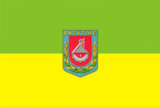
![Coat of arms [d]](http://upload.wikimedia.org/wikipedia/commons/thumb/2/25/Vatutine_gerb.png/90px-Vatutine_gerb.png)
Content
History
The city arose in connection with the development of the Yurkovsky brown coal deposit near the village of Yurkovka , discovered by residents of neighboring villages at the end of the 19th century .
In June 1930, prospectors first arrived at the site, at the 11th Zvenigorod District Congress of Soviets on February 7, 1931, they reported that large reserves of brown coal were found here.
By the end of 1931, three small mines were built on the site of the deposit and planned to produce 80 thousand tons of fuel next year. Given the prevailing manual labor, lack of electricity, and the absence of fixing timber, this was a difficult task. For its successful implementation, an additional open pit was built, which provided 30% of the production plan, a power plant with a capacity of 1,500 kW was built, and builders and miners were provided with a dormitory. Komsomol led the heavy sections of production. They were a good example of labor heroism. Overcoming difficulties, the Komsomol-youth team consisting of F. Shestopalov, S. Kostenko, A. Ocheretyany and others quickly put the mine into operation, exceeding the plan for the first quarter of 1932 by 200 tons. Gradually, residents of nearby villages, workers from other cities of the country began to come to the basin of the deposit . They were placed in temporarily equipped dormitories, tents. Everyone was eager to quickly begin the construction of new mines .
After the outbreak of World War II, the development of the Yurkov basin was discontinued, the structures built were destroyed during the German occupation .
Immediately after the end of the war, the restoration of old and the construction of new mines began . In November 1945, the Council of Ministers of the USSR issued a decree on the construction of a complex of industrial enterprises for the extraction and processing of brown coal from the Yurkovsky basin. The USSR Ministry of Fuel Industry, having included the field in its list, in 1946 sent construction and technical personnel to the basin region.
1946 - 1952
The settlement was founded in 1946 as the working village of Shakhtinskoye [2] with the start of the construction of a complex of enterprises for the extraction and processing of brown coal in the steppe valley through which the Shpolka River , a tributary of the Rotten Tikich , flowed between Shpola and then the deaf station Bogachevo, where instead of the station stood old broken wagon. The first builders came to the undeveloped land. By the beginning of March 1946, they had created 10 brigades, which made a breakdown of the area for the construction of three dormitories for 225 people. At the same time, preparations were under way for the installation of a diesel power station and access roads . Workers arrived from all over the country. In the conditions of the post-war recovery of the national economy, there were not enough building materials. Therefore, it was decided to produce them on the spot. So, in May, burned 100 thousand pieces of brick from local raw materials. This helped to early commission the woodworking plant. The crew of carpenters was led by M. A. Kosenko, who, along with his comrades, was the first to arrive at the construction site. His work was marked by many honorary diplomas, prizes, he was one of the first among builders to be awarded the mark "Excellence in Socialist Competition ."
In 1946, a mine was rebuilt, which was called “Oktyabrina” before the war, and with the onset of 1947, equipment arrived for coal mining (including the trophy transport and dump bridge brought from Germany). The demobilized soldiers and miners who arrived from the mines of Donbass and from other places of the country, are imbued with a sense of friendship and mutual assistance, showed examples of selfless work. To strengthen the party organization of the new building in December 1947 , the Central Committee of the All-Union Communist Party of Bolsheviks sent P. M. Khachaturian, a party organizer, who knew the mining business well and was a capable organizer. The party organization, headed by P. M. Khachaturian, then numbered only 37 party members. After the mines were put into operation in the spring of 1947 , the development of the Yurkovsky opencast coal mine for open pit mining began . First of all, machines for removing soil from coal layers were mounted. So the Menk excavator was mounted and put into operation. For almost three years, the transport and dump bridge was erected. This unique structure weighing 8 thousand tons, 82 meters high, with a wingspan of 335 meters to remove rock, could replace the work of several thousand excavators. In December 1953 , having removed the 45-meter stratum of the earth, the miners uncovered brown coal deposits with a layer of up to 12 meters and began its production by mining excavators with loading electric trains in wagons. The transport and dump bridge was served by 40 workers. Communist, engineer A. I. Lukin supervised the work. For the skillful leadership of the bridges and the smooth operation of the structure, he was awarded the Order of the Red Banner of Labor .
On April 19, 1949, the village of Shakhtinskoye (previously part of the Yurkovsky Village Council) was transformed into an urban-type village of Vatutino (named after the Soviet commander of the Hero of the Soviet Union, General N. F. Vatutin ) [2] .
In May 1949 , the Yurkovsky Village Council transferred 23.5 hectares of land to the Village Council, already occupied by individual housing construction, carried out in 1946-1948 .
The Central Committee of the Komsomol declared Vatutino shock construction. Young men and women from different regions of Ukraine arrived on Komsomol vouchers for construction. Only the Zhytomyr regional committee of Komsomol sent more than 300 young enthusiasts to the new building. According to the decision of the Kiev regional committee of the Komsomol (until 1954 it was the territory of the Kiev region ) of the Komsomol members who arrived in the Yurkov basin, a united Komsomol organization was created, which numbered more than a thousand Komsomol members. The party and Komsomol organizations, together with the village council, launched extensive construction and took care of the improvement of the city. Four construction and installation departments were created to carry out the work: the first carried out the commissioning of the Yurkovsky brown coal deposit, the second laid the foundations of the future city, the third built a briquette factory, and the fourth power station . In the last year of the fourth five-year plan, a brick factory was commissioned on the northern outskirts of the city. The construction of the first day nursery and kindergarten was completed. On the southern outskirts of the city built a new room for high school.
1952 - 1991
In May 1952 , the village of Vatutino became a city of district subordination [2] , and the village council was transformed into a city. According to the master plan developed by the Kharkov branch of Giprograd of the Gosstroy of the Ukrainian SSR, housing construction has acquired a large scale. According to the results of the five-year plan, more than 200 residential buildings with spacious, well-arranged two and three-room apartments, 26 grocery stores, a clinic, a bath and laundry complex were built in the city. At the same time, the Komsomolsky Park was created.
In 1955 a railway station was built.
In the early 1960s, more than a thousand students attended 2 primary and 2 secondary schools, also worked as a secondary school for working youth, an evening branch of the Irpen industrial technical school and a school for agricultural mechanization, and 2 libraries for adults and young people worked.
In the center of the city, a palace of culture was built with a hall for 450 seats, rooms for work of amateur groups. By the decision of the City Council in October 1952 , the Palace of Culture was named after V.I. Lenin. For sports enthusiasts, the Shakhtar stadium has been built with streamlined venues.
In 1964 , the development of new quarters with five-story residential buildings began . The layout of the city is rectangular, with wide streets and sidewalks. All of them are asphalted and lined with slender lindens and chestnuts. In the evening, fluorescent lamps illuminate the city. On the right bank of the Shpolka River , the Komsomolsky Park was created. The shores are concreted from the park, a park with a water station is equipped on the right bank, and a relay television center is located on the opposite side. On the southwestern outskirts of the city, coal miners planted a new park, which has 14 thousand trees and ornamental bushes.
In May 1965, a monument to N. F. Vatutin [2] was unveiled on the forecourt square, and a memorial stone was erected at the entrance to the city in honor of the soldiers of the 53rd Army of the 1st Ukrainian Front.
In 1967 , a vocational school No. 2 [3] was opened, which graduates builders of a wide profile.
In 1969, the population was 14.1 thousand people, the largest enterprises of the city were a refractory materials factory, a reinforced concrete products factory, a woodworking factory, an asphalt plant, a meat factory and a bakery [4] , there were also a steam transport department, a repair factory, and a factory consumer services, medical school, evening branch of the Irpen industrial technical school (which trained mining electricians and mechanics for opencast mining of coal deposits), A black school, three high schools, an eight-year school, a seven-year music school, a hospital with 150 beds, a tuberculosis dispensary, a sanitary epidemiological station, first-aid posts, as well as a network of retail and household institutions (a department store, 33 shops, a restaurant, a cafe, and 14 canteens).
In 1970, as a result of unsuccessful reconstruction of the dump bridge (lengthening of the rotary boom) and violation of operating conditions (alcohol was not poured into the bridge hydraulic support system in winter), a 300-meter-long metal structure collapsed. Since by this time the main coal reserves had been exhausted, a slow but inevitable extinction of the complex became inevitable. In subsequent years, mining was carried out in small mines, and by the beginning of the 1990s, the coal complex was closed [5] .
In 1979, there was a briquette factory , a refractory materials factory, a mechanical repair factory, a meat factory, a bread factory, a consumer services factory, a medical school, vocational school No. 2, 4 secondary schools, a music school, a sports school, a hospital, the Palace of Culture, a wide-screen movie theater , a club and five libraries [2] .
In January 1989, the population was20 362 people [6] .
After 1991
June 26, 1992 Vatutino became a city of regional subordination [7] .
In May 1995, the Cabinet of Ministers of Ukraine approved a decision on the privatization of a mechanical repair plant located in the city [8] , a meat processing plant, a refractory materials factory, an experimental mechanical factory, a building materials factory, construction and installation department No. 4 and a mechanized convoy No. 25 of the trust " Agro-construction machinery " [9] , in July 1995, approved the decision on the privatization of the ATP -17163 located here [10] .
In 1997, the Vatutinsky Medical School was turned into a branch of the Cherkasy Medical College [11] , and the Yurkovskaya TPP was closed.
As of January 1, 2013, the population was 17,653 people [12] .
Transport
Railway station Bogachevo [2] on the line Tsvetkovo - Talnoe of the Odessa railway [4] .
Also, Vatutino is connected with all villages of the district by bus.
Notes
- ↑ The number of the explicit population of Ukraine on 1 September 2019 rock. State Statistics Service of Ukraine. Kiev, 2019.p. 75
- ↑ 1 2 3 4 5 6 Vatutino // Ukrainian Soviet Encyclopedia. volume 2. Kiev, “Ukrainian Soviet Encyclopedia”, 1979. p. 133
- ↑ Postanova of the Supreme For the sake of Ukraine No. 88/95-ВР від 3 birch trees 1995 р. “About the change of ownership, so as not to privatize privatization of foreign values”
- ↑ 1 2 Vatutino // Great Soviet Encyclopedia. / ed. A.M. Prokhorova. 3rd ed. volume 4. M., "Soviet Encyclopedia", 1971. p. 366
- ↑ City history on a city site
- ↑ 1989 All-Union Population Census. Number of urban population of Union republics, their territorial units, urban settlements and urban areas by gender
- ↑ Postanova of the Supreme For the sake of Ukraine No. 2506-XII vid 26 of a red heart 1992 p. “About the meeting of the city of Vatutine of the Cherkasy region to the category of the city of the regional order”
- ↑ Postanova of the Cabinet of Ministers of Ukraine No. 343b vid 15 grass 1995 p. “Change of ownership, which is necessary to privatize privatization in 1995”
- ↑ Postanova of the Cabinet of Ministers of Ukraine No. 343a vid 15 grass 1995 p. “Change of ownership, which is necessary to privatize privatization in 1995”
- ↑ " 03119397 Vatutinske ATP-17163 "
Postanova of the Cabinet of Ministers of Ukraine № 538 від 20 Lipnya 1995 р. “About the additional transfer of assets, which is necessary to privatize privatization in 1995” - ↑ Postanova of the Cabinet of Ministers of Ukraine No. 526 від 29 May 1997 “About the near-secondary measures of professional and technical-technical primary mortgages”
- ↑ The number of the explicit population of Ukraine on 1 September 2013. State Statistics Service of Ukraine. Kiev, 2013.