Alexander Ilyich Dutov (August 5 ( 17 ), 1879 , Kazalinsk - February 7, 1921 , Suidun , China) - Russian military, member of the White movement , ataman of the Orenburg Cossacks , lieutenant general (1919).
| Alexander Ilyich Dutov | |
|---|---|
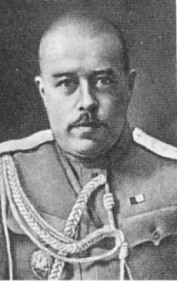 in 1919 | |
| Date of Birth | August 5 (17), 1879 |
| Place of Birth | Russian Empire , Syrdarya Province , Kazalinsk |
| Date of death | February 7, 1921 ( 41) |
| Place of death | Republic of China , Suidong |
| Affiliation |
 White movement White movement |
| Type of army | cavalry |
| Years of service | 1897 - 1921 |
| Rank | corral ( 1899 ) |
| Commanded | Orenburg Separate Army |
| Battles / wars | Russian-Japanese war
Civil war in Russia :
|
| Awards and prizes |   |
Biography
The ancestors of A.I. Dutov on the male line came from the Samara Cossack army , which was subsequently abolished. Father, Ilya Petrovich Dutov - military officer of the era of Turkestan campaigns, in September 1907 , when dismissed from service, he was promoted to the rank of major general . Mother - Elizaveta Nikolaevna Uskova - the daughter of a police officer , a native of the Orenburg province .
A. I. Dutov was born during one of the campaigns in the city of Kazalinsk, Syrdarya region , the first-born in the family. [1] His childhood years passed in Ferghana , Orenburg , St. Petersburg and again in Orenburg .
During the training of his father in the Officer Cavalry School in 1888-1889, he lived in St. Petersburg and at the age of seven began to go to Letnikova’s school, and then, in preparation for entering the cadet corps, to the Nazarova school. Later he entered the school of Zhoravich in Orenburg.
In 1889 he was accepted for military scholarship to the Orenburg Neplyuevsky cadet corps , which he graduated in 1897 .
After graduating from the Nikolaev cadet school in 1899, he was promoted to coronet and sent to the 1st Orenburg Cossack Regiment , stationed in Kharkov .
In 1902, he was first sent to Kiev for a preliminary test at the headquarters of the 3rd Sapper Brigade for transfer to the engineering troops, and then went to St. Petersburg to take an exam at the Nikolaev Engineering School for the right to second to engineering troops. The preparation took four months, successfully passing the exam for the entire course of the school (according to the official biography - the first), entered the disposal of the Main Engineering Directorate and again ended up in Kiev, in the 5th combat engineer battalion, for a service test and subsequent transfer. Three months later, in the battalion, he was appointed teacher of the sapper, and in 1903, the telegraph school. In addition to this work, he was in charge of a battalion soldier's shop; October 1, 1903 received the rank of lieutenant.
At this time, he married Olga Viktorovna Petrovskaya, who came from hereditary noblemen of the St. Petersburg province.
After graduating from courses at the Nikolaev Engineering School on October 1, 1903, he entered the General Staff Academy , but in 1905 he volunteered for the Russo-Japanese War . He fought as part of the 2nd Manchu army , where he was awarded the Order of St. Stanislav of the 3rd degree for "excellent-diligent service and special work" during the fighting.
Upon his return from Manchuria, he continued his studies at the Academy of the General Staff, which he graduated in 1908 in the 2nd category (without production in the next rank and being ranked by the General Staff) with the rank of headquarters captain . He was sent to familiarize himself with the service of the General Staff in the Kiev Military District at the headquarters of the 10th Army Corps.
From 1909 to 1912 he taught at the Orenburg Cossack Junker School . One of his students was G. M. Semenov - later the Transbaikal military chieftain . In addition to performing his duties, he organized performances, concerts and evenings at the school.
In December 1910 he was awarded the Order of St. Anne of the 3rd degree.
In October 1912 he was sent for the annual qualification command of the 5th hundred of the 1st Orenburg Cossack Regiment to Kharkov. December 6, promoted to rank of army foreman (corresponding army rank - lieutenant colonel ). At the end of his command in October 1913 he returned to school, where he served until 1916 .
World War I
On March 20, 1916, he volunteered for the army, in the 1st Orenburg Cossack of His Imperial Highness Heir Tsesarevich regiment, which was part of the 10th cavalry division of the 3rd cavalry corps of the 9th army of the Southwestern Front .
He took part in the offensive of the South-Western Front under the command of A. A. Brusilov , during which the 9th Russian army, where Dutov served, defeated the 7th Austro-Hungarian army between the Dniester and the Prut . During the offensive he was twice wounded, the second time he was seriously injured. However, after two months of treatment in Orenburg he returned to the regiment. On October 16, he was appointed commander of the 1st Orenburg Cossack Regiment together with Prince S.V. Bartenev .
In the certification of A. I. Dutov, the head of the 10th cavalry division, General V. E. Markov and corps commander Count F. A. Keller, on February 11, 1917 it was written: “The last battles in Romania, in which the regiment took part under the command of military foreman Dutov "they give the right to see him as an excellently versed in the situation commander and make appropriate decisions energetically, which is why I consider him an outstanding and excellent military commander of the regiment." [one]
By February 1917, for military distinctions, the Dutov was awarded swords and a bow to the Order of St. Anne of the 3rd degree and the Order of St. Anne of the 2nd degree.
After the February Revolution
After the February Revolution in March 1917 he was elected comrade (deputy) chairman of the Provisional Council of the Union of Cossack Troops. June 1, elected chairman of the II General Cossack Congress in Petrograd . June 7, elected chairman of the Council of the Union of Cossack Troops. In September, he was elected ataman of the Orenburg Cossack Army and head (chairman) of the army government. In his political views, he stood at republican and democratic positions.
Rise of A.I. Dutov
By October 1917, the 38-year-old A. I. Dutov turned into an iconic figure, known throughout Russia and popular in the Cossacks [2] .
October 26 (November 8) returned to Orenburg and began to work in his posts. On the same day, he signed an order for army No. 816 on the non-recognition of the Bolsheviks’ power in the territory of the Orenburg Cossack army, who made a coup in Petrograd, thus becoming the first military chieftain to declare war on Soviet power. On October 27, he issued a new decree on the Orenburg Cossack army: "From now on, until the restoration of the powers of the Provisional Government and telegraph communication, I assume the entire fullness of the executive state power." The city and the province were declared martial law. The created Committee for the Salvation of the Homeland, which included representatives of all parties, with the exception of the Bolsheviks and the Cadets, appointed him the chief of the armed forces of the region [3] .
A. I. Dutov took control of a strategically important region that blocked the communication of the country's center with Turkestan and Siberia . He was faced with the task of holding elections to the Constituent Assembly and maintaining stability in the province and the army until the convocation of the assembly. On the whole, he coped with this task. Arriving from Petrograd and locals who did not go underground, the Bolsheviks were arrested, and the decomposed and pro-Bolshevik-minded garrison of Orenburg was disarmed and discharged to their homes.
In November, A. I. Dutov was elected a member of the Constituent Assembly from the Orenburg Cossack Army.
| The Rodzianko, Milyukovs, Guchkovs, Konovalovs want to regain power and, with the help of the Kaledins, Kornilovs and Dutovs, turn the labor Cossacks into an instrument of their criminal goals ... |
- with these words a lengthy appeal of the Council of People's Commissars of November 25, 1917 was opened. And to the chief commissar of the Black Sea Fleet and the "Red Commandant of Sevastopol" V.V. Romenets SNK sent the following "installation" telegram:
| Kaledins , Kornilovites , Dutovs are illegal! |
Opening the 2nd regular Troop Circle of the Orenburg Cossack Army on December 7, Dutov said:
“Now we are experiencing the Bolshevik days. We see in the twilight the outlines of tsarism, William and his supporters, and clearly we are clearly facing the provocative figure of Vladimir Lenin and his supporters: Trotsky-Bronstein, Ryazanov-Goldenbach, Kamenev-Rosenfeld, Sukhanov-Himmer and Zinoviev-Apfelbaum. Russia is dying. We are present at her last breath. There was Great Russia from the Baltic Sea to the ocean, from the White Sea to Persia, there was a whole, great, formidable, powerful, agricultural, working Russia - there is none ”
On December 16, he sent a call to the commanders of the Cossack units to send the Cossacks with arms to the army. However, the bulk of the Cossacks returning from the front did not want to fight, only in some places the village squads were formed. In connection with the failure of the Cossack mobilization A.I. Dutov could count only on volunteers from officers and students, not more than 2 thousand people, including the elderly and unshooted youth.
Meanwhile, troops loyal to the Soviet regime launched an offensive on Orenburg . After heavy battles, the Red Army units numerically superior to the Dutovites, under the command of V.K. Blucher on January 31, 1918, as a result of joint operations with the Bolshevik underground, captured Orenburg. A.I. Dutov decided not to leave the territory of the Orenburg army and single-handedly went to the center of the 2nd military district - Verkhneuralsk , which was far from major roads, hoping to continue the struggle there and to mobilize new anti-Bolshevik forces.
Verkhneuralsk was also commissioned in March, after which the Cossack government settled in the village of Krasninskaya, where by mid-April it was surrounded. On April 17, breaking through the encirclement with the forces of four partisan detachments and an officer platoon, A. I. Dutov escaped from Krasninsky and left for the Turgai steppes .
In the spring of 1918, outside of Dutov, a powerful rebel movement began in the territory of the 1st military district, provoked by the policies of the Soviet government and led by a congress of delegates from 25 villages and a headquarters led by army foreman D.M. Krasnoyartsev . On the night of April 4, a detachment of Cossacks of military foreman N.V. Lukin and a detachment of S.V. Bartenev made a daring raid on Orenburg, taking it for a while and inflicting tangible losses on the Red Army units. In response, anti-Kazakh punitive measures followed (in particular, 11 villages were burned).
As a result, by June, only in the territory of the 1st military district, more than 6 thousand Cossacks took part in the uprising. At the end of May, the Cossacks of the 3rd Military District [4] joined the movement, supported by the rebel units of the Czechoslovak Corps . The Red Guard detachments on the territory of the Orenburg army were defeated everywhere, and on July 3 Orenburg was taken by Cossack units. A delegation was sent from the Cossacks to A. I. Dutov, as the legitimately elected military chieftain, to the Turgai steppes. July 7, he arrived in Orenburg and led the Orenburg Cossack army, declaring the territory of the Orenburg province “Special Region of the Orenburg Army”. September 28, the Cossacks took Orsk - the last of the cities on the territory of the army occupied by the Red Army. Thus, the territory of the army was completely cleared of the Reds for some time.
Among the first to support the Supreme Ruler - A. I. Kolchak . Troops obeying A. I. Dutov in November became part of the Russian army of the admiral.
The Orenburg army of A. I. Dutov fought with varying success against the Red Army, but in September 1919 it was defeated near Aktyubinsk . Ataman with the remnants of the army retreated to Semirechye , where he joined the ataman B.V. Annenkov in the Semirechye army. Due to the lack of food, crossing the steppes became known as the “ Hunger Campaign ”.
Upon arrival in Semirechye, A. I. Dutov was appointed ataman Annenkov as Governor General of the Semirechye Region . The command of the Orenburg army passed to General A. S. Bakich . Under the onslaught of the Red Army in May 1920, Dutov, with an Ataman detachment and civilian refugees, fled to China, where the Ataman Annenkov Semirechensky army soon retreated.
Death
On February 7, 1921, the chieftain A.I. Dutov was killed in Suidun by agents of the Cheka during a special operation whose purpose was either to kidnap him and take him to Jarkent , or to kill him. Kasymkhan Chanyshev , the Tatar prince, the head of the Dzharkent district police, led the operation. The group consisted of 9 people (all except Chanyshev were Uighurs).
Chanyshev, using his connections among whites and posing as an adversary of Soviet power, capable of raising an uprising in the Dzharkent district, in October 1920 achieved a meeting with A. I. Dutov. During this meeting, he was able to gain confidence in the chieftain, and also noted the tired look and a certain skepticism of Dutov to his reports and excellent knowledge of the affairs in Semirechye, which indicated the excellent work of the Dutovsk intelligence and counterintelligence. A month later, Chanyshev again went to Dutov, this time achieving full confidence.
There is a version that preparations for the abduction were in full swing, when suddenly they ceased to trust Chanyshev and the road to the chieftain became closed for him. The Chekists, in turn, began to suspect a double agent in Chanyshev, arrested him and took all his closest relatives hostage. He was given an ultimatum: either he kills Dutov (there was no talk of abduction anymore), or all his relatives will be shot.
On the night of January 31 to February 1, 1921, a sabotage group crossed the state border. On February 2, while in Suidun, Chanyshev wrote a note to Dutov that everything was ready for the uprising and that the speech should begin immediately: “Mr. Ataman. Stop waiting for us, it’s time to start, everything is done. Ready. We are waiting for only the first shot, then we won’t sleep. "and sent it with his courier Makhmud Hajamirov. They knew at the headquarters of the courier, so they allowed him to go directly to Dutov’s office, where in addition to the chieftain was his adjutant, the centurion Lopatin. Khadzhamirov handed over the note and, as soon as A.I. Dutov began to read, he shot and shot him, and then Lopatin, point blank. At the same time, the sentry was killed. The entire sabotage group without losses ran back across the border [5] [6] .
On February 11, a telegram was sent from Tashkent to carry out the assignment to the chairman of the Turkestan commission of the All-Russian Central Executive Committee and the Council of People's Commissars, member of the Revolutionary Military Council of the Turkestan Front G. Ya. Sokolnikov , and a copy of the telegram was sent to the Central Committee of the RCP (B) [7] . Members of the group were awarded F.E. Dzerzhinsky , and in the 1930s became victims of political repression . The last participant in the operation lived in the Orenburg region (where he was exiled) until his death in 1968 [8] .
A. I. Dutov and the two Cossacks killed with him were buried with military honors in the outskirts of Suidun, in a Catholic cemetery. A few days after the funeral, the ataman’s grave was desecrated: unknown people dug up the body and beheaded it [9] .
Rewards
- Order of St. Stanislav 3rd degree (01/23/1906)
- Order of St. Anne of the 3rd degree (6.12.1910)
- swords and bow to the Order of St. Anne 3rd degree (1917)
- Order of St. Anne of the 2nd degree (05/08/1915)
See also
- White movement
- The end of the chieftain
Notes
- ↑ 1 2 Sergey Rakovsky. Dutov Alexander Ilyich :: Personalities - History of the Orenburg . kraeved.opck.org. Date of treatment March 6, 2018.
- ↑ Voinov V.M. THE REBELLION OF A. I. DUTOV 1917-18 (inaccessible link)
- ↑ Operation "Trust". Soviet intelligence against Russian emigration. 1921-1937
- ↑ THE FIGHT AGAINST BOLSHEVIKI IN THE TERRITORY OF THE III MILITARY DISTRICT OF THE ORENBURGIAN COSSACK TROOP 1917-1918: ON MATERIALS OF PERMANENT QUESTIONS Archive copy of September 7, 2008 on the Whiteback Wayman Machine Almanac White Guard of Russia. M., "Sowing", pp. 185—192
- ↑ Kozubsky K.E., Ivlev M.N. Terrorist attack in Suidun: the murder of the Orenburg chieftain - Prostor magazine, No 8/2004.
- ↑ team of authors. Soviet police: history and modernity. - Moscow: Legal literature, 1987. - P. 73. - 336 p.
- ↑ Vladimir Markovchin. The end of the chieftain / Moscow Komsomolets
- ↑ The participant in the murder of Ataman Dutov lived in Orsk for almost 20 years
- ↑ The murder of Ataman Dutov
Literature
- Akulinin I.G. Orenburg Cossack army in the fight against the Bolsheviks .
- Artemyev Konstantin - The last refuge of ataman Dutov.
- Vasilenko S. Yu. Cossacks in the struggle against the Bolsheviks in the Semirechye and Xinjiang in 1920-1922. - N. Novgorod, 1998.
- Volkov E.V. A new book about the ataman A.I. Dutov // New Sentry (St. Petersburg). 2010. No. 19-20. S. 358-359. [one]
- Gagkuev R. G. The Forgotten Ataman // Military History Journal. 2007. No 7. P. 78-79 [2]
- Ganin A.V. Ataman A.I. Dutov (Russia forgotten and unknown. At the great turning point) . - M.: “Centerpolygraph”, 2006. - 623 p. - ISBN 5-9524-2447-3
- Ganin A.V. Alexander Ilyich Dutov // Issues of History 2005 No. 9. - P. 56—84
- Ganin A.V. Troop Ataman of the Orenburg Cossack Army A.I. Dutov // Kubanets: Magazine of Kuban cossack association / Ed. Kuban. Cossack union. 2001. No 209. February. S. 27-32.
- Ganin A.V. Alexander Ilyich Dutov // Svoy. The magazine of Nikita Mikhalkov. 2008. No. 3-4. S. 37-43.
- Ganin A.V. Marching ataman of all Cossack troops (Alexander Dutov) // The Cossacks are great, fearless. St. Petersburg, 2008.S. 599-601.
- Ganin A.V. Attempt to overthrow the chieftain A.I. Dutov in Orenburg in December 1918 // History of White Siberia: Materials of the 5th international scientific conference February 4-5, 2003 Kemerovo. Kemerovo: Kuzbassvuzizdat, 2003. S.151-154. [3]
- Ganin A.V. Conspiracy against Ataman Dutov in the recollections of eyewitnesses // Archeography of the South Urals. Materials of the Third Interregional Scientific and Practical Conference September 30, 2003. Ufa: Information advertising. 2003.S. 27-36. [four]
- Ganin A.V. Leaders of the anti-Bolshevik movement of the Orenburg Cossacks in the Nikolaev Academy of the General Staff, 1901-1914: Experience in historical and psychological research // Russian collection. Studies on the history of Russia XIX-XX centuries. T. 1.M., 2004.S. 152-196.
- Ganin A.V.The death of the ataman A.I. Dutov in the territory of Western China in 1921 // New and recent history. 2006. No. 6. S. 162-174.
- Ganin A.V. Ataman A.I. Dutov and the case of Yesaul F.A. Bogdanov // History of White Siberia. Materials of the 6th international scientific conference February 7-8, 2005. Kemerovo, 2005.P. 119-123. [five]
- Ganin A.V. Ancestors and descendants of the Ataman of the Orenburg Cossack Army A.I. Dutov // Genealogical Bulletin. St. Petersburg. 2005. No. 21. P. 40-47. [6]
- Ganin A. V. Ataman A. I. Dutov and the “case” of Colonel V. G. Rudakov // White Business. 2 Congress of representatives of print and electronic publications. Resolution and materials of the scientific conference "White work in the civil war in Russia, 1917-1922." M., 2005.S. 226–239.
- Ganin A. V. Ret .: Paramonov O. V. “Dutovki”. Bonds of the Orenburg Branch of the State Bank in 1917-1918 Catalog research. M., 2005: Numismatic Literature. 400 s .; silt // Questions of history. 2007. No. 2. P. 169.
- "... the ardent desire of the small army to help the older brothers." Letter of the Military Administration of the Irkutsk Cossack Army to the Ataman of the Orenburg Cossack Army, A. I. Dutov, March 19, 1919. Publication and notes by A. V. Ganin // Cossacks of Russia in the White Movement. White Guard. Almanac. 2005. No. 8. P. 278. [7]
- Ganin A.V., Semenov V.G. Officer corps of the Orenburg Cossack army. 1891-1945: Biographical reference book. - M., 2007 [8]
- Golinkov D. L. The collapse of the anti-Soviet underground in the USSR - M., Politizdat, 1975
- Denisov S.V. White Russia. Album No. 1 - N. York, 1937
- Kozubsky K.E., Ivlev M.N. Terrorist attack in Suidun: the murder of the Orenburg chieftain - in the journal Prostor, No. 8/2004.
- Milovanov N. Kasymkhan Chanyshev - in the collection “The Invisible Front. 1917-1967 ", Alma-Ata," Kazakhstan ", 1967.
- Ogarov O. Agony of whites in the Xinjiang province - in the journal "Military Thought", No 2/1921.
- Puchenkov A.S. A.V. Ganin. Ataman A.I. Dutov. M. CJSC Centerpolygraph. 2006.623 p. // Questions of history. 2008. No 1. S. 171-172 [9]
- Serebrennikov I.I. The Great Departure. The scattering of Asian White Russian Armies. 1919-1923 - Harbin, publishing house of M.V. Zaitsev, 1936.
- Khinshtein A., Zhadobin A., Markovchin V. The end of the ataman - "Moscow Komsomolets" on May 30, 1999.
- Гульбану Абенова. Конец атамана Дутова: загадке советских чекистов исполнилось 90 лет
Links
- Дутов, Александр Ильич . // Project "Russian Army in the Great War".
- Празднование юбилея А. И. Дутова в Краснинской станице, видеоклип [10] (недоступная ссылка)
- 2009 г. Празднование юбилея атамана А. И. Дутова в станице Краснинской, видео
- Установка Мемориальной доски Атаману А. И. Дутову / Празднование юбилея А. И. Дутова в Краснинской станице. Фотоальбом
- Биография на «Хроносе»
- Ганин А. В. Александр Ильич Дутов. Biography