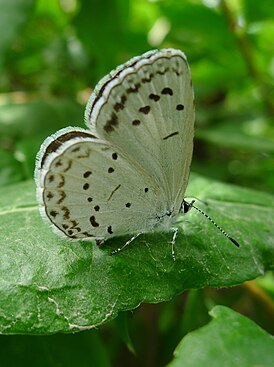
Lyubyanka Filipieva [1] [2] ( lat. Celastrina (Maslowskia) filipjevi ) is a butterfly from the family Lycaenidae . Endemic of Russia. The representative of the oligotypic, Amur-Chinese genus. The species name is given in honor of Ivan Nikolaevich Filipiev (1889-1938) - Russian and Soviet zoologist, entomologist, helminthologist, one of the founders of phytohelminthology.
Lyubyanka Filipieva | ||||||||||||||
|---|---|---|---|---|---|---|---|---|---|---|---|---|---|---|
 | ||||||||||||||
| Scientific classification | ||||||||||||||
| ||||||||||||||
| Latin name | ||||||||||||||
| Celastrina filipjevi Riley , 1934 |
Content
- 1 Description
- 2 Area
- 3 Flight time
- 4 Reproduction
- 5 Strength
- 6 Security Notices
- 7 notes
- 8 References
Description
Wingspan 27–32 mm. The male coloration of the upper side of the wings is violet-blue, along the edge with a narrow border of black color. In the female, the black marginal border is wider, expanded near the apex of the wing, and continues along the costal margin. On the underside, the wings are light gray in color, with a blue coating on the roots. On the front and hind wings, a black pattern is expressed: discal strokes, the outer and usually sublinear row of dots.
Range
Endemic to Russia, found only in the south of Primorsky Krai . It is found exclusively in mixed valley forests and shrubs along river banks.
Flight Time
Two generations a year. The first generation - from late June to mid-July, the second - from late July - to September.
Reproduction
Females of the first generation lay eggs on young twigs at the base of the petioles of the leaves, on the petioles and the leaves themselves. Females of the second generation - on the trunks, under the bark and on the branches. In clutch 1-10 eggs, located one at a time, or 2-5 pieces together. Eggs laid by second-generation adults are wintering. Caterpillars emerge in mid-late April, in April-May they feed on fresh unfolding leaves, then they meet from late July to early August. The feed plant of the caterpillars is the shrub Prinsepia sinensis (Prinsepia sinensis) . Pupae attach from below to intact leaves of the feed plant.
Strength
Quantitative surveys were not carried out. According to indirect data, it is recognized as having reached a critical level. Six small isolated populations are known.
Security Notes
It is listed in the Red Book of Russia (I category - endangered species). It is protected in the Ussuriisky reserve. The fodder plant - Prinsepia chinensis - is listed in the Red Book. At different times and in different places in the Ussuri nature reserve princepia bushes were planted, on which this polygonum is now developing. However, the state of these plantings needs to be monitored, as they can disappear, displaced by other plants. Absolutely unique plantations of princepsy exist on the Kabaniy key (a tributary of the Komakovka River). Only by chance they were not destroyed by logging associated with the laying of a new power line.
Notes
- ↑ Korshunov Yu. P. Qualifiers for the flora and fauna of Russia // Lepidoptera Lepidoptera in North Asia. Issue 4. - M .: KMK Scientific Publications Partnership, 2002. - P. 153. - ISBN 5-87317-115-7 .
- ↑ Mazin L.N., Sviridov A.V. GOLUBYANKA FILIPIEVA - Neolycaena filipjevi (Riley, 1934) . Date of treatment January 14, 2012. Archived April 10, 2012.
Links
| The Red Book of Russia the view disappears | |