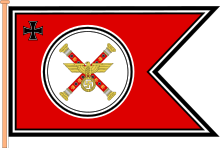

OKV (from the German Oberkommando der Wehrmacht , German OKW ) - Wehrmacht Supreme High Command , the central element of the administrative structure of the German armed forces in 1938-1945.
The Supreme Command of the Wehrmacht was created on February 4, 1938 after the liquidation of the Ministry of War ( German: Reichskriegsministerium ). Its creation was determined by the desire of Adolf Hitler (on whose loyalty the personnel of the armed forces were obliged to take the oath) to receive full authority over the adoption of military decisions. Artillery General Wilhelm Keitel was appointed chief of staff of the OKW, who, despite numerous disagreements with Hitler, held this position throughout the entire period of the OKW's existence (until May 1945).
Structure
Formally, the OKW carried out leadership and coordination of the activities of the supreme commands of certain types of armed forces:
- OKH - ( German: Oberkommando des Heeres ) High Command of the Ground Forces;
- OKL - ( German Oberkommando der Luftwaffe ) High Command of the Luftwaffe (Air Force);
- OKM - ( German Oberkommando der Marine ) The High Command of the Kriegsmarine (Navy).
- OKL - ( German Oberkommando der Luftwaffe ) High Command of the Luftwaffe (Air Force);
However, in practice, the OKW had a limited influence on the high command of certain types of armed forces, which became evident in December 1941, when Walter von Brauchitsch was removed from the post of head of the OKH after an unsuccessful attack on Moscow and this post was taken directly by Adolf Hitler, Fuhrer and Supreme Commander-in-Chief armed forces of the Third Reich.
The OKV apparatus included four departments:
- Operations Management Headquarters ( German: Wehrmacht-Führungsamt ) ( Alfred Jodl );
- Intelligence and Counterintelligence Directorate ( German: Amt Ausland / Abwehr ) ( Wilhelm Canaris );
- Defense Economics and Arms Economics Service ( German: Wirtschafts- und Rüstungsamt ) ( Georg Thomas );
- Department of General Affairs (legal and administrative departments) ( German: Amtsgruppe Allgemeine Wehrmachtangelegenheiten ) ( German Reinecke ).
Powers and Activities
The OKW's formal appointment was to fulfill the functions of the General Staff for coordinating the actions of the ground forces, aviation, and navy, but in practice, the Wehrmacht Supreme Command was Hitler's personal headquarters, which formalized his military plans in orders to specific command and control bodies and did not directly influence them. As the war progressed, the OKW began to gain greater control over the troops, primarily on the Western Front. Since 1942, there has been a geographical division of powers between the OKW and the OKH headed directly by Hitler - while the latter's activity was increasingly concentrated on the Eastern Front, the OKW received more and more authority to direct military operations on the Western Front, in Africa, and later in Italy.
Condemnation of OKW activities
At the end of World War II, the activities of the OKW and its individual leaders were the subject of consideration during the Nuremberg trials. Based on the results of the process, charges of criminal activity by OKW were dismissed. At the same time, OKW head Wilhelm Keitel and chief of staff of the operational leadership Alfred Jodl were recognized as war criminals, sentenced to death and hanged.