Victor Gorsley (Horsley) ( born Horsley Victor Alexander Haden , April 14, 1857 - July 16, 1916 ) - British scientist neurophysiologist, surgeon, founder of world neurosurgery . Known as the person who completed the first operation to remove a spinal tumor, who made a great contribution to the treatment of myxedema and many neurosurgical diseases. An ardent opponent of alcoholism and a supporter of the emancipation of women.
| Victor Alexander Gorsley | |
|---|---|
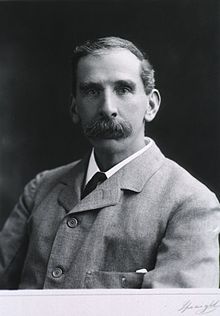 Victor Gorsley (circa 1900) | |
| Date of Birth | |
| Place of Birth | Kensington , London , UK |
| Date of death | |
| A place of death | Amara in the area of Mesopotamia, under British occupation, now Iraq |
| A country |  United Kingdom United Kingdom |
| Scientific field | Surgery , Neurophysiology , Neurosurgery |
| Place of work | University Hospital London Brown University National Hospital for the Treatment of Paralytics and Epileptics (now the National Hospital of Neurology and Neurosurgery) |
| Alma mater | Crenbook School, University College London |
| supervisor | William Govers |
| Famous students | Thierry de Martel |
| Known as | surgeon , neurophysiologist, founder of British neurosurgery ; first removed spinal cord tumor , which made a huge contribution to the treatment of myxedema , various neurosurgical diseases |
| Awards and prizes | Royal Medal (1894) |
Content
- 1 Biography
- 2 Scientific activities
- 3 social activities
- 4 Interesting fact
- 5 Memory
- 6 Monographs
- 7 notes
- 8 References
Biography
Victor Alexander Gorsley ( April 14, 1857 - July 16, 1916 ) was born in Kensington in London in the family of a famous artist , member of the Royal Academy - John Colcott Horsley . It was named after Queen Victoria , who became his godmother. [4]
He studied at the Crenbook School in Kent , after which he studied medicine at a university college in London. From 1884 to 1890 he worked at the Brownian Institute , from 1886 he was an associate professor of surgery in the national hospital of epileptics and paralytics (now the National Hospital of Neurology and Neurosurgery), professor of pathology ( 1887 - 1896 ) and professor of clinical medicine ( 1899 - 1902 ) at university college in London.
October 4, 1887 married Eldred Bramwell, daughter of Frederick Bramwell , from whom he had two sons and one daughter (Seward, Oswald and Pamela) [5] .
In 1886 he was admitted to the Royal Society of London , in 1894 Gorsley was awarded the Royal Medal of the Royal Society of London [6] , and in 1902 was elevated to the knighthood.
During World War I he was sent as a colonel of the British Army medical service to Egypt during the Dardanelles operation . Then he was sent to Mesopotamia, where he suddenly died in Amara (modern Iraq ) at the age of 59 years from a fever [7] .
Scientific activity
Victor Gorsley first removed the spinal tumor in 1887. William Osler refers to this case as "the most brilliant operation in the entire history of surgery ." It was carried out by the 42-year-old captain Gilby, who for several years complained of back pain, weakness and numbness of the limbs. Doctors attributed his suffering to intercostal neuralgia, aneurysm and neurosis. When Captain Gilby’s legs became completely numb and paralyzed, thanks to his acquaintances, he was consulted by Dr. Govers , who diagnosed a spinal tumor and recommended surgery. During the operation, Gorsley initially did not detect a tumor. However, then he further bit the arch of the superior vertebra and, in the end, discovered and removed the amygdala at the level of 3 and 4 of the posterior thoracic roots on the left. The patient fully recovered and lived another 30 years [8] .
He applied the approach to the gasser node via pterional access in the treatment of trigeminal neuralgia in 1890. However, due to the fact that the operation was unsuccessful (the patient died 7 hours after the operation), Gorsley did not use it for a long time. In 1893, regardless of Gorsley, a similar operation was performed by the German surgeon Fedor Krause , who later (after Hartley's modification) became known as the "Hartley-Krause operation." Subsequently, the future founder of American neurosurgery, who arrived in the UK in 1900 , Harvey Cushing describes the operation by Gorsley to remove the gasser node:
Gorsley went upstairs and in 5 minutes brought the patient into ether anesthesia. The operation lasted 15 minutes - making a huge hole in the skull of a woman, raising the temporal lobe - blood everywhere - pushing a lot of gauze into the middle cranial fossa, he cut a knot and ended the operation. He went out into the street no more than an hour later when he entered the house [9]
.
He has developed many innovations in the technique of neurosurgical operations, in particular hemostatic bone wax .
In 1908, he proposed together with Robert Clark an apparatus for stereotactic neurosurgical interventions (the so-called Gorsley-Clark apparatus). This device made it possible to clearly localize the location of the deep structures of the brain .
As a neurophysiologist, he studied the functions of the brain, mainly the cerebral cortex in animals and humans. Irritating various parts of the cerebral cortex and inner capsule, he expressed his assumptions about their functional significance. These studies subsequently served as the basis for the surgical treatment of epilepsy . Between 1884 and 1886 for the first time in the world, before Krause , Förster and Penfield , performed intraoperative electrical stimulation to determine the epileptogenic focus [10] [11] .
In 1886 he performed the first successful experimental hypophysectomy. He developed a transcranial approach to remove pituitary tumors, which Frank Thomas Paul used on his advice. He personally performed 4 successful operations for pituitary tumors [12] .
However, Gorsley remained primarily a general surgeon. For example, he drew an analogy between the subdural and intraperitoneal spaces. In particular, with syphilitic damage to the central nervous system, he proposed irrigation of the subdural space with a mercury solution.
Also known as a pioneer in the study of thyroid function . In 1884, he showed in an experiment that thyroidectomy (removal of the thyroid gland) causes myxedema . While treating myxedema and cretinism caused by an insufficient level of thyroid hormones , he was the first to propose using the thyroid gland extract of animals (monkeys) for therapeutic purposes.
He founded the Journal of Pathology.
Community Activities
One of Victor Gorsley’s deep convictions was an implacable stance regarding alcohol abuse . Watching the many victims of alcoholism entering his hospital, Gorsley enters into a sobriety society. He soon became vice president of the National Temperance League and chairman of the British Medical Temperance Association. In 1907, he even published the book "Alcohol and the Human Body."
Other aspects of Victor Gorsley’s civic position include support for the women's emancipation movement, and statements about the need for medical reform to provide free medical care to the working class.
In 1886, he was appointed chairman of the British state commission for the study of rabies vaccine developed by Louis Pasteur . Having evaluated the results of its use, he launched a wide campaign for the use of rabies vaccine in the UK .
Interesting fact.
After the death of Gorsley, it was rumored that the severe course of the fever leading to death was caused by Gorsley’s rejection of alcohol, which was used by the British military as a preventive and therapeutic agent for nutritional infections in southern countries [13] .
Memory
In the leading neurological and neurosurgical hospital in Liverpool, the intensive care unit is named after Victor Gorsley.
Monographs
- Functions of the Marginal Convolutions (1884).
- Experiments upon the Functions of the Cerebral Cortex (1888) (co-authored).
- Alcohol and the Human Body (Alcohol and the human body) (1907).
Notes
- ↑ 1 2 Encyclopædia Britannica
- ↑ 1 2 SNAC - 2010.
- ↑ 1 2 Paris Medical Academy - 1820.
- ↑ DR. VICTOR HORSLEY (1857-1916) (English)
- ↑ AIM25 collection description
- ↑ Royal Medal .
- ↑ Hanigan WC. Obstinate valour: the military service and death of Sir Victor Horsley. Br J Neurosurg. 1994; 8 (3): 279-288.
- ↑ B. L. Likhterman NEUROSURGERY: the development of clinical discipline. Moscow 2007 p.134-143
- ↑ Sir Arthur MacNalty. Sir Victor Horsley: His Life and Work. British Medical Journal April 20, 1957 pp. 910-917
- ↑ Tan TC, Black PM Sir Victor Horsley (1857-1916): pioneer of neurological surgery. Neurosurgery 2002 Mar; 50 (3): 607-611; discussion 611-62
- ↑ David C Taylor One hundred years of epilepsy surgery: Sir Victor Horsley's contribution. Journal of Neurology, Neurosurgery, and Psychiatry 1986; 49: 485–488
- ↑ Transcranial surgery for pituitary tumors performed by Sir Victor Horsley. (2003) | Labmeeting
- ↑ British Medical Journal April 20, 1957 p. 910