Barcelonon ( Cat. and Spanish Barcelona ) is a province in northeast Spain as part of the autonomous community of Catalonia . The administrative center is Barcelona .
| provinces | |||||
| Barcelona | |||||
|---|---|---|---|---|---|
| cat. província de Barcelona Spanish provincia de Barcelona | |||||
| |||||
| A country | Spain | ||||
| Included in | author Catalonia community | ||||
| Adm. Centre | Barcelona [1] | ||||
| The president | |||||
| History and Geography | |||||
| Square | 7733 km² (33rd place ) | ||||
| Timezone | |||||
| Population | |||||
| Population | 5 523 784 people ( 2014 ) ( 2nd place ) | ||||
| Density | 676 people / km² | ||||
| official languages | Catalan , Spanish | ||||
| Digital identifiers | |||||
| ISO 3166-2 Code | ES-B | ||||
| Postal codes | |||||
| Official site | |||||
 | |||||
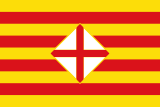
![Coat of arms [d]](http://upload.wikimedia.org/wikipedia/commons/thumb/e/e9/Escudo_de_la_provincia_de_Barcelona.svg/90px-Escudo_de_la_provincia_de_Barcelona.svg.png)
Content
Geography
Territory - 7733 km² (33rd place).
Population
The population is 5.226 million (2nd among provinces of the country; 2005 data).
Policy
The province elects 31 deputies to the Chamber of Deputies and 4 senators of the Senate .
Municipalities
The main administrative unit into which the province is divided is the municipalities. In the province of Barcelona, there are 311.
Mosquitoes
| Mosquito | Square | Population | Density | Municipalities | Adm. Centre | |||||
|---|---|---|---|---|---|---|---|---|---|---|
| Alt penedès | 592.7 km² | 106 168 people | 179.1 people / km² | 27 | Villafranca del Penedès | |||||
| Anoya | 866.6 km² | 117 444 people | 135.6 people / km² | 33 | Igualada | |||||
| Bazhes | 1,092.3 km² | 174 604 people | 159.85 people / km² | thirty | Manresa | |||||
| Bash Llobregat | 486 km² | 806 651 people | 1659.8 people / km² | thirty | Sant Feliu de Llobregat | |||||
| Barcelona | 145.8 km² | 2,225,144 people | 15 266.9 people / km² | five | Barcelona | |||||
| Bergeda | 1,185.3 km² | 39 517 people | 35 people / km² | 33.3 | Berga | |||||
| Garraf | 185.1 km² | 145 983 people | 788.6 people / km² | 6 | Vilanova i la Geltru | |||||
| Maresme | 398.5 km² | 439 512 people | 1102.8 people / km² | thirty | Mataro | |||||
| Moines | 337.9 km² | 13 098 people | 38.76 people / km² | ten | Moya | |||||
| Osona | 1245.2 km² | 154 925 people | 124.42 people / km² | 50 | Vic | |||||
| Valles Occidental | 583.1 km² | 900 661 people | 1544.5 people / km² | 23 | Sabadell / Tarras | |||||
| Valles Oriental | 735 km² | 400 375 people | 544.7 people / km² | 39 | Granollers | |||||
| Source: Statistical Institute of Catalonia [2] | ||||||||||
Since the administrative boundaries of districts (mosquitoes) and provinces do not completely coincide, there are several municipalities that administratively belong to one of the listed areas, but not to the province of Barcelona. These are the municipalities of Espinelves , Vidra and Viladrau , which are part of the Osona mosquito , but at the same time belonging to the province of Girona , and the Gosol municipality, which is part of the Bergeda mosquito , but to the province of Lleida . In contrast, the municipality of Fogas de Tordera is part of the Selva Comarte, but belongs to the province of Barcelona.
Attractions
Olympic Village
Area of catalonia
Canaletes Fountain
Theater " Liseo "
Skyscrapers of the Olympic Village
A new residential area was built for the 1992 Olympics. The Olympic Port and two skyscrapers - the Arts Hotel and the Mapfre Insurance Company building with a height of more than 150 m - are located in this area. The buildings were designed by architects Bruce Graham, Inigo Ortiz and Enrique Leon.
Malgrat de Mar
The city conditionally consists of two parts - * the old city *, which has retained its original appearance, where the population of Malgrat de Mar directly lives, and the new-built up with numerous hotels along the Maritim embankment. The new part of the city flows smoothly into the neighboring fused city of Santa Susanna. In the old city, the main attractions are the St. Nicholas the Wonderworker Basilica, built in the 16th century, standing on a cozy town square, old villas and palaces. From the square near the Basilica on the modern ski lift (3-4 floors high), you can climb to the territory of the former lighthouse, which is now Del Castell city park, where plants of different climatic zones are planted in circles, in segments. The park is an excellent viewing platform with a panoramic view of the city and the sea, as well as a resting place - if the bustle of the city and the beach is tired, there are even bench chairs for thoughts and sunbathing, and a clean public toilet. The photo was taken just from the park. Malgrat de Mar is a favorite vacation spot for tourists from Spain itself, as well as Northern Europe and Russia. The city has a lot of Russian-speaking and local residents, and employees of travel agencies and hotels. You can get to Barcelona by train, the railway lines are laid under the windows of the hotels along the sea line, but the movement of trains is almost silent. In the town, in addition to boutiques, purely tourist shops, there are two stores of major Spanish chain companies, with a price category not higher than the Russian one. Not far from Malgrat de Mar there is also a zoo with sea animals.
Santa Susanna
A small resort town in the heart of the Costa del Maresme , ideal for families with children. Very quiet and calm in winter, in summer the city is filled with tourists coming here from all over the world. In the old part of Santa Susanna, located on picturesque hills, there is a wonderful park Parque Natural de la Font del Boter, known for its healing springs of hot mineral waters.
Pineda de Mar
Remains of a Roman Aqueduct
Beach
A small resort town in Catalonia, located in the province of Barcelona , a resort on the Costa del Maresme . The city, which retains its agricultural character, was founded by the Romans in the 1st century BC. e., from that time there are four arches of the Roman aqueduct located along the road to the Montnegre Nature Reserve. The development of tourism entailed the construction of hotels, guest houses, summer residences and campsites and led to the formation of the infrastructure of shopping and entertainment centers. The city is divided into two districts: the historical center, which is located around the parish church, and the tourist promenade, along which there are many hotels, shopping establishments, bars, restaurants and cafes. The resort offers its guests extensive beaches of coarse sand, stretching for many kilometers, where you can relax, relax, sunbathe, breathe in the fresh sea air, sit on the veranda of one of the many coastal cafes and bars or go in for sports. Among the main attractions of the old city, the Iglesia de Santa Maria church of the 16th century deserves special attention - a beautiful building with an unusual baroque facade. The Can Jalpi Palace, dating back to the 15th and 16th centuries, is located near the church. On the mountain you can see the ruins of the Montpalau fortress, built in the 11th century to protect the coast. On the Plaza de Catalunya (Placa de Catalunya) you can see the most interesting buildings and palaces of the 18-19 centuries. The liveliest centers of city life are the Plaza de les Melies and the Paseo Maritimo, where city festivals are held and the city’s most popular bars and restaurants are located.
Calella
Municipality Area
Calella Beach
A city in Catalonia , located in the province of Barcelona, the largest resort on the Costa del Maresme. In the past, Calella was a fishing village and gained the status of a city in 1925. The huge sandy beach, bordered by a shady walking alley from the promenade and stretching for more than three kilometers along the entire city line, near the city of San Paul de Mar, passes into a rocky stretch of coast with cliffs and bays resembling the coastal landscapes of the Costa Brava. Calella is an international resort where you can meet tourists from many European countries. One of the walking routes passes through the central part of the city. There are many shops, souvenir shops, bars, cafes and restaurants offering international cuisine as well as local delicacies. Closer to night, discos, flamenco bars, night clubs and restaurants begin to work. A feature of the city is the proximity of modern hotels with historic quarters. Among the attractions of the city are the Iglesia de Santa Maria church (Iglesia de Santa Maria, 16th – 18th centuries) in the neoclassical style, the Municipal Dalmau park with tropical vegetation, and the Calella Museum and Archive.
Sant Paul de Mar
The city is located 47 km from Barcelona. Here you can see one of the most interesting ancient churches of Catalonia - Iglesia de Sant Pau, preserved from the monastery of VI-VII centuries. The temple is located in the eastern part of the city and is considered its symbol. One of the tourist centers of the Costa del Maresme. Its spacious sandy beaches, less crowded than the beaches of larger resorts, attract lovers of relaxing vacations and are suitable for families with children. The city is divided into two parts by a highway tape. The resort area is located along the coast and connects to the neighboring resort of Malgrat de Mar. The historical part of the city is located above the highway, in the hills covered with dense vegetation. Here you can see the watch tower of the 16th century, as well as the restored palace and castle of Castell de Can Rates, in the territory of which there is a cultural and art center. Near the old town is Parque Natural de la Font del Boter. In this area, among the variety of tropical trees and flowers, the famous local healing springs of hot and mineral waters beat.
Montserrat Monastery
Montserrat is a mountain range in northern Spain, in the heart of the province of Catalonia, near Barcelona. The mountains are unusually beautiful, bizarre stone formations in places look like castles made of wet sand, and in places they resemble huge idols that cause both admiration and horror. In the mountains is a Benedictine monastery, which can be reached from the Llobregat river valley in a few hours on foot along a mountain trail. This place has long attracted pilgrims and tourists, and in 1892 a cable car was built there from the town of Monistrol de Montserrat to the monastery. Subsequently, it was replaced by a cable car, but the old funicular still carries tourists from the monastery to the top of Santa Magdalena mountain, from where you can reach the Hermitage monastery St. Jeroni.
Singing Fountains
Each performance consists of two acts of 20 minutes. This is a huge fountain, which consists of many small ones. To the music of Tchaikovsky, Bach, Beethoven, he begins to shimmer with several thousand flowers, constantly changing his shape. The fountain seems to be dancing. For the entire act, the shape of the fountain is never repeated. Until recently, the fountain was completely "manual." It was controlled by a person: both music, and form, and colors, as an organ. But in the age of computers, most functions were automated. But from this spectacle did not cease to be interesting and exciting. This fountain is like a living one, it completely feels all the transitions in the melody and as if breathing. It can even be called not a singing fountain, but a dancing one, it is so inspired. The fountain is located near the palace, which gives it an even more chic look.
Spanish Village
The Spanish village (Poble Espanyol) is a city of craftsmen and artisans, a museum city, a city of nightlife, retail shops, bars and restaurants, exhibitions and concerts ... And it’s also an open-air architectural museum, in which a natural or slightly reduced size is collected copies of the most beautiful and famous buildings of Spanish architecture. This architectural complex was built in 1927, and its opening was timed to coincide with the opening of the 1929 World's Fair in Barcelona. Its authors Xavier Noges, Miquel Utrilto and Ramon Raventhos thoroughly familiarized themselves with the heritage of medieval, Renaissance and Baroque architecture in various parts of Spain. Here are collected 116 houses, churches and palaces belonging to different eras, but, irrespective of this, of architectural and artistic interest. Pueblo Espanyol was the first such project. The 'Swiss village' in Geneva, the 'Village of the Pharaohs' on the Nile in Egypt and many other places with a folklore-architectural bias appeared later. Passing through the high gate (a copy of the medieval fortress gate of San Vicente of the city of Avila), we get to Castile Square. On the right side are the buildings of the city of Cáceres. On the contrary, through the porticoes of the Navarre town of Sanguesa, you can see the Plaza Mayor - a collective image of the central, main square of many Spanish towns. It is surrounded by buildings originating from Aragon , Burgos , Navarre , Soria , Castilla, Teruel and Catalonia . It often hosts concerts, popular festivities, dinners 'de gala'. Nearby is a copy of the municipality of Valderrobles - buildings of the Renaissance . From the square you can go in several directions, among which there are dead ends. If you go up the stairs of Santiago de Compostela , surrounded by houses from Galicia , you will get to the central tower of Utebo. On the other side of the square, Caballeros street begins, reminiscent of Castilian streets. Behind the Maya arch overhanging its bridge, Caballeros Street passes into Prince de Viana Street, which is built up with houses from the Basque Country and Navarra. Behind the ramparts, a little higher on the hill, are a Roman-era monastery and temple, copied from originals from the Catalan Pyrenees. Valencia and Murcia are represented by buildings on Levante Street. And on the street Arcos, which reproduces the pure Anadalusian style, a naked lady has been waiting for you on the balcony for a long time. This statue greatly enlivens tourist photographs taken as a keepsake. Pueblo Espanyol allows you to not only visit the seventeen autonomies that form Spain, but also get acquainted with the creativity and typical crafts created by the masters of these regions. In the afternoon on the streets of Pueblo Espanyol crowded. Tourists click their cameras and look in shops looking for souvenirs as a keepsake. Along with the traditional 'tourist set', here you can buy truly unique handmade items. In the mornings, craft workshops open their doors. They organize courses and conduct master classes for Catalan schoolchildren and students, as well as for everyone. After the 1929 International Exhibition, they wanted to tear down the Pueblo Espanyol. But the Barcelonaers defended their City of Masters, and today it is one of the most visited places in the Catalan capital.
Notes
- ↑ Barcelona // Military Encyclopedia : [in 18 vol.] / Ed. V.F. Novitsky [et al.]. - SPb. ; [ M. ]: Type. t-va I. D. Sytin , 1911-1915.
- ↑ Instituto de Estadística de Cataluña. Densitat de població. 2015 Comarques, àmbits i províncies. 2015