The Fifth Republic of South Korea is the government of the country from 1981 to 1987 . During this period, the president was Jung Doo-hwan , a military ally of the assassinated president Park Jung-hee The period was characterized by reform attempts. The foundations were laid for the stable development of democracy in the country.
| Independent state | |||||
| The Republic of Korea | |||||
|---|---|---|---|---|---|
| box 대한민국 (Tekhanminguk) | |||||
| |||||
| Motto : “ 널리 인간 세계 를 이롭게 하라 (The good of all mankind, 홍익 인간 ) " | |||||
| Anthem : Patriotic Song | |||||
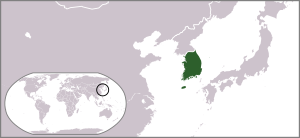 | |||||
←  → →- | |||||
| Capital | Seoul | ||||
| Languages) | Korean | ||||
| Currency unit | South Korean Won | ||||
| Square | 99 720 km² | ||||
| Population | 39 910 403 people ( 1983 .VII) | ||||
| Form of government | Presidential Republic ( de jure ) , Authoritarian dictatorship ( de facto ) | ||||
| The president | |||||
| • 1981 - 1987 | Jung Doo-hwan | ||||

After the assassination of Park Jung-hee in 1979 , Korean society was greatly agitated, resulting in a series of protests and demonstrations against authoritarian rule.
On December 12, 1979, Chung Doo-hwan carried out a military coup in Seoul. In April - July 1980, he headed the Central Intelligence Agency of South Korea , and after the resignation of President Choi Gyu Ha and indirect presidential elections in August 1980, where he was the only candidate, he was elected president of the country.
A draft new constitution was proposed for referendum on October 22, 1980 , providing for indirect presidential elections, a 7-year term for the president, the president’s right to impose a state of emergency and the dissolution of parliament, and the right to finance the ruling party with the state. For the draft new constitution, 91.6% of the referendum voted. [one]
The next presidential election , held in accordance with the 1980 Constitution, was held on February 25, 1981. Jung Doo-hwan, as a candidate from the Democratic Justice Party (later renamed the Democratic Republican Party ), won in them, receiving 4755 out of 5277 votes of the electoral college (over 90%). This day in the Republic of Korea is considered the beginning of the period of the Fifth Republic.
This period is considered authoritarian , but less severe than previous regimes. The 1980 constitution proclaimed more freedom than its previous version of 1972 ( Yusin Constitution ), but still delegated broad powers to the president.
By 1986, unrest in society had calmed down mainly due to stable economic growth and an overall increase in the well-being of the population, however, radical left student groups were still unsatisfied with the political course of the government. As a result, in June 1987, a massive wave of protests swept across the country. In the same month , US President Ronald Reagan sent a letter to Jong Do Hwan, urging the country to begin democratic reforms. After these events, a reform program was proclaimed on June 29, which included direct presidential elections , the lifting of the ban on the political activities of some politicians who were objectionable to the regime, including future President Kim Dae-jung and other measures. Reform was led by Ro Dae Woo, who later succeeded Jung Doo Hwang as president.
The first democratic elections in the country took place in 1987, marking the beginning of the Sixth Republic of South Korea.
See also
- History of South Korea
- History of Korea
Notes
- ↑ http://rikonti-khalsivar.narod.ru/Korea43.htm Establishment of the Fifth Republic