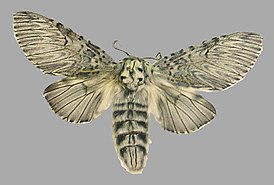
The harpy is large [3] , or the forked tail [1] is spotted [2] , or the forked tail is large [4] , or the silkworm-harpy [5] ( lat. Cerura vinula = Dicranura vinula ) is a nocturnal butterfly of the Corydalis family.
| Harpy big | ||||||||||||||
|---|---|---|---|---|---|---|---|---|---|---|---|---|---|---|
 | ||||||||||||||
| Scientific classification | ||||||||||||||
| ||||||||||||||
| Latin name | ||||||||||||||
| Cerura vinula Linnaeus , 1758 |
Content
Description
Fore wing length 3.5–4 cm. Wingspan 58–75 mm. Large butterfly of light gray color with matte zigzag lines on the front wings. Hind wings are light gray. The head and chest are densely pubescent with white hairs; on each segment of the abdomen there is a dark transverse strip [2] .
Range
Europe , the Caucasus , Iran [2] , Siberia up to and including Western Baikal, Central Asia [2] , North Africa [1] .
Habitat
Floodplain forests along streams and reservoirs [1] . Often in poplar alleys [2] .
Flight Time
The end of April - the beginning of May. Active at night [1] .
Reproduction
Egg
After mating, females lay up to 400 eggs individually on leaves . The eggs are bronze-colored, hemispherical in shape, with a white spot at the apex, in the middle of which there is a black dot [1] .
Caterpillar
Caterpillar Stage: June - September . Adult caterpillar up to 6 cm long, green. On the back with a large purple spot in the shape of a rhombus, edged with a white stripe. The head is brown in color, with a red border, flat, pulled into the chest. At the end of the body of the caterpillar is a large fork-like outgrowth. Being alarmed, it takes a special menacing pose: it inflates and raises the front end of the body, then pulling it into the enlarged first segment of the abdomen [1] , while at the rear end of the body two odorous strands are stretched - appendages of modified pushers, that is, the last pair of legs - that the most forked outgrowth. A heavily disturbed caterpillar can spray caustic liquid from the transverse fissure located on the first thoracic segment [2] . Feed plants of the willow and poplar genus , including aspen . Caterpillars eat leaves.
Doll
Pupation in late summer - early autumn . A chrysalis overwinter . Usually surrounded by a strong cocoon made by a caterpillar from crushed bark . Located on the trunks and branches of the forage tree [1] . Pupa is dark, brown-red, thick cylindrical [2] .
Gallery
Imago
Caterpillar
Notes
- ↑ 1 2 3 4 5 6 7 8 Striganova B. R. , Zakharov A. A. The Bilingual Dictionary of Animal Names: Insects (Latin-Russian-English-German-French) /Ed. Dr. biol. sciences, prof. B.R. Striganova . - M .: RUSSO, 2000 .-- S. 234. - 1060 copies. - ISBN 5-88721-162-8 .
- ↑ 1 2 3 4 5 6 7 8 Lampeter K. Atlas of butterflies and caterpillars. Habitat. Physical characteristics. Behavior. Reproduction / K. Lampert; Ed. A.I. Bykhovets. Mn .: Harvest, 2003.736 p.
- ↑ Gornostaev G.N. Insects of the USSR. - Moscow: Thought, 1970 .-- 372 p. - (Reference guides to the geographer and traveler).
- ↑ Forktail // Encyclopedic Dictionary of Brockhaus and Efron : in 86 volumes (82 volumes and 4 additional). - SPb. , 1890-1907.
- ↑ Silkworm-harpy // Brockhaus and Efron Encyclopedic Dictionary : in 86 volumes (82 volumes and 4 additional). - SPb. , 1890-1907.