Horseradish or Tree Horseradish ( Latin Armorácia rusticána ) is a perennial herbaceous plant of the genus Horseradish ( Armoracia ) of the Cabbage family ( Brassicaceae ). Popular cultivated plant; leaves and roots are used in cooking and medicine.
| Horseradish ordinary | |||||||||||||||||||||||
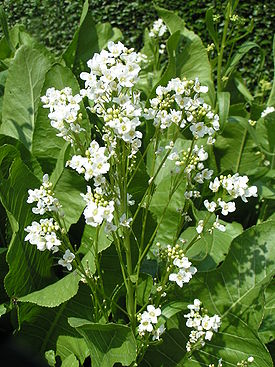 General view of a flowering plant | |||||||||||||||||||||||
| Scientific classification | |||||||||||||||||||||||
|---|---|---|---|---|---|---|---|---|---|---|---|---|---|---|---|---|---|---|---|---|---|---|---|
| |||||||||||||||||||||||
| International Scientific Name | |||||||||||||||||||||||
Armoracia rusticana G.Gaertn. , B.Mey. & Scherb. 1800 | |||||||||||||||||||||||
| Synonyms | |||||||||||||||||||||||
| |||||||||||||||||||||||
Content
Spread
Natural habitat - Europe (except for the Arctic regions), Siberia and the Caucasus .
It is introduced and now grows also in Asia and America .
In nature, it grows along rivers, in damp places.
Two types of horseradish grow in Russia - horseradish (European part of Russia), horseradish (mainly in Siberia) [2] .
Botanical description
The root is thick, fleshy.
The stem is erect, branched, 50–150 cm high.
Bottom leaves are very large, oblong or oblong-oval, crenate, heart-shaped at base; lower - pinnately-separated; oblong-lanceolate; upper - linear, entire.
Calyx about 3 mm long; petals about 6 mm long, white, short-clawed.
Fruits - pods , oblong-oval, swollen, 5-6 mm long; reticulate veins, nests with 4 seeds.
Chemical Composition
All parts of the plant contain an essential oil that has a sharp peculiar smell and taste.
Fresh root sap contains a protein substance lysozyme , which has antimicrobial activity, ascorbic acid (0.25%), thiamine , riboflavin , carotene , fatty oil , starch , carbohydrates (74%), and resinous substances .
Ascorbic acid (0.35%), carotene, alkaloids were found in the leaves; in the seeds - fatty oil and alkaloids.
Horseradish roots contain many mineral salts ( potassium , calcium , magnesium , iron , copper , phosphorus , sulfur , etc.). The yield of essential oil from the roots after fermentation is 0.05%; its main component is allyl mustard oil . In addition, the essential oil contains phenylethyl and phenylpropyl mustard oil . The plant also contains horseradish peroxidase , an enzyme widely used in molecular biology. In particular, this enzyme is used in an enzyme immunoassay to visualize a reaction associated with the interaction of an antigen antibody (oxidation of a dianisidine dye with conversion to a colored form), as well as in some methods for determining specific proteins in a sample using luminescence .
Top down: root; root incision; flowers; |
Meaning and application
In Russia, horseradish supposedly began to grow from the 9th century, has long been used as a spice and as a medicinal plant. In Europe, horseradish hit at the beginning of the XV century. He gained special popularity in Germany and the Baltic countries. The English called horseradish horseradish ( horseradish ) and used it exclusively for medicinal purposes. Currently, horseradish is cultivated in many countries around the world, mainly as a vegetable.
Cultivation
Horseradish is undemanding to the soil, but it requires fertile, loamy or sandy loam for the formation of good massive roots. Prefers moderately moist, well-lit places. Propagated by rhizome segments. Excess nitrogen in the feed leads to excessive branching of the roots. The roots can be excavated, starting from the second year of life of the plant. This should be done in late autumn after the leaves die off or in early spring before they appear.
Sometimes horseradish is grown as a shade-tolerant garden plant , in which both large leaves and flower stalks have decorative properties [3] .
Cooking applications
Horseradish is most widely used as a spicy flavor in cooking , using fresh, grated or chopped roots, as well as leaves; as a spice when salting and pickling cucumbers , tomatoes , mushrooms , red beets and sauerkraut . The roots are used to prepare the seasoning of the same name - horseradish , and also as part of more complex mixtures, for example, gravy , horseradish kvass , horseradish , horseradish .
From time immemorial, horseradish mixed with other components has been an indispensable seasoning for brawn and fish filler , as well as for cold boiled meat [2] . Horseradish is served with grilled meat, sausages, smoked meat, ham , fatty pork, cooked beef, tongue and roast beef . It is added to various mayonnaises , cottage cheese, yogurt , sauerkraut, cucumbers and other vegetables. These mixtures are served to grilled and boiled meat, fish, cold snacks.
Mix of horseradish with sour cream or apples serves as a good seasoning for fish, especially carp , cod , eel and salmon .
Medical use
In Russia, horseradish has long been widely used in traditional medicine . Root juice has pronounced antibacterial properties, is used for influenza , for rinsing the mouth and throat for sore throat , tonsillitis , toothache , it is laid in the ears with inflammation and purulent secretions. Fresh juice of horseradish and its water dilutions enhance the secretion of hydrochloric acid in the stomach and are effective in the treatment of anacid gastritis (the use of horseradish is dangerous in case of inflammatory diseases of the digestive tract , liver and kidneys ). In the experiment it was shown that water decoction of horseradish has a positive effect in the treatment of dysentery , liver disease and giardiasis , as well as hypertension . Due to the high content in all parts of the plant vitamin C horseradish is used as an adjunct in the treatment of viral hepatitis. Root, brewed in a beer with juniper berries, is used in dropsy.
In folk medicine, horseradish was used as an appetite- enhancing agent for improving the activity of the digestive tract , edema , kidney, bladder and liver diseases , as an expectorant for inflammation of the upper respiratory tract [2] . In scurvy , tendency to bleeding , physical and mental exhaustion, malaria used the infusion of horseradish roots inside, and gruel in the form of a compress as a local irritant and distracting agent (slightly weaker than mustard ) was used externally for radiculitis , gout , rheumatism , and also for the treatment of purulent wounds . Peter the Great issued a decree according to which in each compound there should be several quarters of crap vodka, especially for those people who are engaged in physical labor. Lotions with grated horseradish is used for bruises and fungal skin lesions.
In cosmetics, horseradish infusion extract freckles , spots and sunburn on the face.
Proverbs and sayings
- Efrem loves hell, and Fedka loves radish .
- In foreign land and sweet mustard, and home and horseradish for candy.
- Not happy fuck grater , but on its sides dancing.
- Greetings for greetings and love for love, and to the envious - fucking yes pepper, and then not from our table.
- Radish came, but horseradish, but the book of Ephraim (great post) .
- For seven years the worm wintered in the hell, but did not know the taste.
- The same pike, but under horseradish.
- Fuck cheap, but what's the point in it?
- Horseradish radish is not sweeter (horseradish radish is not sweeter, devil's hell is no easier; horseradish radish is not sweeter, soot coal is not white).
- What the hell, that mustard - little difference.
Classification
Taxonomy
Horseradish species is included in the genus Horseradish ( Armoracia ) of the Cabbage ( Brassicaceae ) family of the order Cabbage Flowers ( Brassicales ).
| 14 more families (according to the APG II System ) | 3 more species | ||||||||||||
| order cabbage flowers | genus horseradish | ||||||||||||
| department Flowering, or Angiosperms | Cabbage family | horseradish view | |||||||||||
| 44 more orders flowering plants (according to the APG II System ) | more than 330 births | ||||||||||||
Notes
- ↑ About the conditionality of specifying the class of dicotyledons as a higher taxon for the group of plants described in this article, see the section “APG Systems” of the article “Dicotyledons” .
- ↑ 1 2 3 Igor Sokolsky Piglet sur le chen // Science and Life . - 2017. - № 5. - p. 130—134
- ↑ Marchenko A.M. Horseradish flower beds : [ arch. February 1, 2018 ] // Herald Florist: Journal. - 2009. - № 15. - p. 17.
Literature
- Bush, N. A. Genus 588. Horseradish - Armoracia // Flora of the USSR : in 30 t. / Ch. ed. V.L. Komarov . - M. L .: Publishing House of the Academy of Sciences of the USSR , 1939. - Vol. 8 / ed. Tom N. A. Bush . - pp. 142-143. - 696, XXX with. - 5200 copies
- Alekseev, Yu. E., et al. Grassy plants of the USSR. In 2 t / Otv. ed. Dr. Biol. Sciences Rabotnov T. And . - M .: Thought, 1971. - T. 1. - p. 415-416. - 487 s. - 60 000 copies
- Gubanov, I.A., et al. 635. Armoracia rusticana G.Gaertn., B.Mey. & Scherb. - Horseradish ordinary // Illustrated determinant of plants in Central Russia. In 3 t . - M .: T-in scientific. ed. KMK, In-t technologist. Ex., 2003. - T. 2. Angiosperms (dicotyledons: otloplepestnye). - p. 261. - ISBN 9-87317-128-9 .
- All about medicinal plants in your beds / Ed. S. Yu. Radelova. - SPb. : LLC SZKEO, 2010. - p. 84-87. - 224 s. - ISBN 978-5-9603-0124-4 .
- Goncharova, TA Horseradish // Encyclopedia of medicinal plants. - M .: House of SMEs, 1997.