The German Dictionary ( German: Das Deutsche Wörterbuch , also DWB or Der Grimm ) is the largest and most famous German language dictionary begun by the Grimm Brothers in the late 1830s, subsequently continued at the University of Gottingen and the Berlin Academy of Sciences , the first edition of which was completed only in 1960.
| German dictionary | |
|---|---|
| Das deutsche wörterbuch | |
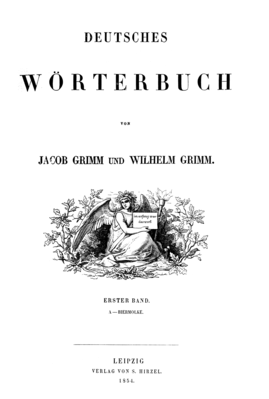 The title page of the first volume. | |
| Genre | |
| Author | Brothers Grimm |
| Original language | Deutsch |
| Date of writing | 1838-1957 (1st edition) |
| Date of first publication | 1854-1960 (1st edition) |
Content
- 1 History of creation
- 1.1 Background and predecessors
- 1.2 German Dictionary of the Brothers Grimm
- 2 notes
- 3 References
Creation History
Background and predecessors
The idea of creating an etymological dictionary of the German language arose in the academic environment long before the Brothers Grimm. Similar attempts have been repeatedly made since the 17th century not only by scientists, but also by writers. In 1691, Caspar Stieler ( German Kaspar Stieler ) published a small work, “The Family Tree of the German Language” ( German Der Teutschen Sprache Stammbaum ), a little later developed and supplemented by G. F. Leibniz in his “Preliminary Reflections on the Exercise and Improvement of the German Language” "( German Unvorgreiflichen Gedanken betreffend die Übung und Verbesserung der deutschen Sprache , 1698), who proposed a universal plan of the German etymological dictionary [1] . However, the ideas of Stieler and Leibniz were first embodied, however, not in their entirety, only half a century later. At the end of the 18th - beginning of the 19th centuries 3 major works of this kind were published:
- Johann Leonhard Frisch in 1741 published a two-volume German-Latin Dictionary ( German Teutsch-Leteinisches Wörterbuch ) with an extensive etymological commentary.
- Johann Christoph Adelung ( German: Johann Christoph Adelung ) in 1774-1786 published the classic five-volume work “The Experience of a Complete Grammar-Critical Dictionary of the High German Dialect” ( German: Versuch einen vollständigen grammatisch-kritischen Wörterbuchs der hochdeutschen in Mundart ) his many years of research in the history of the German language, including a general picture of the development of Germanic languages.
- Joachim-Heinrich Campe ( German: Joahim-Heinrich Campe ) in 1807-1811 published the Dictionary of the German Language in Five Volumes ( German: Wörterbuch der deutschen Sprache in 5 Bände ), where he also attempted to substantiate the norms of usage.
A feature of the three above-mentioned publications is their exceptional attention to the “normative element”: an attempt to develop the norms of “good” or “high German”. However, by the middle of the 19th century, the discrepancy between these attempts and the changing scientific requirements and standards of research work became apparent. All these works were narrative and descriptive in nature, in order to become truly scientific, they lacked a rigorous methodological basis [2] .
Grimm Brothers German Dictionary
In March 1838, the Leipzig book publishers Raimer and Gierzel, on the initiative of the Germanist Rudolf Friedrich Haupt, invited the Grimm brothers to prepare an etymological dictionary of the German language that meets modern scientific requirements [3] . The Grimm brothers set themselves not only a scientific, but also a high patriotic task: to enable a simple citizen to feel the unity of a nation, albeit divided into three hundred dwarf states, but united by language and culture [4] . This goal is also due to the choice of the method put by the Grimm brothers as the basis of the study, a comparative historical method that allowed us to consider the evolution of the language, its genetic connections in the context of the development of the society that was its carrier. So the comparative historical method was first consistently applied in the study of language, which testified to the birth of a new science - linguistics [5] . At the time of Jacob Grimm's death, which followed in 1863, sections with words in the letters A, B, C, E, composed by Jacob, and in the letter D, composed by William were completed . The section on the letter F Jacob did not have time to complete, focusing on the article "Frucht".
The next generation of philologists continued this work: the Prussian Academy of Sciences created a special working group of researchers, which completed work by 1960, that is, only 120 years after its beginning. Ironically, the dictionary was completed just a year before the construction of the Berlin Wall . Work on improving the dictionary (compiling comments and including marginalized people) continues at the Berlin Academy of Sciences and today a group of 13 researchers led by Professor C. Unger ( German Dr. Christian Unger ) is preparing an electronic version of the dictionary. To date, the dictionary has 33 volumes and about 600,000 dictionary definitions [6] .
Notes
- ↑ Lemmer M. Die Brüder Grimm. Leipzig, 1985.S. 58.
- ↑ Lemmer M. Idem. S. 59.
- ↑ Ginschel G. Der Junge Jacob Grimm. Berlin, 1989. S. 61 und ff.
- ↑ Grimm J. Vorwort 1 // Deutsches Wörterbuch. Bd. 1. Leipzig, 1854. S. XXXIV.
- ↑ Ginschel G. Idem. S. 282 und ff.
- ↑ Die Statistik zur Erste Ausgabe (BBAdW) .