Zlatka ( lat. Buprestidae ) is an extensive and large family of beetles , including more than 15,000 species with 450 genera, which are common on all continents and islands except the Arctic and Antarctic . In the European part of Russia there are about 180 species. The highest abundance and species diversity of goldfish is observed in countries with tropical and subtropical climates, where about 80% of known species are concentrated.
| Goldfish |
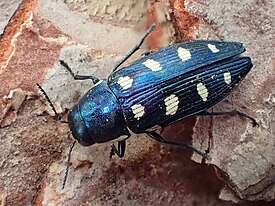
Buprestis octoguttata - type species of the type genus of the family - Buprestis |
| Scientific classification |
|---|
| No rank : | Bilateral symmetrical |
| Subtype : | Tracheo-breathing |
| Infraclass : | Winged insects |
| Treasure : | Fully Transformed Insects |
| Infrastructure : | Elateriform |
|
| International scientific name |
|---|
Buprestidae
Leach , 1815 |
| Type genus |
|---|
Buprestis |
| Subfamilies |
|---|
- Agrilinae Laporte, 1835
- Buprestinae Leach, 1815
- Chrysochroinae Laporte, 1835
- Galbellinae Reitter, 1911
- Julodinae Lacordaire, 1857
- † Parathyreinae Alexeev, 1993
- Polycestinae Lacordaire, 1857
|
|
Content
Adult morphology
Beetles of medium size from 2 to 100 mm in length. Mostly 10-30 mm. The color is very often shiny metallic, depending on the pigmentation and the fine structure of the surface. Often there is intraspecific variation in color, usually from copper-red, through green to blue-violet, sometimes this color is associated with the floor. Some parts of the body may be deprived of pigmentation, forming white spots, usually yellowing posthumously. This spotty color is characteristic of many species and is very variable within the species in terms of size and number of spots, but their location is constant. Very rarely, differences in this coloration serve as secondary sexual characteristics. In desert species, a wax coating is usual, abundantly covering punctured parts of the body, especially the sides of the abdomen and chest.
The integument is hard, often very thick and strong in large species. The surface of the body is from smooth mirror to densely punctured; points that usually carry a hair often form wrinkled structures. The body is elongated, flattened or cylindrical, the elytra narrowed at the end. Antennae short, serrate. The body shape is usually elongated, except for a few genera with a short body, usually more or less flattened, less often cylindrical, usually the upper side is flatter than the lower. The limbs are usually relatively short, strong, the antennae and legs are often extended, often can be pressed tightly to the body, but there are no recesses for their placement, except for the femurs on the hind coxae. Elytra usually cover the entire abdomen; wings are strong, short, not folding transversely. Characterized by fast, jerky movements and light, rapid flight.
The head is usually small, vertical, facing downward by the mouth organs. Antennae short, flattened, saw-shaped. Complicated eyes are highly developed, occupy a significant part of the head, in desert forms from different groups, usually the eyes are apart and occupy a more lateral position, which is an adaptation to the excess of light.
The legs are strong, usually short, rarely quite long, their hips without teeth. In many genera, the legs have secondary sexual characteristics, sometimes greatly changing their size and shape. The last segments of the male abdomen form a copulative apparatus , at rest pulled into the body, in the female, the last segments of the abdomen form a retractable soft ovipositor.
Larval morphology
Larvae are whitish, legless, flat, with a long and thin abdomen and an expanded prothorax, into which a small head is drawn. The body of the larvae is straight, the head is well developed. Prothorax sclerotized from above and below. The body in the section is flattened. They feed on bark and wood. Larvae of individual species living in the steppes and semi-deserts develop in the roots of grasses and shrubs, or in the soil (genus Julodis ). Most species of goldfish are characterized by adaptability to certain types of trees and shrubs.
