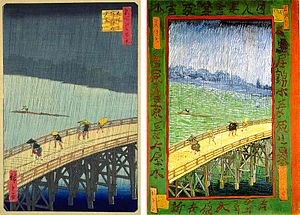
Japonism (from French Japonisme , ジ ャ ポ ニ ス ム ) is a direction in European art of the 19th century that developed under the influence of Japanese color woodcuts of ukiyo-e and artistic craftsmanship. Motives, technique and color presentation in Japanese art were reflected in the works of such masters as Mane , Gauguin , Van Gogh and other impressionists . Japaneseism also had a significant impact on Art Nouveau and on Cubism .
Content
History
After the discovery of Japan in 1855 for the outside world, Japanese goods and works of art are imported into Europe in large quantities and quickly find connoisseurs in it. During the World Exhibition in London and the World Exhibition in Paris , Japanese color engraving and various handicrafts (porcelain, kimono, screens, varnishes, etc.) were demonstrated.
In his garden in Giverny in 1883, Claude Monet builds a Japanese wooden bridge.
In the work of Vincent Van Gogh, the influence of Japanese graphics is huge. In his three paintings, Van Gogh copies Japanese color prints, or reproduces them in oil painting. These works demonstrate the artist’s desire to penetrate the secrets of Japanese art. Based on Japanese pen engraving, Van Gogh, having studied the 15-volume manga (collection of sketches) by Hokusai , developed his rhythmic “dot-dash” painting structure, which he later transferred to oil painting.
However, even before Van Gogh, the Impressionists were looking for the necessary means of image in Japanese color engraving. They adopted various forms of composition, for example, images of a separate object, as if “cut off” by the frame of a picture of an object; a figure standing in the foreground of the canvas; asymmetric construction of the picture; extremely deep in the distance diagonals; The "lattice" of the picture with the help of trees, etc. The series of color graphics of Hokusai (for example, 100 types of sacred Fuji ) were a model for the serial works of Cezanne and Monet.
In Britain, the most important representative of Japaneseism should be considered the American artist Whistler who lived and worked there. However, the latter, in his imitation of the Japanese style, went so far as to be sharply criticized by English art journalism, which ended in a lawsuit won by the artist.
It is also impossible to imagine the development of the art of Art Nouveau (Art Nouveau ), with its depiction of ornament, form of vases and utensils, without taking into account the influence of Japaneseism. Gustav Klimt , who collected a rich collection of Japanese kimonos and curtain fabrics from the theater, but reworked Japanese ornamental abstract patterns on textiles into compositions for his paintings.
Gallery
Gustav Jonge “The Japanese Fan” (c. 1865)
Franz Vergas "Lady in a Kimono Arranges Flowers in a Vase" (1847 - 1897)
Claude Monet "Madame Monet in a Kimono" (1876)
Van Gogh "The Courtesan" (1887)
Van Gogh "Portrait of Uncle Tanguy" (1887/88)
Georg Hendrick Breitner "The Girl in the Red Kimono" (1894)
Advertising kimono 1900-1910 years
Notes
Literature
- Broer, W. Epochen der Kunst / W. Broer, O. Kammerlohr. - München: Oldenbourg, 1994. - Bd. 4: 19. Jahrhundert: vom Klassizismus zu den Wegbereitern der Moderne. - 288 s. - ISBN 3-486-87524-8 .
Links
- Wikimedia Commons has media related to Japaneseism
- Zhukovskaya D. The influence of Japanese graphics on the work of Van Gogh . Historicus .