György Bernat Lukach of Szeged ( Hungarian Szegedi Lukács György Bernát [2] , present name György Bernat Löwinger , Hungarian Löwinger György Bernát ; during the years of his life in the USSR - George Osipovich Lukach ; April 3 , 1885 - June 4, 1971 Budapest , ibid.) - Hungarian philosopher - neo-Marxist of Jewish origin, literary critic . One of the key figures in the so-called Western Marxism , the founder of the Budapest school of Marxism . It is also considered one of the largest representatives of Marxist literary criticism [4] .
| György (Georg) Lukács | |
|---|---|
| György Lukács | |
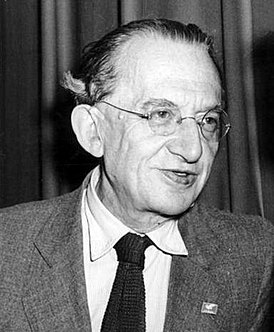 | |
| Birth name | |
| Date of Birth | April 13, 1885 |
| Place of Birth | Budapest , Hungary |
| Date of death | June 4, 1971 (86 years old) |
| Place of death | Budapest , Hungary |
| A country |  Austria-Hungary (1885-1918) Austria-Hungary (1885-1918)  Hungarian Democratic Republic (1918-1919) Hungarian Democratic Republic (1918-1919)  Hungarian Soviet Republic (1919) Hungarian Soviet Republic (1919)  First Austrian Republic (1919-1929) First Austrian Republic (1919-1929)  USSR (1929-1945) USSR (1929-1945)  The Republic of Hungary (1945-1949) The Republic of Hungary (1945-1949)  Hungarian People's Republic (1949-1971) Hungarian People's Republic (1949-1971) |
| Academic degree | Doctor of Philosophy (PhD) in Literature (1909), Doctor of Philosophy (1942) |
| Academic rank | corresponding member of the Hungarian Academy of Sciences (1948) Full Member of the Hungarian Academy of Sciences (1949) |
| Alma mater | |
| School / tradition | neo-Kantianism (in the early years), Western Marxism [1] , neo-Marxism [1] |
| Direction | Western philosophy |
| Period | 20th century philosophy |
| Core interests | political philosophy , social philosophy , aesthetics , philosophy of art |
| Significant ideas | reformation , class consciousness |
| Influenced | Hegel , Fichte , Kierkegaard , Marx |
| Influenced | Frankfurt School , Budapest School , Praxis School , Lucien Goldman , Bolivar Echeverria |
Lukacs creativity can be divided into two periods: the early, pre-Marxist from 1909 to 1930 and the Marxist period from 1930 to 1971 [5] . Lukacs created a system of Marxist aesthetics that denies the need for political control of artistic expression and defends humanistic principles [6] . He continued to develop the Marxist theory of the alienation of the individual in industrial society [6] .
Biography
Born into a wealthy Jewish family. His father, the banker Jozsef Löwinger [7] ( József Löwinger , from 1891 - Szegedi Lukács József , from 1901 (received hereditary nobility) - József von Lukács , 1855 - 1928 ), was originally from Szeged ; mother, Adele Wertheimer ( Wertheimer Adél , 1860 - 1917 ), was a native of Vienna . The spoken language in the family was German , as Lukac's mother never mastered Hungarian [8] [9] . In 1907, the family adopted Lutheranism . [ten]
After graduating from a Protestant gymnasium, he studied philosophy at the universities of Budapest, Berlin and Heidelberg . He graduated from the Law Department of the University of Budapest (1902-1906, defended himself at the University of Kolozhvar). Doctor of Philosophy in Literature (1909) for his thesis "Form of Drama", defended at the University of Budapest. From May 1912 to 1918 he lived in Heidelberg.
During his studies in Budapest, he became close to socialist circles, in particular, anarcho-syndicalist Erwin Szabo , who introduced Lukacs to the work of Georges Sorel , who at the beginning of the century was the ideological inspirer of many left and right movements. From 1904 to 1908 he took part in the theatrical circle, the efforts of which were staged by the greatest Hungarian and foreign playwrights (including works by Henryk Ibsen , Johan August Strindberg , Gerhart Hauptmann ) aimed at attracting workers to the theater. Being engaged in a circle, Lukac proved himself as a translator, director and playwright himself.
In the German period, became close to George Simmel , Max Weber , Ernst Bloch . Even then, he seemed a contemporary of considerable size - it is believed that Thomas Mann took it as a prototype for the image of the Catholic reactionary of Jewish origin Naphta in the “ Magic Mountain ” [11] . Part of Lukac's papers of this period were handed over to him in the safe of a German bank in 1917 and only in 1973 were unexpectedly discovered [12] .
In 1914 he married a Russian student Elena Andreevna Grabenko, a former Socialist-Revolutionary . A divorce ensued four years later: “Lukac’s family happiness with a Russian bomb thrower turned out to be short-lived. Elena will soon have an affair with an insane musician, a triangle will form ” [13] . In 1919 he married Gertrude Bortstieber (Jánossyné Bortstieber Gertrúd, d. 1963), with whom he lived for more than forty years.
After World War I, Lukacs left Weber’s circle and took an internationalist position. The October Revolution in Russia had a great influence on him. In 1918, under the influence of Bela Kuna, he joined the Communist Party of Hungary . In 1919 he was deputy, and. about. Commissar of Education of the Hungarian Soviet Republic , Commissioner of the Hungarian Red Army [14] .
After the fall of the republic, he emigrated to Vienna , where he lived in 1919-1929. He participated in the underground activities of the Communist Party of Hungary. Member of the CPV Central Committee in 1919-1921 and 1926-1930. In 1928 he was elected General Secretary of the CPV Central Committee, but was soon removed from this post by the Executive Committee of the Comintern for his right deviation [15] .
In 1929-1945 he lived in Moscow, with a break for 1931-1933, when he was in Germany. He joined the Union of Writers of the USSR . This is how Lukach certified the party secretary of the Institute of Marx and Engels at a meeting of the Commission of the Central Control Commission of the CPSU (B.) On the inspection and cleaning of workers and office workers of March 5, 1931, F. F. Kozlov:
“Got here recently. He hung around in one room, then in another. For a long time was idle. In general, he is a philosopher, but Deborin does not accept him as a philosopher, it is impossible to put him in a philosophical cabinet. They tried to organize a special cabinet of the “Philosophy of History”, in the end Lukac took refuge in the office of Marx, where Ryazanov was in charge. The political position is undoubtedly with the right moments <...> As a philosopher he is known as a deviator (!) ” [13] .
In the summer of 1941, he was arrested [16] [17] and briefly imprisoned.
In the winter of 1942 at the Institute of Philosophy of the Academy of Sciences of the USSR defended his work "Young Hegel" as a doctoral dissertation. Collaborated with the Communist Academy and the journal Literary critic . Mikhail Lifshits argued that in those years he had a great influence on the evolution of Lukac's views [18] .
During these years, Lukács wrote the works collected in the collection Literary Theories of the 19th Century and Marxism (1937), as well as Towards the History of Realism (1939), Historical Novel, Goethe and His Era, Young Hegel other.
Return to Hungary
In 1945, Doctor of Philosophy Lukacs returned to Hungary. He has been a member of the World Peace Council since 1950. In 1946-1958 he was a professor at the University of Budapest. Member of State meetings of the Hungary in 1949-1951 and 1953-1957. Member of the Hungarian Academy of Sciences (1949, corresponding member since 1948).
During the Hungarian uprising of 1956, he was Minister of Culture in the government of Imre Nagy , for which he was subsequently expelled from the party (reinstated in 1967). November 1-7, 1956, member of the Interim Leadership of the All-Russian Popular Front After the suppression of the uprising, he was hiding in the embassy of Yugoslavia, was lured and interned in Romania, and returned to Hungary in April 1957.
In the 1950s, Lukacz continued his work in the field of Marxist aesthetics , a systematic exposition of which is given in the book “The Specificity of the Aesthetic” (1963). The first two volumes of this work contain an analysis of the principles of realism in art from the perspective of the theory of reflection. These views of Lukac caused criticism from the Frankfurt School , Roger Garaudy and others [19] .
At the beginning of the 1960s, A. Solzhenitsyn was highly praised as the author of works that “crushed the bastions of Stalinism” [20] .
Lukacs died in Budapest [21] after several months of suffering from lung cancer [22] .
Budapest School
Although at the end of his life Lukacs had many students who are sometimes united under the general term “Budapest School” ( Agnes Heller , György Markush , Ferenc Feher , Mihai Varga), and they continued the philosophical search for a teacher in line with unorthodox Marxism, but after Lukac’s death the key representatives of the Budapest school renounced not only him, but, in general, Marxist ideas. Most of them, deprived of the opportunity to teach in Hungary, emigrated to Austria, where they finally took up the position of social liberalism . Agnes Heller , who remained loyal to the left idea longer than others, over the past decade has moved to neoliberalism and neoconservatism [23] . However, the students of Lukacs, Istvan Mesaros and the late Miklos Kraššо , who fled to Britain even after the suppression of the 1956 uprising, remained left-wing radical Marxists.
Prizes and Awards
- Koshut Prize (1948, 1955).
- The jubilee medal of the USSR to commemorate the centenary of the birth of V. I. Lenin
- Goethe Prize (1970)
Major works
- Soul and Form (1910)
- The history of the development of modern drama (1912)
- Theory of the novel (1920)
- History and class consciousness (1923) - where “highlighted the thesis of integrity. He insisted that the decisive difference between Marxism and bourgeois thought was not that in explaining the historical process the main role is given to economic motives ... The most important is the category of integrity. It is the essence of the method. Its revolutionary beginning ” [24] .
- Lenin: a sketch of the relationship of his ideas (1924)
- 19th Century Literary Theories and Marxism (1937)
- To the history of realism (1939)
- Historical novel
- Goethe and his era
- Young Hegel
- The specifics of the aesthetic (1963)
- The Destruction of the Mind (1954)
Books in Russian
- Literary theories of the XIX century and Marxism. M., 1937.
- To the history of realism. M., 1939.
- The struggle of humanism and barbarism. Tashkent: State ed. UzSSR, 1943.
- The originality of the aesthetic. M .: Progress, 1t.-1985, 2t.-1986, 3t.-1986, 4t.-1987.
- Young Hegel and the problems of capitalist society. M .: Nauka, 1987.
- Lukach D. Lenin. A research essay on the relationship of his ideas / Avt.vstup.stay S.N. Zemlyanoy. - M .: Intern. Relations, 1990. - 141 p. - ISBN 5-7133-0356-X .
- Lukac, D. Letter from Alberto Carocci (inaccessible link from 05/26/2013 [2297 days] - history , copy ) // Philosophical Sciences. - 1989. - No. 6. - S.102-104
- Lukach, D. Regarding the debate between China and the Soviet Union (inaccessible link from 05/26/2013 [2297 days] - history , copy ) // Philosophical Sciences. - 1989. - No. 6. - S.105-111
- Lukach, D. The democratic alternative to Stalinism (inaccessible link from 05/26/2013 [2297 days] - history , copy ) // Communist. - 1990. - No. 14. - S. 34-46
- Lukach D. Ontology of social being. Prolegomens (inaccessible link from 05/26/2013 [2297 days] - history , copy ) / D. Lukacs; Per. with him. I.N. Burova, M.A. Zhurinskaya; Total ed. and entry. Art. I.S. Narsky, M.A. Hevesi . M .: Progress, 1991.410 s.
- History and class consciousness. Studies on Marxist dialectics. M .: Logos-Altera, 2003.
- Lukacs, G. Bourgeois and l'art pour l'art: Theodore Storm ( PDF ) // Logos. - 2006. - No. 1. - S. 116-137.
- Political texts. M .: Three squares, 2006. ISBN 5-94607-067-3
- Lukach, D. Tailing and Dialectics // Problems of Political Philosophy: Translations, Comments, Controversy. Rostov-on-Don: Rostizdat, 2012.
About Lukache
N. A. Berdyaev in his book “The Origins and Meaning of Russian Communism” (M., 1990, p. 82, 87) called Lukacs [25] , “the most intelligent of the communist writers”.
M. A. Lifshits :
“Lukac is a mass of philosophical words and turns, but there is no control over the main idea, which God knows where goes and is held only by common places, often memories of“ diamate “” [26] .
Notes
- ↑ 1 2 Zemlyanoy S.N. http://ecsocman.edu.ru/data/2010/11/30/1214822650/Lukas1.pdf S. 8.
- ↑ In many sources, especially in the West, it is transmitted in German form Georg Bernhard Lukach von Szegedin , German. Georg Bernhard Lukács von Szegedin
- ↑ From the transcript of the meeting of the general meeting of full-time employees and contractors of the Institute of Philosophy of the Academy of Sciences of the USSR (May 17, 1937)
- ↑ A. S. Sticalin. Gyorgy Lukach is a thinker and politician. M., 2001.S. 16.
- ↑ NFE, 2010 .
- ↑ 1 2 Gyorgy Lukacs | Hungarian philosopher | Britannica.com
- ↑ George's father made a phenomenal career as a financier and a prominent politician backstage: in 1906 he became director of the Hungarian Credit Bank, the largest in Hungary; in the 1910s was close to Prime Minister I. Tisse, in the 1920s, under Horthy, who sentenced his communist son to death, he retained his influence in the financial and political life of Hungary - in fact, until his death in 1928 [1] .
- ↑ Judith Marcus and Zoltán Tarr. Preface to Georg Lukács: theory, culture, and politics, p. 123
- ↑ The “Lukács Effect” in Twentieth-Century Hungarian Literature and Film Archived June 27, 2010 by Wayback Machine : The Wertheimers were one of the wealthiest Jewish families in the Austro-Hungarian Empire.
- ↑ Georg Lukács sobre la cuestión judía (unavailable link) . Date of treatment January 18, 2012. Archived on May 6, 2011.
- ↑ Lukasch returns . Independent newspaper (February 19, 2004). Date of treatment August 13, 2010. Archived on February 13, 2012.
- ↑ “In 1973, one of the employees of the Heidelberg German Bank caught the eye of a small book by Fritz Raddac, published in Hamburg (1972) and dedicated to Georg Lukacs. An unexpected thought occurred to the bank clerk: were they the hero of the Raddats book and the client unknown to bank staff, Georg von Lukacs, who on November 7, 1917 put a bulky suitcase in the safe of a German bank, but didn’t demand it for more than half a century? are these Lukacs the same person? After comparing the biographical data of both Lukacs, the corresponding service of the German Bank in Heidelberg came to an unambiguous conclusion: yes, this is the same person. Information in the media about this find and its owner, who had already been resting in the grave for a year and a half, became one of the sensations in the German press. There were valuable sources in the suitcase, shedding new light on the biography and work of young Lukach in 1902-1917: 1,600 letters, notebooks, diary and manuscripts of works that were not completed by the philosopher ... " http://magazines.russ.ru/voplit /2009/1/ze3.html
- ↑ 1 2 www.russ.ru Sergey Zemlyanoy. Soviet period in the biography of Derd Lukac
- ↑ B.N. Bessonov, I.S. Narsky. Gyorgy Lukach. M., Thought, 1989.S. 9.
- ↑ Michael Löwy. Georg Lukács - from Romanticism to Bolshevism . NLB, 1979. P. 203.
- ↑ “Sergeant Pugachev, an interrogator of the NKGB interrogating Lukach, was puzzled by the circumstances of the philosopher’s entry into the Communist Party of Hungary in 1918 - a week after he published the article“ Bolshevism as a moral problem ”in a bourgeois magazine, where, according to his own wording for questioning,“ denied violence in general, thereby objectively denied the violent seizure of power by the proletariat "" The Soviet period in the biography of Derd Lukach .
- ↑ NKGB investigators interrogating Lukacs explained to him: “In vain are you trying to impersonate a communist, Marxist. In theory, you were an idealist, and in the field of practice you were an opportunist, a factionalist. And simply - you were in the service of foreign intelligence - a spy. ”The Soviet period in the biography of Derd Lukach .
- ↑ “It can be said that I spoiled Lukacs, but that his rejection of the ideas of“ History and class consciousness ”etc. was connected with our acquaintance, that in the 30s another Lukacs arose, this cannot be denied. ” Cit. by: M. Lifshits. What is a classic? M., 2004. ISBN 9785980510183 . S. 161.
- ↑ https://www.google.com/search?tbm=bks&q=%22 Lukac +++++ recognition +and + development + im + theories + reflections % 22
- ↑ R. N. Blum and modern left theory | Igor Rosenfeld (inaccessible link)
- ↑ Georg Lukacs (person) @ Everything2.com
- ↑ Internationale Georg-Lukács-Gesellschaft eV
- ↑ Tormey, Simon (1998) From "Rational Utopia" to "Will-to-Utopia". On the "Post-modern" Turn in the Recent Work of Agnes Heller. Daimon, 17. Pp. 133-149.
- ↑ RETURN
- ↑ "German Hungarian"
- ↑ Lukach (inaccessible link) . Date of treatment March 12, 2011. Archived February 12, 2012.
Literature
- Conversations on the Lubyanka. Investigation of Derdy Lukacs. Materials for the biography. / Stykalin A., Sereda V. (comp.) - Institute of Slavic Studies of the Russian Academy of Sciences, 2001. - 268 p. - ISBN 5-7576-0090-X
- Dmitriev A.N. Marxism without the proletariat: Georg Lukacs and the early Frankfurt School (1920-1930s). - SPb. ; M .: Publishing House of the European University in St. Petersburg ; Summer Garden , 2004 .-- 528 p. - (Proceedings of the Faculty of Political Sciences and Sociology; Issue 10). excerpts
- Zizek S. G. Lukach - the philosopher of Leninism // History and class consciousness. Studies on Marxist dialectics. M .: Logos-Altera, 2003. ( short version (unavailable link from 05/26/2013 [2297 days] - history , copy ) )
- Zemlyanoy S. N. Spiritual searches of the young Lukach ( PDF ) // Logos . - 2006. - No. 1. - S. 109-115.
- Ishitsuka S. The concept of nature in Lukacs and Husserl. Translation by V.V. Bibikhin . // Philosophy and man. M., 1993. Part II. S.224-227.
- Lukac / MA Heveshi // New Philosophical Encyclopedia : in 4 volumes / before. scientific ed. Council V. S. Styopin . - 2nd ed., Rev. and add. - M .: Thought , 2010 .-- 2816 p.
- Lukach / Zemlyanoy S.N. // Lomonosov - Manizer. - M .: Big Russian Encyclopedia, 2011. - P. 118-119. - (The Big Russian Encyclopedia : [in 35 vols.] / Ch. Ed. Yu. S. Osipov ; 2004—2017, vol. 18). - ISBN 978-5-85270-351-4 .
- Oiserman T.I. Gyorgy Lukach as a researcher of Hegel's philosophy // Problems of Philosophy . No. 11. 1985.
- S. Kiss. “History and Class Consciousness” by D. Lukacs: The Theory of “Reification” and Romantic Anti-Capitalism. // Questions of philosophy . 1993. No. 4.
Links
- Archive of the works of Gyorgy Lukacs and Mikhail Lifshits
- György Lukáč in the Wiki sections of the RKSM Internet portal (b)
- Lukacs, György - article from the Great Soviet Encyclopedia .