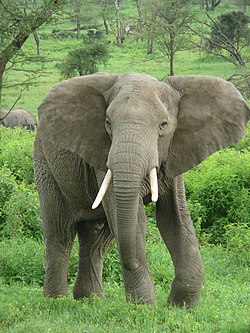
African elephants ( lat. Loxodonta ) - a genus of African mammals of the proboscis order. Presumably includes two modern species: the savannah elephant ( Loxodonta africana (L. Blumenbach, 1797 ) ) and the forest elephant ( Loxodonta cyclotis (Paul Matschie, 1900 ) ). Recent studies of the nuclear DNA of African elephants suggest that these two species of the genus Loxodonta formed 1.9 and 6 million years ago. Until recently, they were considered subspecies ( Loxodonta africana africana and L. africana cyclotis ).
| African elephants |

Forest elephant in the Nuabale Ndoki National Park in Congo |
| Scientific classification |
|---|
| No rank : | Bilateral symmetrical |
|
| International scientific name |
|---|
Loxodonta (Anon., 1827) |
| Kinds |
|---|
see text |
| Area |
|---|

|
|
A change in the systematics of the group will occur if the findings of the researchers are approved by the African Elephant Specialist Group (AfESG) [1] . According to paleogenetics, the African savannah and forest elephants separated about 5–2 million years ago. For the last 500 thousand years they lived in isolation from each other and did not interbreed [2] [3] .
The isolation of the third species, the East African elephant , is in question.
According to recent estimates, about 500-600 thousand African elephants remain in the wild [4] , of which a quarter are forest elephants [5] .
Elephants can be attacked by land leeches. To get rid of a sucked leech, an elephant, taking a stick with his trunk, scratches it over his body with it. Even if the elephant cannot reach the leech with a stick, the other elephant also helps him to free himself from bloodsuckers with a stick [6] .