Kurland Province ( 1796 - 1920 ) is one of the three Baltic provinces of the Russian Empire . The provincial city is Mitava (now Jelgava ).
| Province of the Russian Empire | |||||
| Courland province | |||||
|---|---|---|---|---|---|
| |||||
| A country |  Russian empire Russian empire | ||||
| Adm. center | Mitawa | ||||
| History and Geography | |||||
| Date of formation | |||||
| Date of Abolition | |||||
| Area | 27,290 km² | ||||
| Population | |||||
| Population | 674 034 people | ||||
 | |||||
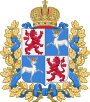
It was formed on the territory of Courland and Semigalia after the accession of the duchy to Russia during the third partition of Poland ( 1795 ). At present, most of the territory is part of Latvia , insignificant parts are also part of Lithuania (since 1921 - the city of Polangen and the village of Sventoji, initially were the only access to the sea).
Content
- 1 Geographical location
- 2 Administrative divisions
- 3 Governorate
- 3.1 Governors
- 3.2 Provincial leaders of the nobility
- 3.3 Lieutenant Governors
- 4 Court and police
- 5 population
- 5.1 National composition
- 6 Economics
- 7 See also
- 8 Notes
- 9 References
Geographical position
Between 55 ° 41 'and 57 ° 45½' s. w. It bordered from the north with the Baltic Sea and the Gulf of Riga , from the north-east and east of the Gulf of Riga, the Livonia and Vitebsk provinces , from the south of the Vilnius and Coven provinces and Prussia , from the west - the Baltic Sea . Of its total border - 1260 miles (1344 km) - the sea takes 320 miles (341 km). The border with Prussia is only 6 miles (6.4 km) long and devoid of natural boundaries.
The space is 23 977 square miles (27 290 km²).
Administrative Division
Since 1819 it was divided into 10 counties : Doblensky, Bausky, Tukkumsky, Talsensky, Vindavsky, Gazenpotsky, Grobinsky, Goldinginsky, Friedrichstadt and Illukstsky. Since 1888, in police terms, the Bauska district was attached to Doblensky, and the Gazenpot district - to Grobinsky. There are two district courts, in Mitau and Libau . Five judicial world districts, 22 world sections. In 1894 there were only 24,793 inhabited places in the Courland province; 11 of them are cities, 15 towns (on landlord and state-owned land), 9 villages and 24,758 small towns ( farms ). Of the rural settlements, only 9 fit the type of Russian villages, making up continuous settlements; usually villages consist of 1-4 yards.
| No. | County | County town | Area, verst ² | Population [1] , people ( 1897 ) |
|---|---|---|---|---|
| one | Bausky | Bauska (6532 people) | 1843.0 | 50 547 |
| 2 | Windavian | Vindava (6134 people) | 2756.0 | 48,275 |
| 3 | Gazenpotsky | Gazenpot (3824 people) | 2202.0 | 53,209 |
| four | Goldingen | Goldingen (8671 people) | 2879.0 | 66 335 |
| 5 | Grobinsky | Grobin (1722 people) | 4117.2 | 110 878 |
| 6 | Illuxt | Illuxt (2864 people) | 1976.8 | 66,461 |
| 7 | Mitavsky (Doblensky) | Mitawa (30 100 people) | 2501.8 | 101 310 |
| 8 | Talsensky | Talsen (4319 people) | 2768.9 | 61 148 |
| 9 | Tukkum | Tukkum (7542 people) | 1988,2 | 51 076 |
| 10 | Friedrichstadt | Friedrichstadt (5,223 people) | 3079.1 | 64,795 |
The main cities and towns (except for the provincial and district cities): Libava , Jakobstadt , Pilten , Polangen , Mane , Sasmacken and Kandava .
Community land was not, as well as mutual responsibility . Each estate represented a separate farm, with enough land (25-50 acres); in most cases, the sections are spread out among themselves. These sites were almost never crushed. The lands of each plot were usually located around the estate.
Representative bodies of volosts are volost gatherings ( gemeindeversammlung ), consisting of all taxpayers of volosts, or electoral gatherings elected by taxpayers of volosts, executive bodies of volosts are volost foremen [2] .
Governorate
The Courland province was ruled by a governor appointed by the emperor. The representative body of local self-government is the Kurland Landtag ( Kurländischer Landtag ), which consisted of parish representatives ( Kirchspielsbevollmächtigter , Konvokant ) who were elected by the Sejm parishes ( Landtagskirchspiel , Parochie ) by parish assemblies ( Kirchspielsversammlung ), where all the parishes could participate Marshal of the Sejm deputies ( Landbotenmarschall ), the executive body is the noble committee led by the Land Commissioner ( Landesbevollmächtige ).
Governors
| FULL NAME. | Title, rank, rank | Post time |
|---|---|---|
| Lamsdorf Matvey Ivanovich (Gustav Matias) | major general | |
| Driesen Karl-Wilhelm Karlovich | secret adviser | |
| Arsenyev Nikolay Ivanovich | Valid State Counselor | |
| Gogger Wilhelm Danilovich | Baron, Actual State Councilor | |
| Sivers Fedor Fedorovich | Valid State Counselor | |
| Stanecke Emanuel Yakovlevich | Valid State Counselor | |
| Gan Pavel Vasilievich | chamber junker (current state adviser) | |
| Brevern Christopher Ivanovich | secret adviser | |
| Valuev Peter Alexandrovich | chamberlain, current state adviser | |
| Brevern Johann Hristoforovich | Chamberlain, Privy Advisor | |
| Lilienfeld-Toal Pavel Fedorovich | secret adviser | |
| Pashchenko Konstantin Ivanovich | Valid State Counselor | |
| Sipyagin Dmitry Sergeevich | chamberlain, current state adviser | |
| Sverbeev Dmitry Dmitrievich | chamberlain, current state adviser | |
| Knyazev Leonid Mikhailovich | secret adviser | |
| Nabokov Sergey Dmitrievich | Valid State Counselor | |
| Gendrikov Peter Vasilievich | Count, College Counselor |
Provincial leaders of the nobility
| FULL NAME. | Title, rank, rank | Post time |
|---|---|---|
| Mirbach Ebergard Khristoforovich | baron | |
| Korf Karl Nikolaevich | baron | |
| Medem Karl | graph | |
| Grotgus Dietrich-Karl | baron | |
| Gan Fedor | baron | |
| Medem Peter Ivanovich | Count, Chamberlain | |
| Rekke Karl Matveevich | baron | |
| Keyserling Hugo Karlovich | Count, Chamberlain | |
| Manteuffel Carl | baron | |
| Gaking Alphonse Petrovich | Baron, Actual State Councilor | |
| Keyserling Hugo Karlovich | Earl, with the rank of Hoffmeister, real state adviser | |
| Liven Georgy Andreevich | prince, titular adviser | |
| Reiter Vladimir Evstafievich | Count, Baron, Jägermeister |
Vice Governors
| FULL NAME. | Title, rank, rank | Post time |
|---|---|---|
| Gurko-Romeiko Joseph Iosifovich | Valid State Counselor | |
| Arsenyev Nikolay Ivanovich | State Councillor | |
| Brieskorn Yakov Maximilianovich | Valid State Counselor | |
| Stanecke Emanuel Yakovlevich | State Councillor | |
| Battle Martin Yakovlevich | State Councillor | |
| Maidel Georgy Fedorovich | college adviser (current state adviser) | |
| Beklemishev Alexander Petrovich | Valid State Counselor | |
| Cuba Julius Leontievich | State Councillor | |
| Gaking Alphonse Petrovich | Baron, Privy Advisor | |
| Manzhos Alexander Alekseevich | Valid State Counselor | |
| Dunin-Barkovsky Joseph Yakovlevich | State Councillor | |
| Muravyov Alexander Valerianovich | State adviser, camera junker | |
| Starynkevich Konstantin Sokratovich | Colonel | |
| Korostovets Izmail Vladimirovich | lieutenant colonel (colonel) | |
| Kropotkin Nikolay Dmitrievich | Prince, College Counselor (State Counselor) | |
| Kanshin Boris Anatolyevich | State Councillor | |
| Khitrovo Boris Nikolaevich | college counselor |
Court and Police
The highest court is the Courland Higher Court of Appeal ( Kurländisches Oberhofgericht ), the courts of appeal are the highest Hauptmann Courts ( Oberhauptmannsgericht ), the courts of first instance are the Hauptmann Courts ( Haupmannsgericht ), for the peasantry - the district courts are lower volost courts ( Gemeindegericht ) [3] .
Population
| Year | Total | Men | Women |
|---|---|---|---|
| 1857 | 555 003 | 271 902 | 283 101 |
| 1895 | 736 885 | 358 917 | 377 968 |
| 1897 | 674,034 | 326 252 | 347,782 |
In 1894, 6511 hereditary nobles lived in Courland Province; 3,908 personal nobles; 610 clergy, merchants and honorary citizens; 85 830 bourgeois and workshop; 622,876 peasants; 14,382 military estates; 2,315 foreigners; 453 others.
In the same year there were 16,875 Orthodox , 583,480 Lutherans , 68,722 Catholics , 55,470 Jews , 6834 schismatics , 4592 Baptists , 582 reformers, 330 others.
National composition
| Nationality | 1852 | 1860 | 1867 | 1897 |
|---|---|---|---|---|
| Zhmudiny | 2000 | |||
| Lithuanians | 8000 | 8000 | 10,000 | 17,000 |
| Latvians | 402,000 | 435,000 | 460,000 | 506,000 |
| Do you | 2000 | 2000 | 2541 | |
| Jews | 24,000 | 28,000 | 33,707 | 38,000 |
| Russians | 15,000 | 12 222 | 26,000 | |
| Poles | 13,000 | 3000 | 9029 | 20,000 |
| Belarusians | 700 | 4115 | 12,000 | |
| Germans | 39,000 | 40,000 | 43,518 | 51,000 |
The largest number of Great Russians lived in the counties of Illuksk and Doblen, the Belarusians settled exclusively in Illuks, and the Poles mainly in Illuks and Friedrichstadts and partly in Bauska and Grobinsky, the Lithuanians in Illuks and Grobinsky, Zhmudins (and its Rittikh) and in the cities of Mitava, Bauska and others. Latvians are distributed fairly evenly throughout the province; most of them are in Doblensky County, all less in Illukstsky. Livs live exclusively in Vindava County; Germans and Jews - everywhere.
In 1913 the population of the province amounted to 783.1 thousand people.
National composition in 1897 [4] :
| County | Latvians | Germans | the Jews | Russians | Poles | Lithuanians (including Zhmudinov ) | Belarusians |
|---|---|---|---|---|---|---|---|
| Province in general | 75.1% | 7.6% | 5.6% | 3.8% | 2.9% | 2.7% | 1.8% |
| Bausky | 87.4% | 6.0% | 4.3% | ... | ... | 1.1% | ... |
| Windavian | 85.2% | 7.9% | 2.9% | ... | ... | 2.8% | ... |
| Gazenpotsky | 90.4% | 5.4% | 2.5% | ... | ... | ... | ... |
| Goldingen | 86.6% | 8.5% | 4.0% | ... | ... | ... | ... |
| Grobinsky | 58.5% | 15.3% | 6.5% | 6.9% | 5.8% | 5.5% | ... |
| Doblensky | 76.8% | 11.0% | 4.0% | 4.8% | ... | 1.2% | ... |
| Illuxt | 28.5% | 1.6% | 9.6% | 15.2% | 17.1% | 10.5% | 17.3% |
| Talsensky | 88.8% | 4.2% | 6.3% | ... | ... | ... | ... |
| Tukkum | 89.0% | 4.3% | 5.3% | ... | ... | ... | ... |
| Friedrichstadt | 83.0% | 2.8% | 9.3% | 2.6% | ... | 1.2% | ... |
Economics
In the 19th century, the province was predominantly agricultural. In 1817, serfdom was abolished in the province, the peasants received personal freedom, but all the land remained in the property of the landowners . In 1863, peasants received the right to buy land in personal property, a layer of kulaks began to form. Fists , along with the German landowners, are the main suppliers of commodity agricultural products. The main crops grown in the province are rye , wheat , barley , peas , oats , potatoes . Gardening and horticulture are developed.
The province industry is predominantly manufacturing. On the territory of the province in 1912 there were about 200 factories and plants (flour mills, vodka, sawmills, leather, brick, flax spinning and others) and about 500 artisanal enterprises.
Railway construction developed on the territory of the province. In 1867, the Riga - Mitava railway was built, in 1871-76 a section of the Libavo-Romenskaya railway. In total, the length of the railway lines of the province amounted to more than 560 miles.
Education in the province was better than the national average. In the 1910s, the province had 8 secondary educational institutions (over 3 thousand students), 13 special secondary (over 460 students), 790 lower (36.9 thousand students). In the province in 1913 there were 33 hospitals with 1300 beds [5] .
See also
- Courland
- Kurlandskaya street (St. Petersburg)
Notes
- ↑ First General Census of the Russian Empire in 1897. Courland province
- ↑ § 61. Local self-government of the Baltic provinces
- ↑ Baltic Management System
- ↑ First General Census of the Russian Empire in 1897
- ↑ Encyclopedia "History of Russia from Ancient Times to 1917," Volume 3, p. 227, Moscow, 2000
Links
- ESBE: Courland Province
- Materials for geography and statistics of Russia, collected by officers of the General Staff. Courland province. Type of. Department of the General Staff. St. Petersburg: 1862-602 p.
- Library Tsarskoye Selo, books on the history of the Courland province (Commemorative books, maps and plans), PDF
- Kurlandia.ru
- Map of the Courland Province from the Atlas of A. A. Ilyin of 1876 (viewed on the Google engine on runivers.ru)
- Bilbasov V.A. Accession of Courland // Russian Antiquity 1895. - T. 83. - No. 1. - P. 3-55.
- Heyking K.-G. background. Memoirs of Senator Baron Karl Heyking. / Per. with it., publ. and foreword. A. A. Girsa // Russian Antiquity , 1897 - T. 91. - No. 8. - S. 291-308; No. 9. - S. 517-537; T. 92. - No. 10. - S. 121-138; No. 11. - S. 405-424; No. 12. - S. 591-614.]
- Schebalsky P. Question of the Duchy of Courland under Peter III // Russian Archive, 1866. - Issue. 3. - St. 284-304.
- Province on a three-verst military topographic map of European Russia. (automated viewing with modern maps and satellite images)