Hummingbird mango [1] ( lat. Anthracothorax ) - a genus of birds of the hummingbird family. Birds 110-120 mm long have a wide rounded tail , slightly curved beak with plumage at its base and partially exposed nasal coverings. They live in the territory from southern Mexico to Brazil , Bolivia and Peru , as well as on the Antilles (except for the island of Cuba ). Unlike most hummingbirds, they build completely open nests. Like the rest of the family, they lay two white eggs and are chicks .
| Hummingbird mango | |||||||||||||||||||||||||||||||||||
|---|---|---|---|---|---|---|---|---|---|---|---|---|---|---|---|---|---|---|---|---|---|---|---|---|---|---|---|---|---|---|---|---|---|---|---|
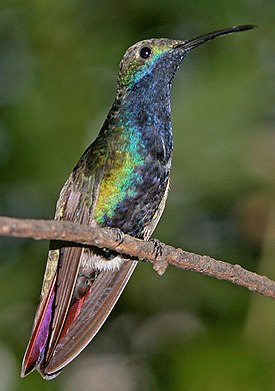 Black- necked mango | |||||||||||||||||||||||||||||||||||
| Scientific classification | |||||||||||||||||||||||||||||||||||
| |||||||||||||||||||||||||||||||||||
| International scientific name | |||||||||||||||||||||||||||||||||||
Anthracothorax F. Boie , 1831 | |||||||||||||||||||||||||||||||||||
The genus Anthracothorax was isolated in 1831 by the German zoologist Friedrich Boyer . It is part of the vast subfamily of typical hummingbirds (Trochilinae) and, according to the classification of the International Union of Ornithologists (IOC), includes seven species .
Content
- 1 Description
- 1.1 Nutrition
- 1.2 Reproduction
- 2 Distribution
- 3 Systematics
- 4 notes
- 5 Links
Description
Mangoes are rather large hummingbirds with a total length of about 110-120 mm with a wide rounded tail [2] .
The bird above is painted in metal, bronze or olive green. The plumage from below differs in males and females. Adult males are painted in metallic green color, in the center there is a black vertical strip, the color of which on the sides changes to greenish-blue or violet-red (around the neck). In this case, a black stripe may be absent, in this case the lower part of the birds is colored in greenish and golden-bronze colors, the chest is black. Adult females usually have a whitish plumage from below, while a black, green or bluish central stripe may be present. The exception is hummingbird mango and emerald mango, in which the color of males and females is the same [2] .
The tail length of birds is more than half the length of the wing . The tail is slightly rounded with wide, dense rounded steering feathers. The main colors are chestnut, glossy, with a purple or purple hue; emerald mangoes are bright bluish-green or steel green. The tail tail feathers may be colored differently. The tips of the feathers are black. The wings of the bird are less than three times longer than the beak, the external feather is the longest [2] .
The beak is thick, rather wide, flattened at the base and bent, its length exceeds the size of the head. The beak is round, with small notches along the cutting edge. A wide transverse median groove runs along the subbeak [2] . At the base of the beak there are feathers, and the nasal coverings are partially exposed [3] .
The external fingers of the bird are almost the same length (the external can be slightly longer than the internal), slightly shorter than the middle finger. Hind finger shorter than front, claws relatively small [2] .
Nutrition
Like all hummingbirds, mangoes feed on nectar of flowering plants and insects [4] .
Reproduction
All duties associated with reproduction, as with other hummingbirds, are performed by the female. Unlike most hummingbirds, mangoes build completely open nests . Birds lay two eggs , which is typical for all hummingbirds without exception. Hummingbirds usually have the ability to produce two broods per year, but re-lay eggs only if something happened in the early stages of the first laying [5] . Dominican [6] , black-necked [7] and green-necked [8] mangoes can do two masonry.
Chicks are born naked, blind and completely helpless , but they do not squeak (so as not to attract the attention of predators to a fully open nest) [5] . The plumage of young hummingbirds is similar to the plumage of adult females, but is dimmer [9] . The very next year, members of the family become sexually mature [10] . In the wild, the maximum age of hummingbirds is on average 5–8 years; in captivity, birds live several years longer [5] .
Distribution
The range of mangoes extends from southern Mexico and Cayenne to eastern Brazil , Bolivia, and Peru , including the Greater Antilles of Jamaica , Haiti , Puerto Rico, and St. Thomas. [2] The most common member of the genus is the black-necked mango, which lives in the territory from Panama to northeast Argentina , as well as on the island of Trinidad [7] . In continental Central America, besides it, there are hummingbirds Prevost and veragan mango, which for a long time was considered a subspecies of the latter, while the range of veragan mango is very limited and for a long time this species was considered endemic to Panama. Recently, scientists have noted the presence of a bird on the southwestern coast of Costa Rica ; in 2009, Veragan mango was officially included in the list of birds of this country [11] . Given that hummingbirds are widely distributed in the Antilles , scientists pay attention to the fact that this genus is not represented in Cuba , despite the relative proximity of the island to the continent. In this case, the hummingbird Prevost lives on the island of Cozumel 235 km from Cuba and can migrate across the ocean at a distance of more than 16 km [12] .
Mostly live in open lowlands. Dominican and emerald mangoes on the island of Puerto Rico divide the territory, choosing for themselves a different habitat [13] . Dominican mango lives mainly in lowlands, gardens, and forest edges, usually distributed in coastal areas with fairly rare trees [6] , while emerald mango is rarely found on the coast and prefers forests above sea level [14] .
The hummingbird family, including the hummingbird mango, is included in the CITES II application of the Convention on the International Trade in Endangered Species of Wild Fauna and Flora , that is, their trade is controlled [15] . All members of the genus belong to the species causing the least concern [16] .
Systematics
The genus Anthracothorax (from the Greek. Anthrax - “coal, black” and the Greek. Thorax - “chest” [17] ) was isolated in 1831 by the German zoologist Friedrich Boyer [18] (1789-1870). It is part of the vast subfamily of typical hummingbirds (Trochilinae) and the unofficial cluster “saber-wings and mangoes” ( English sabrewing-and-mango ) [12] .
In the traditional classification supported by the works of Rodolf Meyer de Schauency (1970), Charles Sibley and (1990), Karl-Ludwig Schuchmann (Schuchmann K.-L.) (1999), ( 2003), this genus is adjacent to the hummingbird ( Colibri ). Studies by specialists in the laboratory of Jim McGwire (2014) showed a close relationship between the genera of hummingbirds and e ( Eulampis ), in particular, the emerald mango and are closer to each other than to other representatives of both genera. The proximity of labor is confirmed by phenotypic similarity, as well as biogeography. Thus, Anthracothorax is a paraphyletic group in relation to Eulampis . McGwyer separated these two genera into a separate group (Anthracothorax group), and in 2015 and others suggested merging them into one genus, leaving the main name to Anthracothorax , since both genera are described by one scientist, but the first by two pages before. Schuhmann in 1999 proposed to add the only representative of the saberblood ( Avocettula ) genus to the hummingbird - the ( Avocettula recurvirostris ), but McGweire and colleagues in 2014 showed that for this the combined genus should also include ( Chrysolampis ), closest to Crested Hummingbird ( Orthorhynchus ) [12] .
The distribution of mangoes within the genus remains an open question. The widespread belief that the hummingbird species is sister to other members of the genus means that all hummingbirds came from the Antilles and settled in Central and South America as a result of the migration of the ancestor of the nigricollis group. In 1978, American ornithologist James Bond suggested that the Dominican mango is akin to the hummingbird of Prevost, finding this connection unusual for taxa that are highly separated by distances. According to the assumption of Remsen and his colleagues, the Dominican mango is sisterly to the treasure [ Anthracothorax viridis + Eulampis ], and the hummingbird Prevost separated later. Thus, they all form a monophilic group . The question of the species affiliation of Anthracothorax nigricollis iridescens also remains open. This mango, found in southwestern Ecuador and northwestern Peru, is considered by most scientists as a subspecies of the black-necked mango, but some researchers believe that it is a subspecies of the hummingbird Prevost, or even consider it as a separate species. Scientists are unable to obtain DNA copies for analysis. Angela Schmitz Ornés and M. Haase in 2009 proposed a phylogenetic tree based on the analysis of the color spectrum of plumage, which radically differs from the traditional one, but strongly contradicts the study of DNA sequences [12] .
The classification of the International Union of Ornithologists (IOC) (2019) includes 7 species [18] , (2018) - 8 species (Dominican mango is divided into two types) [16] , Dickinson and Remsen ( 2013) - 9 species (in addition, two species of pomegranate hummingbirds are included : Eulampis holosericeus and Eulampis jugularis ) [12] , in the back of the American Ornithological Society (1983) - 6 species (the Veraguan hummingbird is described as a subspecies of the Prevo hummingbird) [19] , in Ridgway ( 1911) - 9 species, but only 8 are described (Dominican mango is divided into two types) [2] .
| Species (according to IOC) | ||||
|---|---|---|---|---|
| Scientific name | Russian name | Picture | Description | Spread |
| Anthracothorax dominicus ( Linnaeus , 1766) | Dominican Mango | Total length - 11-12.5 cm; the mass of males is 6–8.2 g, females are 4–7 g [20] ; two subspecies [18] . | Haiti and Puerto Rico Islands [20] . | |
| Anthracothorax mango ( Linnaeus , 1758) | Hummingbird mango | Total length - 11-12 cm; weight 8.5–9.1 g [21] . | Endemic of Jamaica [21] . | |
| Anthracothorax nigricollis ( Vieillot , 1817) | Black-necked mango | Total length - 11-12 cm; the mass of males is 5.5-7.5 g, females - 6-7.3 g [7] . | Almost everywhere in the northern and central parts of South America [7] . | |
| Anthracothorax prevostii ( Lesson , 1832) | Hummingbird Prevost [1] | Total length - 11-12.5 cm; the mass of males - 7.2 g, females - 6.8 g [22] ; five subspecies [18] . | The coast of Central America, the northernmost coast of South America [22] . | |
| Anthracothorax veraguensis Reichenbach , 1855 | Veragan Mango | Total length - 11-12 cm; mass - 7 g [23] . | The southern coast of Panama and Costa Rica [23] . | |
| Anthracothorax viridigula ( Boddaert , 1783) | Green-necked mango | Total length - 10.5-12.5 cm; the mass of males is 7.5-8.5 g, females - 6 g [8] . | The northeastern coast of South America [8] . | |
| Anthracothorax viridis ( Audebert & Vieillot , 1801) | Emerald mango | Total length - 11-14 cm; mass - 7 g [14] . | Endemic of Puerto Rico [14] . | |
Notes
- ↑ 1 2 Boehme R. L. , Flint V. E. The Bilingual Dictionary of Animal Names. Birds. Latin, Russian, English, German, French / Ed. ed. Acad. V. E. Sokolova . - M .: Rus. lang., "RUSSO", 1994. - S. 156. - 2030 copies. - ISBN 5-200-00643-0 .
- ↑ 1 2 3 4 5 6 7 Ridgway R. Genus Anthracothorax (English) // The birds of North and Middle America: a descriptive catalog, Part V. - Marshall Cavendish, 1911. - P. 454-473.
- ↑ Chubb Ch. Genus Anthracothorax (English) // The birds of British Guiana: based on the collection of Frederick Vavasour McConnell. - Tailor and Francis, 1916. - P. 409-412.
- ↑ HBW Alive: Hummingbirds , Food and feeding.
- ↑ 1 2 3 HBW Alive: Hummingbirds , Breeding.
- ↑ 1 2 del Hoyo J., Collar N., Kirwan GM Puerto Rican Mango . Handbook of the Birds of the World Alive (December 7, 2018). Date of treatment March 31, 2019.
- ↑ 1 2 3 4 Schuchmann KL, Kirwan GM Black-throated Mango . Handbook of the Birds of the World Alive (December 7, 2018). Date of treatment March 31, 2019.
- ↑ 1 2 3 Schuchmann KL, Boesman P., Kirwan GM Green-throated Mango . Handbook of the Birds of the World Alive (December 7, 2018). Date of treatment March 31, 2019.
- ↑ HBW Alive: Hummingbirds , General.
- ↑ Koblik E. A. Hummingbird family - Trochilidae // Variety of birds (based on materials from the exposition of the Zoological Museum of Moscow State University). - M .: Publishing house of Moscow State University, 2001. - T. 3. - P. 62-70. - 360 p. - 400 copies. - ISBN 5-211-04072-4 .
- ↑ Riedl IG, Schulze CH Observación de manguito de veragua Anthracothorax veraguensis (Reichenbach 1855) en las tierras bajas del Pacífi co sur de Costa Rica (Spanish) // Zeledonia. - 2010. - Fasc. 14 . - P. 21-27.
- ↑ 1 2 3 4 5 Remsen JV Jr., Stiles FG, McGuire JA Classification of the Polytminae (Aves: Trochilidae) (eng.) // Zootaxa . - Magnolia Press, 2015 .-- Vol. 3957 , no. 1 . - P. 143-150 . - DOI : 10.11646 / zootaxa.3957.1.13 .
- ↑ HBW Alive: Hummingbirds , Habitat.
- ↑ 1 2 3 Schuchmann KL, Boesman P. Green Mango . Handbook of the Birds of the World Alive (December 7, 2018). Date of treatment March 31, 2019.
- ↑ HBW Alive: Hummingbirds , Status and conservation.
- ↑ 1 2 HBW Alive: Hummingbirds , Species list.
- ↑ Jobling JA The Helm Dictionary of Scientific Bird Names. - London: A&C Black Publishers Ltd, 2010 .-- P. 49, 271. - 432 p. - ISBN 978-1-4081-2501-4 .
- ↑ 1 2 3 4 Gill F. & Donsker D. (Eds.): Hummingbirds . IOC World Bird List (v9.2) (June 22, 2019). doi : 10.14344 / IOC.ML.9.2 .
- ↑ American Ornithologists' Union. Genus Anthracothorax Boie (Eng.) // Check-list of North American birds: the species of birds of North America from the Arctic through Panama, including the West Indies and Hawaiian Islands. - Lawrence, 1983. - P. 331-332.
- ↑ 1 2 Schuchmann KL, Boesman P., Kirwan GM Hispaniolan Mango . Handbook of the Birds of the World Alive (December 7, 2018). Date of treatment March 31, 2019.
- ↑ 1 2 Schuchmann KL, Boesman P., Kirwan GM Jamaican Mango . Handbook of the Birds of the World Alive (December 7, 2018). Date of treatment March 31, 2019.
- ↑ 1 2 Schuchmann KL, Boesman P., Kirwan GM Green-breasted Mango . Handbook of the Birds of the World Alive (December 7, 2018). Date of treatment March 31, 2019.
- ↑ 1 2 Schuchmann KL, Boesman P. Veraguas Mango . Handbook of the Birds of the World Alive (December 7, 2018). Date of treatment March 31, 2019.
Links
- Schuchmann KL, Bonan A. Hummingbirds (Trochilidae ) . Handbook of the Birds of the World Alive (10 September 2014). Date of treatment November 2, 2018.