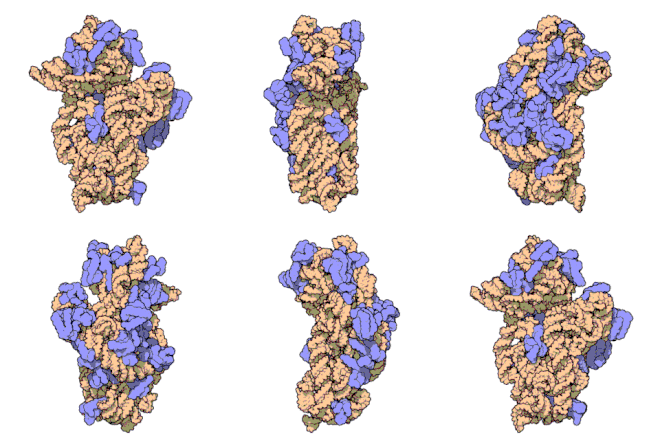
16S rRNA - one of the three main types of rRNA that form the basis of the prokaryotic ribosomes are in their small (30S) subunit. The sedimentation constant is 16 S ( Svedberg units ); The constants of the other two molecules are 5 and 23 S. The length of the 16S rRNA is about 1600 nucleotides . In eukaryotes, there are similar ribonucleic acids 18S rRNA, consisting of approximately 2500 nucleotides.
Of the three types of rRNA, it is most convenient to analyze 16S and 18S rRNA. To date, the sequence of nucleotides in 16S and 18S rRNA has been studied for 400 species from different kingdoms of nature . Based on the data obtained, three groups of evolutionarily similar organisms were distinguished, which received the highest rank of domains :
- Eukaryotes ;
- True bacteria ( eubacteria ), as well as mitochondria and chloroplasts of eukaryotes;
- Archaea .
Studies of kinship among eubacteria showed the presence of 10 evolutionary branches, and in 5 of them photosynthetic organisms were found. This means that different groups of photosynthetic bacteria are more related to non-photosynthetic bacteria than to each other. These discoveries force us to take a fresh look at the evolution of unicellular organisms and the emergence of photosynthesis .
Literature
- R. Guttel, N. Larsen and C.Woese, “Lessons from an evolving rRNA: 16S and 23S rRNA structures from a comparative perpective,” Microbiological review (1994), m8, n1, p.10-24