The Battle of Blore Heath is the first large-scale battle of the Scarlet and White Rose War . It happened on September 23, 1459, at the town of Blor-Heaf in Staffordshire , 2 miles east of the city of Mackith Drayton in Shropshire , England [1] .
| Battle of Blor Heaf | |||
|---|---|---|---|
| Main Conflict: Part of the Scarlet and White Rose War | |||
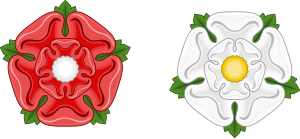 | |||
| date | September 23, 1459 | ||
| A place | Bloor Heaf in Staffordshire , England | ||
| Total | York victory | ||
| Opponents | |||
| |||
| Commanders | |||
| |||
| Forces of the parties | |||
| |||
| Losses | |||
| |||


Content
History
There is little information about the battle. The two warring armies met 2.5 miles east of the Drayton Market at a place known as Blor Heaf. Salisbury with 3,000 warriors was inferior to the enemy in number more than twice, but could not avoid a collision.
Yorkist forces planned to unite at Ludlow . During the Scarlet and White Rose War , Ludlow Castle was briefly the headquarters of the leaders of the York House: Edward IV gathered his supporters here in the late summer of 1459, but faced the larger army of Margarita of Anjou , losing the battle on Ladford Bridge , which led to the ruin of the city and the temporary victory of the house of Lancaster .
On September 23, 1459, at the Battle of Blor-Heaf, one of the detachments under the command of the Earl of Salisbury was intercepted by the army of Lancasterians under the leadership of Baron Audley. The main army of the Lancastrians was at Eccleshall, 10 miles from there.
Audley chose the barren wasteland of Blor-Heaf to ambush [2] . On the morning of September 23, 1459, with an army of about 10,000 people, he took up a defensive position behind a large hedge on the southwestern outskirts of Blor Heaf, facing Newcastle-under-Lyme to the northeast, the direction from which Salisbury was approaching. York scouts spotted Lancaster banners over the top of the hedge and immediately warned Salisbury. When they emerged from the forest, York forces of about 5,000 people realized that much larger enemy forces were awaiting their arrival. Salisbury, instead of disbanding or withdrawing his army, immediately placed his troops in battle formation, out of reach of Lancashire riflemen. To ensure his right flank, he organized the placement of cars in a defensive structure in order to cover the flank.
The two armies were divided approximately 300 meters across the barren wasteland. Between them ran a steep, wide and fast-flowing stream.
Salisbury, realizing that any attack through the stream would be suicide, used a trick to induce the enemy to attack him. He took part of his troops in the center so that the Lancaster believed that they were retreating. Lancaster attacked a cavalry unit. After they launched the attack, Salisbury ordered his men to turn back and defeat the Lancastrians when they tried to cross the stream.
The cavalry was defeated by the York infantry and archers, and then fled [3] .
Baron Audley himself died, which was the reason for 500 Lancasterians to leave the battlefield. Salisbury won the final victory, chasing the enemy for two miles.
About 3,000 soldiers fell in the battle, about 2,000 of them Lancaster.
Memory
Every year until 2009, in September, a staging of the battle was carried out in Blor-Heaf.
Literature
- Anthony Goodman, The Wars of the Roses: Military Activity and English Society, 1452-97 , Routledge & Kegan Paul, 1981.
- Ralph A. Griffiths, The Reign of King Henry VI , University of California Press, 1981.
- Edward Hall, The Union of The Noble and Illustre Famelies of Lancastre & Yorke , 1548.
- Michael Hicks, The Wars of the Roses , Yale University Press, 2010.
- The Blore Heath Heritage Group (BHHG).
- Trevor Royle, Lancaster Against York: The Wars of the Roses and the Foundation of Modern Britain , Palgrave Macmillan, 2008.
- A Global Chronology of Conflict: From the Ancient World to the Modern Middle East , Vol. II, ed. Spencer C. Tucker, ABC-CLIO, 2010.
- Bertram Wolffe, Henry VI , St. Edmundsbury Press, 2001.
Notes
- ↑ Military (Inaccessible link) . Date of treatment October 5, 2016. Archived July 13, 2010.
- ↑ Edwin Wolf. EDWARD HALLE'S "THE VNION OF THE TWO NOBLE AND ILLUSTRE FAMELIES OF LANCASTRE & YORKE" AND ITS PLACE AMONG ENGLISH AMERICANA // The Papers of the Bibliographical Society of America. - 1939-01. - T. 33 . - S. 40–54 . - ISSN 2377-6528 0006-128X, 2377-6528 . - DOI : 10.1086 / pbsa.33.24296523 .
- ↑ Trevor Royle, Lancaster Against York: The Wars of the Roses and the Foundation of Modern Britain , (Palgrave Macmillan, 2008), 161.