The first battle of St. Albans is the first battle of the Scarlet and White Rose War , held on May 22, 1455 in the city of St. Albans [1] , 22 miles (35 km) north of London . Richard, the Duke of York and his ally, Richard, Earl of Warwick, fought with the Lancaster under the command of Edmund, Duke of Somerset , who was killed in this battle. Lancaster defended themselves on the barricades for an hour, until the Earl of Warwick entered their flank. In addition to Somerset, prominent representatives of the Lancaster party died in the battle: Thomas, Lord Clifford , and Percy, Henry, 2nd Earl of Northumberland . Humphrey Stafford , heir to the Duke of Buckingham, was seriously injured. York captured King Henry VI and appointed himself constable of England .
| First Battle of St. Albans |
|---|
| Main Conflict: Part of the Scarlet and White Rose War |
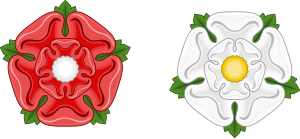 |
| date | May 22, 1455 |
|---|
| A place | St. Albans in Hertfordshire , England
|
|---|
| Total | The convincing victory of the Yorks |
|---|
|
 Yorkie Yorkie
|  Lancaster Lancaster
|
|
|
Richard, Duke of York
Richard Earl of Warwick | Henry VI
Humphrey Stafford, Duke of Buckingham
Edmund, Duke of Somerset †
Thomas Courtenay, Earl of Devon
Henry Percy, Earl of Northumberland †
Thomas, Lord Clifford † |
|
|
|
|
|
|
|
The disability of Henry VI due to a mental disorder in 1454 led to the fact that Richard of York , his closest adult relative, was called to court. As early as 1447, York was appointed lieutenant of Ireland, mostly in exile from England, while his longtime rival, Edmund Beaufort, duke of Somerset and the king's favorite, was appointed lieutenant of France. After Somerset’s failure in France, York unexpectedly returned to London with considerable support not only from the nobility, most of whom saw Somerset’s incompetence in France, but also from the public. He introduced himself as a defender of the law and called on the king to hold Somerset accountable for his failures. He also wanted to be recognized as heir to the English throne, while Henry VI was childless. York formed an armed force to expedite the matter in 1452, and after meeting with the military council and the king, who desperately wanted to avoid conflict, York's demands were agreed upon. As a result, York dissolved its army, but was soon arrested and held captive for three months. Execution was avoided, since the King was nervous because of trouble; The Duke of York was very popular and known as a man of honor. York was released only after he agreed to take the oath in St. Paul’s Cathedral , that he would never again raise a weapon against the king.
After the English army, led by Sir John Taalbot, 1st Earl of Shrewsbury , was defeated at the Battle of Castillon , Henry VI suffered a mental breakdown and could not fulfill his royal duties. Somerset tried to take control of the country and sought to become a protector lord . However, Somerset underestimated the influence and popularity of the Duke of York, since many nobles in the Council (including York's closest allies, his brother-in-law Richard Neville, Earl of Salisbury and Richard Salisbury 's son , Earl of Warwick ) were on the side of York. And so, York was appointed to rule England as patron lord and first adviser to the kingdom, while the king remained incapacitated. He used his position to oppose his main rival, and thus the Duke of Somerset was imprisoned. It was during these 14 months that the parties to the confrontation were clearly formed. In addition, there was a conflict between the Dukes of York and Somerset; in fact, the two richest and most prominent families of the North, Percy and Neville , had their own conflicts . Percy were and remain to this day Earls of Northumberland ; Neville owned and Salisbury , and Warwick (obtained by the right of their wives), and were one of the richest families in all of England. In addition, Neville was related to the Duke of York, since the Duchess of York was Cecilia Neville , sister of the Earl of Salisbury. Most of the battles between them were over land and money, but both clearly chose the side - Percy for Somerset, Neville for York.
By Christmas 1454, King Henry recovered from his illness, depriving York of power. Somerset was released and reinstated. Having again convened a courtyard in Westminster by mid-April 1455, Henry and the elected noble council decided to hold the Great Council in Leicester . York and its closest allies expected Somerset to indict them at this meeting. They gathered an armed retinue and moved forward to prevent the royal retinue from reaching Leicester and intercepting them at St. Albans .

