Chess notation (from Latin notatio - notation, notation) - a system of symbols used to record a chess game or the position of pieces on a chessboard.
Most countries have adopted algebraic notation. It was first proposed back in 1616 in the composition “Chess, or the Royal Game” of the German Duke Augustus the Younger (pseudonym - Gustavus Selenus).
In the next century, it was developed by Philip Stamma , and finally, in its modern form, it appeared in a book published in Germany in 1784 by Hirschel.
Content
- 1 Naming cells
- 2 Naming of figures
- 3 Complete recording of moves
- 4 Shortened Move Record
- 5 Other notations
- 6 Comments on moves [4] [5]
- 7 Recording batch series results
- 8 See also
- 9 notes
Naming cells
| a | b | c | d | e | f | g | h | ||
| 8 | 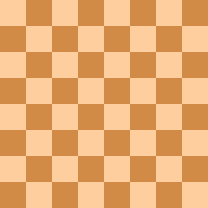             | 8 | |||||||
| 7 | 7 | ||||||||
| 6 | 6 | ||||||||
| 5 | 5 | ||||||||
| four | four | ||||||||
| 3 | 3 | ||||||||
| 2 | 2 | ||||||||
| one | one | ||||||||
| a | b | c | d | e | f | g | h | ||
The horizontal lines are numbered from 1 to 8 from white to black, and the verticals are written in Latin letters from a to h from the queenside to the royal. For example, in the initial arrangement, the white king stands on the field e1.
Naming Shapes
| Figure | Russian abbreviation | English abbreviation |
|---|---|---|
| King | Kr | K (king) |
| Queen | F | Q (queen) |
| Rook | L | R (rook) |
| Horse | TO | N (kNight) |
| Elephant | FROM | B (bishop) |
| Pawn | n or nothing | p (pawn) or nothing |
With a computer set, with its variety of symbols, a fashion has appeared to designate figures with their images.
Complete Record of Moves
The course record consists of the following components:
- (optional) Ellipsis ( ... ) - a sign of Black's move.
- The type of figure that walks (king, horse, etc.)
- The field from which the move was made.
- For a quiet ride - a dash ( - ). For capture - a cross × or the letter x .
- The field on which the move is made.
- If the pawn has completed the transformation, the figure it has become after the target field is indicated.
- For taking on the aisle - the ep sign ( fr. En passant ).
- For the Shah , a plus sign ( + ). For a mat - a lattice ( # ) or two pluses ( ++ ). [1] For a tie there is a “ = ” sign.
- Comments on the move. ! or !! for a strong move ,? or ?? for the weak, ?! for risky, !? for an interesting move. [2]
For example, a child’s mat is written like this:
- 1. e2 — e4 e7 — e5
- 2. Bf1 — c4 Kb8 — c6
- 3. Qd1 — h5 ?! Ng8 — f6 ??
- 4. Qh5 × f7 #
- 2. Bf1 — c4 Kb8 — c6
Castling in the long direction is written as 0-0-0 , in the short as 0-0 . Some computerized moves recording formats require castling to be designated as “OOO”, with the letter “O” instead of zero.
The colon was used in the Soviet notation : for capturing, cross × for mat: 4. Qh5: f7 × . For double check, double plus ( ++ ) was sometimes used. As of 2018, the Russian rules of the game of chess do not even offer it as an alternative, but it is still widely used, including in the Russian Wikipedia; these signs were also used in these meanings in translations of foreign chess literature (books by David Norwood, etc.).
Shortened Move Record
The source field and dash are skipped. The same game in abbreviated Russian notation looks like this:
- 1. e4 e5
- 2. Bc4 Bc6
- 3. Qh5 ?! Nf6 ??
- 4. Ф × f7 #
- 2. Bc4 Bc6
If such a notation does not record the course unambiguously (for example, two identical pieces can go to any field), one of the coordinates of the original field, for example, Rae1 or K3c4, is added .
Pawn captures are recorded c × d4 . Sometimes (most often in the old literature) there is a record cd4 or cd (if unambiguous). [3]
Other notations
In addition to algebraic, there are other chess notations:
- f : The move f2-f4 is written as "a pawn goes to the fourth square of the royal bishop", or P-KB4 . A child’s mat in this notation will be written as follows:
- 1. P-K4 P-K4
- 2. B-QB4 N-QB3
- 3. Q-KR5 ?! N-KB3 ??
- 4. Q-KB7 #
- 2. B-QB4 N-QB3
- 1. P-K4 P-K4
- Digital : Applies to the international pen game . Each field is encoded by a number; The starting and ending points are recorded. For example, the same move f2-f4 is written as 6264 . Castling is considered the move of the king. To turn a pawn, a number is added (1 - queen, 2 - rook, 3 - elephant, 4 - horse); the final horizontal (which obviously should be 1 for black and 8 for white) is often skipped. This format eliminates differences in alphabets and notations, and allows you to transfer moves with anything, including telegraph and SMS .
- Various formats for manual or computer shorthand of lots.
Comments on moves [4] [5]
|
|
| ||||||||||||||||||||||||||||||||||||||||||||||||||||||||||||||||||||||||||||||||||||||||||||||||||||||||
| a | b | c | d | e | f | g | h | ||
| 8 | 8 | ||||||||
| 7 | 7 | ||||||||
| 6 | 6 | ||||||||
| 5 | 5 | ||||||||
| four | four | ||||||||
| 3 | 3 | ||||||||
| 2 | 2 | ||||||||
| one | one | ||||||||
| a | b | c | d | e | f | g | h | ||
- ? - A mistake is a bad move that would not be worth playing.
- ?? - a blunder or a blunder. For example, substitute the queen for battle or not see the mat from the enemy.
- ?! - a dubious move. For example, a victim requiring a complex attack after this.
- !? - an interesting move. For example, a cunning trap in a lost situation. There is a joke: "a lazy commentator writes!? When he does not know what the meaning of the move is."
- ! - a good move.
- !! - an excellent move demonstrating the skill of a chess player.
Such comments are clearly subjective: for example, when Spassky made a dubious move with a knight ( Kb1 !! ) and won, Edmar Mednis stated this: if he lost, the move would have been with two question marks. John Nunn in 1992 attempted to formalize these comments:
- ! - the only move that saves the position score. For example, if the game is a draw, the only move that does not lead to a loss; if the game is winning - the only move that retains victory. Nunn's exclamation point is used no matter how trivial the move (unless it is the only valid move).
- !! - hard-to-find move "!".
- ? - a move that reduces the evaluation of the position, that is, turns the winning one into a draw or draw into a losing one.
- ?? - a clear move "?", "Yawn."
- !? - a move that does not change the score, but simplifies the work of a chess player: for example, in a theoretically lost position, the opponent needs a sequence of moves “!” To win.
- ?! - a move that does not change the score, but complicates the work: for example, to keep the game a draw, it takes several moves “!”.
Hubner holds similar views. Nunn's conventions are rarely used in endgame books; in the comments to the full parties, they are not applicable at the moment.
In a chess composition :! - the key course of the task (as well as the response of the opposing side to the wrong move) ,? - wrong move.
Recording batch series results
To present the generalized results of a series of games (matches or results of performances in a tournament), two types of recording are used:
- Ratio of points
- "XX: YY." Here XX is the number of points scored by the first chess player, YY is the number of points scored by the second. Winning brings 1 point, losing - 0, draw - 0.5 points each. For example, a score of 8.5: 12.5 means that in a series of 21 games the first player lost, gaining 8.5 points against 12.5 points in the second.
- + Wins − Losses = Draw
- The entry has the form “+ AA − BB = CC”, it means that in the series of games the player in question won AA games, lost BB games and made CC draws. For example, “+ 6−4 = 11” means that the player won 6 games, lost 4 and tied 11.
See also
- Forsyth - Edwards Notation
Notes
- ↑ sometimes ++ means double check
- ↑ Chess textbook online: Chess notation . Chess textbook online. Date of appeal October 10, 2018.
- ↑ Chess notation . 4kon.club. Date of appeal October 10, 2018.
- ↑ Enciklopedija šahovskih završnica = Chess Ending Encyclopedia = Encyclopaedia of Chess Endings = Enzyklopädie der Schachendspeile = Encylopédie des finales d'echecs = Enciclopedia de Flicles de Ajedrez = Sciuli Final k Final Final Final Final Final Final Final Final Final Final (ed.). Nicosia: SI Chess Informant Ltd., 1993.
- ↑ Proposal to encode symbols for chess notation (English) (PDF). unicode.org (January 26, 2017). Circulation date May 27, 2019.