Mikhail Nekhemievich Tal ( Latvian. Mihails Tāls ; November 9, 1936 , Riga - June 27, 1992 [5] , Moscow ) - Soviet and Latvian chess player , grandmaster (1957), eighth world chess champion (1960– 1961).
 Michael Tal | |
|---|---|
| Mihails tāls | |
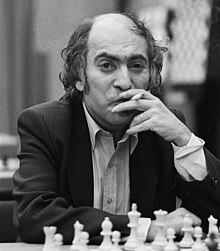 Tal in 1982 | |
| Country | |
| Date of Birth | |
| Place of Birth | |
| Date of death | |
| Place of death | Moscow , Russia |
| Rank | grandmaster ( 1957 ) USSR Master of Sports ( 1954 ) |
| Maximum rating | 2705 (January 1980) |
| Awards and prizes |    |

Honored Master of Sports of the USSR (1960), six-time champion of the USSR (1957, 1958, 1967, 1972, 1974, 1978), champion of the Latvian SSR (1953, 1965), eight-time winner of chess competitions in the USSR team, six-time European champion and three-time world champion among students in the team standings, winner of interzonal tournaments (1958, 1964, 1979), tournament of applicants (1959), participant of two matches for the world championship and seven matches of applicants, winner of 44 international tournaments, journalist, editor-in-chief (1960-1970) of the magazine chess "( Lett. « Šahs "), which was published in R n State Committee of the Latvian SSR sport and Republican Chess Federation.
Content
Biography
Childhood and Youth
Michael Tal was born in Riga into a Jewish family. His parents, Nekhemiya Mozusovich and Ida Tal, were each other's cousins [6] . Father, Nehemiah Mozusovich (Mozesovich) Tal (1896, Libava - 1957, Riga) [7] [8] , was a well-known physician, chief neuropathologist of Latvia [9] . According to a number of Tal biographers, Mikhail’s biological father (which he knew, as well as his circle of acquaintances) was a family friend and subsequently the second husband of chess mother Robert Borisovich Papirmeister [10] [11] . At the same time, the widow of Tal, Angelina, and daughter Jeanne denied this [12] [13] .
At the age of six months, Mikhail suffered severe meningitis [14] .
I learned to read at the age of three, already at an early age showed the ability to mathematics (at the age of five I multiplied three-digit numbers in my mind) [14] .
In 1941, the Tal family was evacuated to the village of Yurla (now the Komi-Permyatsky District of the Perm Territory ). In Yurla they lived until 1945. When Mikhail was seven (according to other sources - ten [15] ) years, his father taught him to play chess [11] .
Tal studied at Riga Secondary School No. 22 and at the same time attended the chess club of the Riga Palace of Pioneers , where his trainer was master candidate Janis Kruzkops [11] . At the age of 13 - a member of the youth team of the Latvian SSR; at 17 - the champion of the republic. At the USSR team championship (1953), he shared 1-2 places on the 2nd board and received the right to a match for the title of USSR master of sports, who won (1954) against multiple champion of Belarus Vladimir Saigin . In 1955, he took 1st place in the semifinals of the 23rd championship of the USSR and made his debut (1956) in the All-Union Championship: 5-7th place.
Challenger
In the fall of 1956, Tal shared 5-6th places in the semifinals of the All-Union Championship, and the next year he again took part in the final tournament ( 24th USSR Championship ). At the start, Tal won several victories, including David Bronstein, a participant in the world championship match. In the middle of the tournament, he lost two games and was slightly behind, but at the finish in the personal game he defeated one of the leaders, Keres, and headed the table with Bronstein and Tolush . In the last round, Tal and Tolush played among themselves and Tal won by conducting a spectacular attack. Since Bronstein drew the last game, Tal became the champion of the country [16] . For this success, he was awarded the title of Grandmaster. Tal's game was distinguished by an aggressive style and a willingness to take risks, which attracted fans [15] .
Subsequent Tal performances - the world championship among students (1957) and the European Championship (1957) - were also successful. The 25th national championship (1958) again ended with the victory of Tal. At the interzonal tournament in Portoroz Tal, it was necessary not only to get into the top six, but also to take no lower than the second place among the Soviet grandmasters, since, according to the FIDE decision, no more than four chess players from one country could participate in the tournament, and Keres and Smyslov already secured this right [17] . Tal took first place with 13½ points out of 20, losing only to Matanovich and ahead of Gligorich and half a point ahead of Benko and Petrosyan . In the same tournament, fifteen-year-old Robert Fisher took sixth place. Tal confirmed the right to fight for the world title at the 13th Olympiad in Munich , showing the absolutely best result: 13½ points out of 15 (1958), 26 USSR championships in 1959 (2-3rd place) and at the international tournament in Zurich - 1 place, 1959. In the Candidates' Tournament ( Bled - Zagreb - Belgrade ( Yugoslavia ), 1959) Tal won (20 of 28, Tal won micromatch matches against Smyslov, Gligorich, Fisher, F. Olafsson and Benko, tied with Petrosyan and He lost the micromatch only to Paul Keres ) and won the right to a match with the world champion.
World Champion
The match for the world title in most of the twenty-four parties started on March 15, 1960 at the Pushkin Theater in Moscow. Before this match, Tal and Botvinnik had never played with each other [11] . Tal won the first game, then several draws followed. Tal also won the sixth and seventh games, and the sixth - thanks to an incorrect knight sacrifice for a pawn. In the next two games, Botvinnik won. The eleventh game became important, which Tal won in the classical manner, gradually increasing his positional advantage and then having a strong endgame [18] . Then a series of draws followed, finally in the seventeenth game Tal went into aggravation and in time trouble Botvinnik watched a tactical strike. Tal's advantage rose again to three points, and he brought the match to victory. After a draw in the twenty-first game on May 7, the match ended ahead of schedule with a score of 12½: 8½ (6: 2 for victories).
Tal became the youngest world champion (only in 1985 did Kasparov surpass his record). The new champion in Riga was met by crowds of people [11] . Tal’s success was explained by the fact that he imposed on Botvinnik inconvenient positions for him, forcing him to go off the laid rails. For the sake of complicating the game, Tal made material sacrifices or worsened his position, but this worked repeatedly at the board, Botvinnik chose non-optimal continuation, which Tal used [11] [19] .
As a champion, Tal performed at the 14th Olympiad in Leipzig (1960) and won the international tournament in Stockholm (1961). In the rematch, Tal lost to the excellent Botvinnik (he lost 10 games, won only 5).
Subsequent Career
During 1961, Tal won a very strong tournament in Bled (14½ out of 19; Fischer, to whom Tal lost the only game, was a point behind, Keres, Petrosyan and Gligorich - by two) and shared 4–5 places with Vasyukov in the next USSR championship . As an ex-champion, Tal was admitted to the Candidates Tournament in Curacao , but the disease did not allow him to compete. Two months before the tournament, Tal underwent kidney surgery, and after three laps, when Tal had three wins with eight draws and ten defeats, he dropped out of the tournament [20] [21] . In 1962, Tal was included as the second substitute in the Soviet team at the Olympics in Varna and took first place on his board (+7 –0 = 6), and also shared 2-3 places in the USSR championship (he won Korchnoi ). The following year, Tal won the Astalosz Memorial in Hungarian Miskolc and commented on the match between Petrosyan and Botvinnik [22] .
At the beginning of the new contender cycle (1964–1966), Tal shared the 1st – 4th places with Smyslov, Spassky and Larsen in the interzonal tournament , which allowed him to enter the contenders ’matches in 1965 (this system replaced the contests of the applicants). Tal prematurely defeated Portisch (5½: 2½) and with great difficulty - Larsen (5½: 4½, in the decisive game Tal sacrificed a piece in the opening, and Larsen did not find the right defense [23] ). In the final match against Spassky, Tal lost 4: 7 [15] .
Tal, as a finalist of the 1965 challenger match, was eligible to participate in the 1968 challenger match. In April-May 1968 he played in Belgrade a quarter-final match with Svetozar Gligorich . Despite the fact that the match was held in the hometown of Gligorich and the defeat in the first game, the Soviet grandmaster managed to win (+3 -1 = 5). However, in the semifinals, Tal with the smallest margin lost to Viktor Korchnoi (+1 -2 = 7).
The last takeoff of Tal occurred in the late 1970s. In 1978, he shared first place with Tseshkovsky in the 46th championship of the USSR (11 of 17), this victory in the national championship became the sixth for him, only Botvinnik won more. The following year, he shared 2-3 places at the Keres Memorial in Tallinn , shared first place with Karpov at the two-round “ Star Tournament ” in Montreal (12 out of 18; the third prize-winner Portisch was 1.5 points behind) and confidently won the interzonal tournament in Riga (14 out of 17, the lead over Polugaevsky was 2½ points). In these tournaments, he lost only one game - in Tallinn. Kasparov attributed these successes to collaboration with Karpov during the World Championship match in Baguio [24] . However, at the end of that year, he ended up only in 14-15 places in the USSR Championship and lost the quarterfinal match to Polugaevsky with a score of 2½: 5½, without winning a single game in it [15] .
Other results in the challenging cycles: Montpellier Challenger Tournament - 4th – 5th (1985); interzonal tournaments: Biel (1976) - 2nd – 4th, Moscow (1982) –– 3rd – 4th, Taxco (1985) –– 3rd, Subotica (1987) –– 4–5th. The quarterfinal match with S. Gligorich was won, the semifinal with the traditionally “uncomfortable” V. Korchnoi (1968) - lost, the extra match for 4th place with J. Timman - Montpellier (1985) (according to additional indicators, Timman was allowed into the semifinal match of the applicants )
Other results of Tal in the USSR championships : 2nd – 3rd place (1971), 3rd (1964–1965), 1st – 2nd (1967, 1974 and 1978), 1st (1972), 2–5– e place (1975). In total, he won the title of champion of the country 6 times. Tal won a number of victories in international competitions: Hastings , Reykjavik and Kislovodsk (1964), Palma (Mallorca Island; 1966), Gori (1968), Sukhumi (1972), Wijk aan Zee , Tallinn and Sochi (1973), Lublin , Galle and Novi Sad (1974), Tallinn and Sochi (1977), Malaga (1979), Cologne - Porz , Yerevan and Sochi (1982), shared 1-2 places - Sarajevo (1966), Tbilisi (1969 and 1986), Tallinn (1971), Dubna (1973), Leningrad (1977), Lviv (1981), Moscow (1982), Tallinn (1983), Albena (1984), Jurmala (1985), shared the 1st-4th place - Hastings (1974) and Jurmala (1987), 1-3rd - West Berlin (1986). Best of all world champions he performed at the World Chess Olympiads. In the national teams of the country, Tal became the winner of the World Olympiads 8 times, taking, as a rule, the first place on his board; three times showed the absolutely best result at the Olympics, participated in matches with a team of selected chess players of the world ( Belgrade - 9th (draw with Naidorf: +1 –1 = 2) and 1984) London - 7th board (won against Nunn and made draws with Nunn and Chandler). He is a six-time European champion and a three-time student world champion in the team event. Won the 1st unofficial world of lightning fast championship (1988).
Tal eagerly responded to invitations to play with youth (grandmaster tournaments against young masters, pioneer palace tournaments, where he led the team of the Riga Pioneer Palace and gave sessions to young chess players from other palaces, played a game of correspondence with readers of Pioneer Truth, etc. .), participated in all kinds of experiments, where scientists needed a “ready for anything” grandmaster (a game with a hypnotized one, a game with a madman, etc.).
Death
Tal played his last official game already seriously ill - on May 5, 1992 at a tournament in Barcelona, in which he took place at the bottom of the table with 5½ points out of 11 [25] . His opponent was Vladimir Hakobyan , Tal won this game. On May 28, Tal took third place in the Moscow Blitz Championship (the first two were left to Kasparov, who won Tal and Bareev ) [26] . Tal was going to play for independent Latvia at the Chess Olympiad in Manila , but could not do it because of poor health [19] [27] . June 28, he died in the 15th Moscow hospital, the cause of death indicated "profuse bleeding. Varicose veins of the esophagus ” [14] .
Tal is buried at the Shmerli Jewish Cemetery in Riga.
Rewards
- For achievements in the field of chess, he was awarded the Order of Friendship of Peoples (1981) and the Order of the Badge of Honor (1960).
Personal life
Tal was married three times. His first wife was the actress of the Riga Youth Theater Sally (Sulamif) Landau . They married in 1958, and in 1960 a son was born (the names German [14] [28] and George [12] [29] are called in various sources), who later became a doctor and emigrated to Israel . In 1970, the couple divorced.
Tal married a Georgian actress who turned out to be fictitious, and in the same year he married the typist Angelina Petukhova, with whom he lived until the end of his life. In a third marriage in 1975, a daughter, Jeanne, was born. For a long time they lived in Germany. In 2016, Jeanne moved to Russia [30] .
Tal was popular with women and was known for his novels. Among his fans were named actress Larisa Sobolevskaya , pianist Bella Davidovich , dancer Mira Koltsova [14] .
Game Style
| a | b | c | d | e | f | g | h | ||
| eight | eight | ||||||||
| 7 | 7 | ||||||||
| 6 | 6 | ||||||||
| five | five | ||||||||
| four | four | ||||||||
| 3 | 3 | ||||||||
| 2 | 2 | ||||||||
| one | one | ||||||||
| a | b | c | d | e | f | g | h | ||
In this position, Tal sacrificed a piece for a pawn and initiative: 21 ... Nf4 . The victim is incorrect, but Botvinnik here and on the 24th move chooses the wrong moves and ultimately receives a lost position [31] . 22.gf ef 23.Cd2 F: b2 24.Lab1 f3! 24.L: b2 fe 25.Rb3 Rd4 26.Ce1 Ce5 + and in the endgame with two pawns per piece and a positional advantage, Black won.
Tal is best known as a master of the combination game, possessing a huge talent, a unique “romantic” style, the ability to quickly calculate multi-pass options and exceptional intuition [11] [31] [32] . Journalists called him “wizard”, “pirate”, “chess Paganini ” [14] , grandmasters Vladimir Kramnik and Sergey Shipov , talking about the simultaneous combination of exceptional talent and vibrant play, characterized Tal as an “alien” [31] [32] .
Many of Tal's victims in the subsequent analysis turned out to be incorrect. Tal often donated material not because he saw a specific winning option, but for the sake of getting a gaming initiative. Tal forced the opponent to defend himself and set new tasks for him, so that, in the end, he made a mistake [33] [34] . Tal's style was radically different from the rational positional style of his predecessors - Botvinnik and Smyslov [31] [34] . Over time, Tal's work has evolved from a combination to a universal style. If the young Tal attached particular importance to an intuitive assessment of the position, the need for creative risk in a difficult game (many victims, in his opinion, do not need a specific calculation at all; just looking at the position that appears is enough to make sure that the victim is correct), then later Tal's game was distinguished by a depth of ideas, high technical skill, and the ability to put into practice integral strategic plans [35] . At the turn of the 1970s - 1980s, Tal won a large number of games, playing strictly positionally [32] .
Tal was not a debut theorist, but he was well versed in the novelties of his debut fashion [31] . He helped Karpov in preparation for the failed match with Fisher , was in the Karpov team at the match against Korchnoi in Baguio .
Due to the special manner of holding the board during the game, holding his eyes for a long time on the opponent, at the peak of Tal’s career there were rumors that he was hypnotizing his rivals [19] . There is a known case when in the last round of the 1959 applicants' tournament for this reason Benko came to the party against Tal wearing dark glasses [36] . What Tal, to the laughter of the audience, also put on the big beach sunglasses he borrowed from T. Petrosyan. He then quickly won the game.
Garry Kasparov recalled Tal like this:
| Despite being very short on the chess throne (also a record), Tal was one of the brightest stars in the chess horizon. Combinations, sacrifices, inexhaustible optimism - all this was a reflection of Soviet society, a sigh of relief after the hedgehogs of Stalinism. [14] |
World Championships
- 1960 - Mikhail Tal: Mikhail Botvinnik +6 −2 = 13
- 1961 - Mikhail Tal: Mikhail Botvinnik +5 −10 = 6
Data. In the cinema and on television
- Vladimir Vysotsky in the song “Honor of the Chess Crown. Preparation ", dedicated to preparing a fictional character for the match with Fisher, sang:" We played with Tal 10 games: in preference, in point and in billiards. Tal said, “This will not fail!” M. Tal himself responded about this song as follows:
... As for the origin of these lines, with all the good attitude of Vladimir Semyonovich, I did not in any way ask there, but got only because of my name.
- At the 31st minute of the Meeting in the Ostankino concert studio with ex-world chess champion Mikhail Tal (1988). Presenter: Yakov Ladies' .
- He starred in the popular science film “ Seven Steps Over the Horizon ” (1968), in which he gave a simultaneous blind- play session for 10 games with first-class chess players. Result: 4 wins and 6 draws [37] .
- He starred in the film " Grandmaster " - in the role of himself.
- Tal's performance at the interzonal tournament in Riga is dedicated to the documentary film by Ansis Epner “Twenty Years Later” (1980) .
- From birth, Tal had three fingers on his right hand; nevertheless, he played the piano [38] .
Memory
- A monument to Mikhail Tal was erected in Verman Park in Riga.
- In 2011, one of the new streets of the Skanste district in Riga was named after Michael Tal [39] .
- In 2001, a postage stamp dedicated to Tal was issued in Latvia.
- Since 2006, a chess tournament has been held in Moscow - Tal Memorial .
- September 5, 2011 in Elista in the conference hall of the city of Chess Chess opened the Museum of Chess Glory , dedicated to Mikhail Tal and named after him.
Books
Many books were written by Tal in collaboration with the master Jacob Ladies . Some of the books sponsored by both chess players came out after Tal’s death, but include his interviews, commentaries on games, etc.
- The Match Botvinnik-Tal (1961)
- “Into the fire of attack” (together with J. Damsky, 1978)
- “When the figures come to life” (1983)
- “Components of success” (together with J. Damsky, 2005)
- “To the Altar of Kaissa” (together with J. Damsky, 2006)
Notes
- ↑ 1 2 Tal Mikhail Nekhemevich // Great Soviet Encyclopedia : [in 30 vol.] / Ed. A. M. Prokhorov - 3rd ed. - M .: Soviet Encyclopedia , 1969.
- ↑ Encyclopædia Britannica
- ↑ grave
- ↑ Find a Grave - 1995. - ed. size: 165000000
- ↑ A number of sources indicate the date of death on June 28:
- Linder I.M., Linder V.I. Mikhail Tal. Life and game. S. 18.
- Mikhail Nekhemyevich Tal . Britannica .
- Michael Tal . ChessPro . Archived on August 5, 2012.
- ↑ Gennady Sosonko "Tal"
- ↑ Victor Vasiliev “The Riddle of Tal”
- ↑ In the birth record, available on the Jewish genealogy website JewishGen.org, the name is recorded as Nehemiah Mozovic Tal.
- ↑ Bach, Alexander Grigorievich; Barsky Vladimir. Alexander Bach: “After talking with Tal, I understand what talent is” . 64 — Chess Review (November 1, 2014). Date of treatment November 26, 2017.
- ↑ Sosonko, G. My Misha // My testimony . - Ripol Classic, 2003 .-- S. 24-33. - 416 p. - ISBN 5-790-52212-2 .
- ↑ 1 2 3 4 5 6 7 Shmachkov, L. Life-long party // Soviet Sport . - January 30, 2003. - Issue. 16 (15998) .
- ↑ 1 2 Vasiliev, Yu. Children of Tal // Sport-Express . - November 24, 2009.
- ↑ Komarov, D. Angelina Tal Interview , Facts (November 20, 2009). Archived November 23, 2009. Date of treatment June 4, 2010.
- ↑ 1 2 3 4 5 6 7 Valiev, B. Mikhail Tal: The Queen of All Sorts // Soviet Sport . - November 16, 2002. - Vol. 209 (15905) . Archived on October 10, 2014.
- ↑ 1 2 3 4 Averbakh, Yu. L. Tal, Mikhail Nekhemievich . Around the world . Date of treatment May 23, 2010. Archived August 23, 2011.
- ↑ Koblenz, A. N. Memoirs of a chess player. C 110–111.
- ↑ Koblenz, A. N. Memoirs of a chess player. C 126.
- ↑ Koblenz, A. N. Memoirs of a chess player. C 168.
- ↑ 1 2 3 McFadden, Robert Mikhail Tal, a Chess Grandmaster Known for His Daring, Dies at 55 . New York Times (June 29, 1992). Date of treatment May 26, 2010. Archived August 23, 2011.
- ↑ Koblenz, A. N. Memoirs of a chess player. Since 195.
- ↑ Kasparov, G.K. My great predecessors. T. 2.P. 473.
- ↑ Kasparov, G.K. My great predecessors. T. 2.P. 478.
- ↑ Kasparov, G.K. My great predecessors. T. 2. From 486-490.
- ↑ Kasparov, G.K. My great predecessors. T. 2.P. 498.
- ↑ Tournament in Barcelona (1992)
- ↑ Kasparov, G.K. My great predecessors. T. 2.P. 514.
- ↑ Hartston, W. Obituary: Mikhail Tal . The Independent (July 3, 1992). Date of treatment June 1, 2010. Archived August 23, 2011.
- ↑ Satellites of the Planet Tal // Spark . - 10/28/1996. - Vol. 44 .
- ↑ Nuzov, V. George Tal: Latvia almost forgot Mikhail Tal // // The Seagull . - May 19, 2006. - Issue. 10 (69) .
- ↑ Politikus.ru> Printable version> "I ate the West up my throat ..."
- ↑ 1 2 3 4 5 Shipov, S. Yu. Mikhail Tal . chesspro.ru. Date of treatment May 25, 2010. Archived August 23, 2011.
- ↑ 1 2 3 Kramnik, V. B. From Steinitz to Kasparov (January 17, 2005). Date of treatment May 25, 2010. Archived on August 11, 2011.
- ↑ Koblenz, A. N. Memoirs of a chess player. S 129-130.
- ↑ 1 2 Kiselev, E. A .; Kasparov, G.K. Our everything: Michael Tal . Echo of Moscow (November 30, 2008). Date of treatment May 25, 2010. Archived August 23, 2011.
- ↑ “Chess: An Encyclopedic Dictionary” / Ch. ed. A.E. Karpov. - Moscow: Sov.Encyclopedia, 1990. - c. 394, p. 1162 - ISBN 5-85270-005-3
- ↑ Koblenz, A. N. Memoirs of a chess player. From 151-152.
- ↑ Excerpt from “7 Steps Beyond the Horizon”
- ↑ Sport-Express, September 21, 2009
- ↑ A street named after Mikhail Tal appear in Riga . DELFI (August 24, 2011). Date of appeal September 24, 2018.
Literature
Biographies
- Vasiliev V. L. The Riddle of Tal. The second "I" Petrosyan. - Moscow, 1973.
- Kasparov G.K. From Euwe to Tal // My great predecessors. - M .: RIPOL classic, 2005 .-- T. 2 .-- S. 415-515. - 512 s. - ISBN 5-790-52239-4 .
- Koblents A. N. Roads of chess battles (from the diary of a coach). - Riga, 1963.
- Koblenz, A. N. Memoirs of a chess player. - M .: Physical education and sport, 1986. - 240 p.
- Linder I.M. , Linder V.I. Mikhail Tal. Life and game. - M .: AST, Astrel, 2008 .-- 312 p. - ISBN 978-5-17-052409-9 .
- Landau S. (lit. record of Arkady Arkanov ). Elegy of Michael Tal. - M .: Nauka, 1998 .-- 215 p. - ISBN 5-784-60012-5 .
Batches
- Michael Tal. Creation. - Riga: RETORIKA - A, 2002 - In six volumes (author - compiler V. Kirillov ). ISBN 9-984-67049-X + add. Tom Says and Shows Tal (Ibid., 2006. - ISBN 9-984-67061-9 )
Links
- Mikhail Tal's games in the database
- Mikhail Tal's personal card on 365chess.com
- Speech by Mikhail Tal at chess Olympiads
- Speech by Michael Tal at the European Team Championships
- Data on webchess.ru
- The mystery of the genius of Mikhail Tal (the eighth world chess champion was born 80 years ago) // FreePress, November 9, 2016
- 85 chess challenges based on Tal games