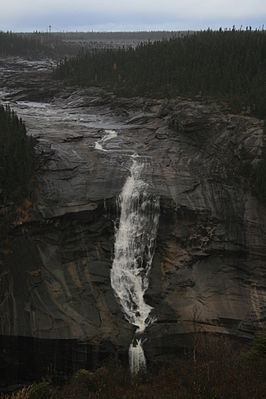
Churchill is a 75- meter- high waterfall on the Churchill River in Canada's Newfoundland and Labrador provinces. After the construction of Churchill Falls Hydroelectric Power Station in 1971 , the river was completely diverted to produce electricity. Since then, Churchill Falls has virtually not existed as a waterfall for a longer time of the year.
| Churchill | |
|---|---|
 | |
| Specifications | |
| Height | 75 m |
| Consumption | 1 380/0 m³ / s |
| Location | |
| River | Churchill River |
| A country |
|
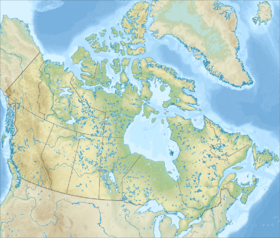
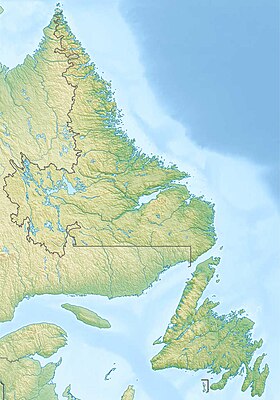
| Provinces | Newfoundland and Labrador |


The river, waterfall and hydroelectric power station are named after the British Prime Minister W. Churchill .
Content
Basic Information
The first European to explore Churchill Falls in 1839 was the representative of the Hudson's Bay Company D. Maclean . Macklin named the river " Hamilton " in honor of the governor of the British colony Labrador of that time. The waterfall was known under the name of " Great Falls " ( Eng. "Grand Falls" ) until 1965 , when the river and the waterfall were given their modern names in honor of the British Prime Minister W. Churchill of the middle of the XX century . In 1894, the river area was explored by the Canadian geologist A.P. Low while searching for ore deposits in Labrador and in northeast Quebec .
The site where Churchill Falls is located is characterized by a narrowing of the river bed to 61 m , which begins upstream by 6.4 km . After the waterfall, the river flowed along the Maclean Canyon 19 km long with a large number of rapids. The total fall of Churchill on a stretch of 25.4 km is 316 m , the height of the waterfall itself is 75 m.
Until 1970, the average water discharge was about 1,380 m 3 / s , now for most of the year there is no water in it and the waterfall operates only in short periods of heavy rainfall.
See also
- R. Churchill (Atlantic Basin)
- HPP Churchill Falls