Ring-tailed mungo [1] , or half-mongoose [2] (in Malagasy - a wuntsika or cookie ) ( lat. Galidia elegans ) - a predatory mammal from the Madagascar wyverre family. Endemic of Madagascar . Outwardly and in a way of life reminds a small mongoose .
| Ringtail Mungo | |||||||||||||||||||||||||||||||||||||||
 | |||||||||||||||||||||||||||||||||||||||
| Scientific classification | |||||||||||||||||||||||||||||||||||||||
|---|---|---|---|---|---|---|---|---|---|---|---|---|---|---|---|---|---|---|---|---|---|---|---|---|---|---|---|---|---|---|---|---|---|---|---|---|---|---|---|
| |||||||||||||||||||||||||||||||||||||||
| International scientific name | |||||||||||||||||||||||||||||||||||||||
Galidia elegans | |||||||||||||||||||||||||||||||||||||||
| Area | |||||||||||||||||||||||||||||||||||||||
 | |||||||||||||||||||||||||||||||||||||||
| Security status | |||||||||||||||||||||||||||||||||||||||
Content
- 1 Description
- 1.1 Appearance
- 1.2 Range and habitat
- 1.3 Behavior
- 1.4 Nutrition
- 1.5 Reproduction and development
- 2 Subspecies
- 3 notes
- 4 Literature
Description
Appearance
The sizes are small. Body length about 38 cm, tail length about 30 cm. The body is elongated, limbs of medium height. The head is wide in the brain with a long muzzle tapering to the nose. Ears of medium height, rounded, widely spaced. Fingers and nails are short. Females have genital skin glands near the genitals. The fangs are short. The second upper pre-molar tooth is very small.
There are several subspecies of ring-tailed mungo, differences in color between which are explained by chromosomal changes. In general, the color of these animals is dominated by red-brown tones, although different subspecies may be darker or lighter. The tail has the same color as the rest of the body, but it is always adorned with 5-6 darker ring bands that give the name to the species.
Habitat and habitat
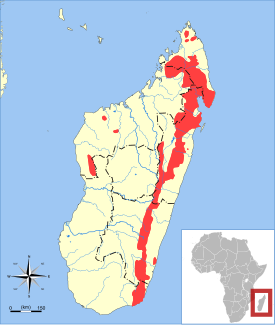
Endemic of Madagascar. It inhabits the eastern, western and northern parts of the island.
It lives mainly in forests.
Behavior
These animals usually take refuge in independently dug holes. They also hide in the hollows of trees at a height of several meters above the ground, or even in the clefts between the stones.
Ring-tailed mungoes move most often on the ground. They often climb tall trees, both in search of prey and for no apparent reason. Climbing a tree more than 3 cm thick, the animal climbs its head up, like a caterpillar . With a trunk thickness of less than 3 cm, it seems to be walking along it, with the front paw extending simultaneously with the opposite rear. The mungo descends head down, regardless of the thickness of the trunk, "walking" along it, like a caterpillar of a moth .
Moving on the ground in a run or step, this beast occasionally suddenly makes sharp turns. In search of prey, he can go into the water.
Like mongooses, ring-tailed mungos are able to break the shell of eggs and shells of snails. The animal takes the egg into the forelimbs, lays on its side, raises its hind legs and, intercepting the egg, hits it on a stone or tree trunk, and then licks the contents from a chopped shell.
Compared to other predators of Madagascar, this beast has a wide range of sound signals. Moving, they whistle quietly, like birds; Apparently, this is a signal of communication. They also publish a variety of meows. Grabbing prey, ring-tailed mungoes make short, muffled, repeating sounds. When defending or attacking, they growl or squeal loudly.
Ring-tailed mungoes make extensive use of odor signals and marking of the territory. They carry out marking in the same way as fanaluki . These mungos have well-developed anal glands , as well as a rudentary perianal gland .
Ring-tailed mungoes live in small family groups of 3-4 or more individuals. When moving, the female usually goes first, the male follows her or closes the procession after the cubs. The group usually lives in one hole. In the afternoon, animals from the same group play with each other for a long time.
Nutrition
Basically, the ring-tailed mungo feeds on rodents , which it tracks down from a tree or digs from holes. In addition, his diet includes many different small animals: insects , worms , snails , reptiles , small lemurs , as well as eggs.
Reproduction and development
The mating period occurs at the end of winter and the spring of the southern hemisphere.
Pregnancy is a little less than three months (in captivity 74–90 days). Cubs are born from August to April, but most of the births are from November to January. There is always one cub in the brood, as is typical of most Madagascar predators.
The newborn has a hairline, the color of which is similar to the color of an adult. He is blind - his eyes open only for 6-8 days. It weighs about 50 g and is not able to move independently.
Immediately after the birth of the cub, the female expels the male from the hole and takes care of the offspring herself for the first weeks. Then the male begins at first to approach the cub no closer than two meters. Gradually, this distance is reduced and after a month and a half the male is allowed to come close to the cub. The first month, the female carries the cub, holding his neck with his teeth.
The cub develops very slowly. He begins to walk after 12 days, meat food appears in the diet after a month, and milk ceases at 2–2.5 months.
At three months old, mungoes begin to catch grasshoppers, and sometimes small frogs. They play with parents for a long time, usually imitating attack and defense in the game.
At 10 months, young animals begin to fish, and hunt rodents no earlier than 14 months. At this age, they already leave their parents, but the final separation occurs no later than two years.
Subspecies
- Galidia elegans elegans - Has a dark red-brown color with a dark brown abdomen dotted with gray hairs. The tips of the paws are black. It lives in the evergreen forests of the eastern part of Madagascar.
- Galidia elegans dambrensis - Has a lighter than the previous subspecies, reddish-brown body. Abdomen, paws and sides differ little in color from the rest of the body. It lives in the northern part of the island.
- Galidia elegans occidentalis - The body color is reddish-brown, and the legs, abdomen and sides are black. It is found in karst areas in the west of the island.
Notes
- ↑ Madagascar: Per. from English / Ans. ed. ser. V. E. Sokolov. - M: Progress, 1990. - (Gold Fund of the Biosphere) - 296 p. - ISBN 5-01-002049-1
- ↑ Sokolov V.E. The pagan dictionary of animal names. Mammals Latin, Russian, English, German, French. / edited by Acad. V. E. Sokolova. - M .: Rus. lang., 1984. - S. 103. - 10,000 copies.
Literature
- Albinyak R. Predatory // Madagascar: Per. from English / Resp. ed. ser. V. E. Sokolov . - M: Progress, 1990. - (Gold Fund of the Biosphere). - S. 211-214. - ISBN 5-01-002049-1