“Domestic notes” ( Russian doref. Domestic notes ) - Russian literary magazine of the XIX century , which had a significant impact on the movement of literary life and the development of public thought in Russia ; came out in St. Petersburg in 1818 - 1884 (intermittently).
| Domestic notes | |
|---|---|
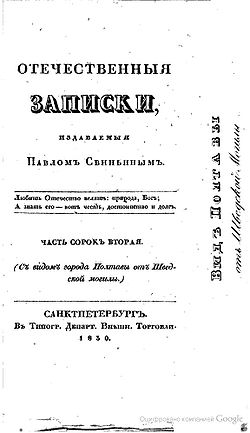 Magazine cover. 1830 year | |
| Specialization | literary magazine |
| Tongue | Russian |
| Chief Editor | , , and |
| Founders | |
| A country |  Russian empire Russian empire |
| Publisher | and |
| Edition History | from 1818 to 1884 (intermittently) |
| Established | |
| Web site | |
Content
Early Period
The magazine was founded by historian and writer Pavel Svinyin in 1818 and was filled with articles on the themes of history, geography, life and customs of Russia. In the early 1820s, the journalist, writer, historian Nikolai Polevoy participated in the magazine. Issued until 1831; in 1838 he was renewed by Svinyin and from January 1839 he was leased to Andrei Kraevsky , who after the death of Svinin became the owner.
Kraevsky Journal
The editor-editor of the journal Kraevsky transformed "Domestic Notes" into a monthly journal of the scientific, literary and political volume (up to 40 printed pages). Each issue contained the sections “Contemporary Chronicle of Russia”, “Science”, “Literature”, “Arts”, “Housekeeping, Agriculture and Industry in General”, “Criticism”, “Modern Bibliographic Chronicle”, “Mix”.
Literary scholars of different directions and generations were involved in the magazine - Vasily Zhukovsky , Vladimir Odoevsky , Denis Davydov , historians Mikhail Pogodin and Stepan Shevyrev , Mikhail Dmitriev , professor of Latin literature and philosophy Ivan Davydov , later famous Slavophile Alexei Khomyakov , Sergey Aksakov , Mikhail Lermontov , Vladimir Sollogub , Ivan Panaev , Fedor Korf and others. The critical department was led first by Vasily Mezhevich , from the fall of 1839 to the spring of 1846 - Vissarion Belinsky , then Valerian Maykov (who drowned in the summer of 1847 ), and later Stepan Dudyshkin .
Belinsky attracted the participation of his friends and like-minded people Vasily Botkin , Mikhail Bakunin , Timofey Granovsky , Nikolai Ketscher , Pyotr Kudryavtsev , later Nikolai Ogaryov , Alexander Herzen , Nikolai Nekrasov , Ivan Turgenev took part in the “Domestic Notes”. The journal was gradually left by Zhukovsky, Vyazemsky , Pletnev , Benediktov , Mezhevich, Khomyakov , Aksakov , as well as future employees of the Moskvityan magazine.
The magazine fought with the "Northern Bee" by Bulgarin and Grech and the "Library for Reading" by Senkovsky, the "Moskvityanin" Pogodin and Shevyrev and the Slavophiles .
For material and domestic reasons (Kraevsky paid a low price for Belinsky’s work, at the same time requiring abundant writing on a wide variety of topics) and for his ideological character, Belinsky stopped working in the journal from April 1846 and became a critic of Sovremennik magazine from Nekrasov and Panaev in January 1847. Herzen also transferred to Sovremennik. The departure of some employees affected the position and reputation of the magazine, which remained a publication of a liberal-Westernist orientation, but gradually lost its popularity. The publisher-editor of the magazine in 1860 - 1866, together with Kraevsky was Stepan Dudyshkin . In 1866 - 1867, the historian and publicist Nikolai Aristov participated in the journal.
In 1868, Kraevsky handed the magazine over to Nekrasov.
Journal of Nekrasov and Saltykov-Shchedrin
Under an agreement with Nekrasov, Kraevsky remained the official editor of the journal and retained some property rights, but in 1868, Nekrasov became the actual director of the journal. Leading the general leadership and poetry department to the leadership of the magazine, Nekrasov drew Mikhail Saltykov-Shchedrin ( fiction ) and Grigory Eliseev (journalism). After the death of Nekrasov, Saltykov-Shchedrin became the head of the "Domestic Notes", and N. K. Mikhailovsky was the co-editor. The magazine, partly continuing the revolutionary-democratic line of Sovremennik , was of a populist character.
G. I. Uspensky , N. A. Demert , F. M. Reshetnikov , A. N. Ostrovsky , D. I. Pisarev , N. Ya. Nikoladze , A. P. Shchapov were involved in the participation. The circulation of the magazine grew from two to six to eight thousand copies and regained influence.
Volume CCXIV of "Domestic Notes" for May 1874 was destroyed by censorship.
In April 1884, the magazine was closed by personal order of the chief censor of Russia, the head of the Main Press Directorate, Evgeny Feoktistov , and in the recent past, an employee of the journal.
Russian literature
"Domestic Notes" in the 1840s contained the works of such writers as D. V. Grigorovich , V. F. Odoevsky , V. I. Dal , V. A. Sollogub , G. F. Kvitka-Osnovyanenko , I. I. Panaev , N.P. Ogaryov , E.P. Grebenka , A.D. Galakhov , A.M. Maykov , A.A. Fet , V.D. Yakovlev , Ya.P. Butkov and others.
The magazine first published the most outstanding works of Russian literature of the 1840s — Lermontov’s poems and novels, Koltsov’s poems, articles, “Notes of a Young Man,” the first part of the novel “ Who is to Blame?” " Herzen , poems, plays" Carelessness "and" Lack of Money ", stories" Andrei Kolosov "and other Turgenev , stories and poems by Nekrasov ," Double "," Mr. Prokharchin "," White Nights "," Netochka Nezvanova "and other stories and the story of Dostoevsky , the story "Contradiction" and "The Tricky Case" of Saltykov-Shchedrin .
In the 1840s, the magazine published the works of women writers: M. Zhukova , E. Gan , N. Sokhanskaya , S. Zakrevskaya .
Later in the journal Thousand Souls ( 1858 ) by Pisemsky , Oblomov ( 1859 ) by Goncharov , the novels The Musk-ox ( 1863 ), Bypassed ( 1865 ), The Islanders ( 1866 ) by N. S. Leskov were published.
In addition to Belinsky, V.P. Botkin , A.D. Galakhov , M.N. Katkov , and N.A. Nekrasov spoke with criticism and reviews in the "Domestic Notes" of the 1840s and 1850s.
In the journal Nekrasov and Saltykov-Shchedrin, Ouspensky , Ostrovsky , Reshetnikov, V. A. Sleptsov , V. M. Garshin collaborated, debuting in the magazine with the story “Chuprinsky Mir” back in 1866, N. N. Zlatovratsky , D. N. Mamin- Sibiryak , N.E. Karonin-Petropavlovsky , A.N. Osipovich-Novodvorsky , poets A.N. Plescheev , S. Ya. Nadson , P.F. Yakubovich and others.
Fiction in the 1870s bore a pronounced populist peasant character.
Journalism
At different times, their articles in the journal were posted by: N.V. Albertini , Ya. V. Abramov , A.A. Golovachev, N.I. Ziber , E.P. Karnovich, I.V. Lavrov , V.V. Lesevich , E.I. Likhacheva, S.V. Maksimov, N. Ya. Nikoladze , V.I. Pokrovsky , V.I. Semevsky, M.N. Tsebrikova, A.P. Shchapov , S.N. Yuzhakov . [2]
From 1880 to 1882, Nikolai Ivanovich Ziber, one of the first popularizers and advocates of Karl Marx’s economic doctrine in Russia , published 8 articles in the journal under the general title “Economic Sketches” (“Domestic Notes” 1880 No. 12; 1881 No. 3 5, 6, 9, 11; 1882 No. 4 and 6). In modern language, N. I. Sieber led a kind of “column”; however, each of these of his "sketches" was an independent finished scientific work.
Another prominent Russian economist , the founder of the school of state socialism in Russia, professor (subsequently academician) Ivan Ivanovich Yanzhul in number 2 of the "Domestic Notes" for 1880 published an article "Child and Female Factory Labor in England and Russia" [3] .
Foreign Literature
Experienced translators N.K. Ketcher , A.I. Kroneberg , A.N. Strugovshchikov participated in the journal. In addition to translations from Goethe and Shakespeare , Domestic Notes also included translations of modern foreign authors: George Sand , Charles Dickens , Fenimore Cooper , G. Heine , Alexander Dumas father , Edgar Allan Poe . Reviews of foreign literature and translated articles about individual authors were published. Later, under Nekrasov and Saltykov-Shchedrin, translations from V. Hugo , A. Dode , E. Zola were published.
Notes
- ↑ Egorov B.F. Kraevsky // Brief Literary Encyclopedia - M .: Soviet Encyclopedia , 1966. - T. 3.
- ↑ Domestic Notes // Brockhaus and Efron Encyclopedic Dictionary : in 86 volumes (82 volumes and 4 additional). - SPb. , 1897. - T. XXII. - S. 414-416.
- ↑ Yanzhul I.I. Child and female factory labor in England and Russia. // Domestic notes, 1880, No. 2. P. 430.
Literature
- The history of Russian journalism of the XVIII — XIX centuries. Moscow: Higher School, 1966. S. 252-267, 437-446.
Links
- Library Tsarskoye Selo, all issues of Russian Notes, PDF
- Archive of the journal from 1818 to 1883 in .pdf format
- Domestic Notes // New Encyclopedic Dictionary : In 48 volumes (29 volumes were published). - SPb. , Pg. , 1911-1916.