Qi , sometimes chi ( Chinese trad. 氣 , ex. 气 , pinyin : qì ; in the Japanese version - ki yap. 気 ki , sometimes ke ; English qi or ch'i ) is one of the main categories of Chinese philosophy , fundamental to Chinese culture , including for traditional Chinese medicine . Most often defined as [1] [2] [3] " pneuma ", "ether" , "air" , "Breath" , "energy" , "Life force" . Qi expresses the idea of a fundamental, [4] continual, dynamic, spatio-temporal, spiritual-material and vital- energetic substance [1] , which underlies the structure of the Universe, where everything exists due to its modifications and movement. [4] The opposite concept is whether [1] .

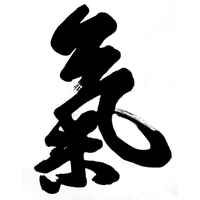
It is customary to distinguish 3 semantic levels of the concept - cosmological (qi as a universal substance of the universe), anthropological (qi as a filler of the human body associated with blood circulation) and psychological (qi as a mental center or “heart” - blue, which is influenced by the will and regulates feeling) [1] . Common to all Chinese philosophy is the consideration of qi as a substandard primary matter (the "Great Beginning"), which corresponded to the first phase of the development of the universe. The differentiation of this primitive occurred in the form of yin and yang , as well as five elements ( in syn ) [1] .
The category has no direct analogues in the Western philosophical tradition [5] .
Content
Concept History
Definition in Chinese sources
Guo Yu Zhou
夫 天地 之 气 , 不失 其 序 ; 若 过 其 序 , 民 乱 之 也。
- “The qi of heaven and earth must not violate their sequence, if the sequence is not followed, this will lead to confusion among the people,” MV Kryukov’s translation.
Neijing
The Treatise on the Inner (Neijing) says:
- “Where the disorder causing the disease penetrates, there is definitely a lack of qi.”
- “Where the defenses are located, the disorder-causing disorder does not penetrate.”
Neo-Confucianism
The spread of the concept of qi was greatly influenced by the founder of neo-Confucianism, Zhu Xi (1130–1200), who is considered the second (after Confucius) figure in the history of Chinese thought. According to his teachings, everything around him pervades qi and li. Whether (or Tao ) people and things receive at the time of their inception, whether determines the nature of things. Qi breathes life into them, qi is the breath of nature itself, the source of the strength of everything that exists. Qi is identified with yin and yang [6] . The correct circulation of qi creates harmony, on the contrary, the lack of qi leads to the cessation of all movement. In the human body, proper qi circulation ensures success and health, and lack of qi leads to illness and death.
Qi category in Chinese medicine
In traditional Chinese medicine, the term "qi" can mean any substances that participate in the life of the body or support the functional activity of organs and tissues. Inhaled air is also called qi. In various treatises, the movement of qi is likened to movement in a circle without a beginning and an end, while it is warned that the laws of its circulation are not allowed to be violated by anyone. [four]
Qi, moving through the innards of a person, warms its dense organs and the hollow organs of fu , and externally moisturizes the skin through the pores. Thus, all types of circulation are carried out through vessels, collateral connections, and through various types of channels (intrinsic canals of the Jing and Yang organs, tendon-muscle, subcutaneous canals, etc.). The yin vessels nourish the five storage organs of Zhang , and the yang vessels nourish the six organ organs of fu . [four]
It is believed that by affecting the meridians, one can change the circulation of Qi and thereby cause physiological changes in the human body. Representations of such influences are widely used in acupuncture and martial arts (see Qigong , Aikido ). Such ideas are subject to criticism of modern science.
The concept of qi is fundamental to feng shui , as well as a number of Chinese systems for improving the human body [7] .
Qi Forms
- Zheng-qi (sometimes sheng qi [7] ) (正氣 zhèngqì, ex.正气) is the true, regular form of qi; breath of nature
- Yuan-qi (元氣 yuánqì, abt .元气) - the original qi (hereditary energy)
- Se-qi (sometimes sha qi [7] ) (邪氣 xiéqì, abt .邪气) - harmful energy, sinister breathing
- Heat
- Cold
- Humidity
- Wind
- Dryness
Similar concepts in other cultures.
The concept of prana (the breath of life), similar to qi (sheng qi) [7] , is found in Indian culture. In Western philosophy, there were close concepts of pneuma (in ancient Greek medicine , Stoicism and early Christian philosophy ), Argeotle's Energeia . The concept of Élan vital (life activity, power), similar in meaning, is in Bergson’s philosophy.
Qi in Japanese Culture
The concept of qi is similar to the Japanese qi [8] . It is an integral part of the names of many martial arts: ai ki do ( 合 気 道 ) [9] , ki ko , ki aijutsu , etc. This is an important component of the Japanese spirit of bushido and Japanese traditional medicine - ki atsu , Reiki , when using the finger method of shiatsu , Ki energy flow is directed into the patient’s body.
Japanese esoteric philosophy distinguishes eight types of Ki :
- Kekki ( Japanese 血 気 , ki of blood) - the original, vital Ki, it is symbolized by blood . In qigong, jin-qi corresponds to it. The energy of the first chakra (hereinafter - conditional comparison).
- Shioke ( Japanese 塩 気 , ki of salt) - bioenergy , bioplasma energy, gives the body structure, it is symbolized by the salt in the blood ("sio" and means "salt"). The energy of the second chakra.
- Mizuke ( Japanese 水 気 , ki of water) - the energy of water ("mizu"), sexual energy, the energy of the genus. Also the energy of the second chakra.
- Cookies ( Japanese 空 気 ku: ki , ki of air) - willpower, the ability to split, destroy and create. The energy of the third chakra.
- Danki ( Jap. 気 気 , ki of thunder) is a socially-organizing force. The energy of the fourth chakra.
- Dziki ( 磁 気 , ki magnet) - magnetic energy, collecting power, creative energy, the power of beauty, aesthetics . The energy of the fifth chakra.
- Reiki ( Jap. 気 気 , ki of spirit) - synergy , spiritual or cosmic energy. Reiki practitioners are perceived as the White Fire or Light descending in the 7th and 6th chakras, lowering the vibrational characteristics for a particular being.
- Sinks ( Japanese 神 気 , ki kami ) - divine energy, which is also evident from the hieroglyph 神 - "syn" - Kami , deity.
Separately, the terms aiki and kiai should be mentioned.
- Aiki ( 合 気 合 , ki connection) - connection (harmony) of energy, a method of using Ki energy. It is widely used in aikido as a way to control the energy of the opponent, and is even part of its name for this type of kempo .
- Kiai ( 気 合 , meeting ki) is the art of using the energy of sound (screaming) to influence an opponent in kempo, for healing in ki-ko , for magically influencing oneself or those around in shugendo , ninjutsu , ki-ko .
Modern views of qi as “energy” or “power”
A lot of teachings and practices are widespread in the modern world in which “qi energy” is presented as a material object, a kind of “vital energy” or “force” that can be manipulated [10] [11] [6] [12] . This approach is criticized by modern Western, as well as Chinese philosophy and science. Modern science denies the existence of a form of energy that could be identified with qi [11] [13] . Some authors characterize as pseudo-scientific and pseudo-medical [14] [15] [16] [17] [18] [19] [20] such teachings and practices as qigong and acupuncture , the basis of which are manipulations with the “qi energy”.
In Chinese philosophy, there are no analytical concepts of "power", "energy" [21] [22] .
See also
- Jing Essence
- Vitalism
- Qigong
- Feng Shui
- Tai chi
- Prana
- Pneuma
- Shechina
- Reiki
- Qi (Power Standard)
Notes
- ↑ 1 2 3 4 5 Kobzev A.I. Qi - Pneuma // Spiritual Culture of China: Encyclopedia : in 5 volumes / Ch. ed. M. L. Titarenko; Institute of the Far East. - M.: East. lit., 2006. T. 1. Philosophy / ed. M.L. Titarenko, A.I. Kobzev, A.E. Lukyanov. - 2006 .-- 727 p. S.549-551.
- ↑ Bo Mou History of Chinese philosophy / Routledge history of world philosophies, Vol. 3. p.72
"It is interesting to note that the original texts of the Zhou-Yi did not mention qi , and it is not until the writing of the Yi-Zhuan commentaries of the Yi text that the term qi was used. But this is not to say that experiences and understanding of qi as a living force may not begin with the observation and experiences of the yin-yang forces in process of change in reality (nature). " - ↑ Philosophical dictionary. Ruach ( Heb. רוח ) air, also Spirit; Ruah Elohim , Ruah Ha-qodesh ( Hebrew רוח הקודש ) Divine Spirit or Divine Inspiration; corresponds to the Holy Spirit of Christians. Also wind, breath and flowing water
- ↑ 1 2 3 4 Dubrovin D.A. Difficult issues of classical Chinese medicine. L .: Asta-press, 1991
- ↑ Kobzev A.I. Categories and basic concepts of Chinese philosophy and culture // Spiritual culture of China: encyclopedia: in 5 volumes / Ch. ed. M. L. Titarenko; Institute of the Far East. - M.: East. lit., 2006. T. 1. Philosophy / ed. M.L. Titarenko, A.I. Kobzev, A.E. Lukyanov. - 2006 .-- 727 p. S. 66-81.
- ↑ 1 2 Qi and Yin and Yang
- ↑ 1 2 3 4 The breath of nature (sheng qi) and the sinister breath (sha qi)
- ↑ http: //womenshealth/about.com/od/sexualhealthissues/a/taoismsexuality.htm (unavailable link from 05/16/2013 [2267 days])
- ↑ And the Korean hap ki that comes from him ( 合氣道 )
- ↑ Micozzi MS Foreword // Tianjun Liu. Chinese Medical Qigong, 2010.
"Qigong also recognizes the role of Qi or" vital energy " in health and healing, a key feature of human physiology and biology that is not fully recognized or utilized in Western biomedicine. Notwithstanding Western medical technology, Qi represents a powerful force of Nature which may be cultivated for healing purposes. " - ↑ 1 2 Stenger VJ Bioenergetic Fields (inaccessible link) . // The Scientific Review of Alternative Medicine, Vol. 3, No. 1, Spring / Summer 1999 / colorado.edu. Date of treatment December 8, 2011. Archived on February 8, 2012.
"Chi or qi remains the primary concept in traditional Chinese medicine, still widely practiced in China and experiencing an upsurge of interest in the West. Chi is said to be a living force that flows rhythmically through „meridians“ in the body. The methods of acupuncture and acupressure are used to stimulate the flow at special acupoints along these meridians, although their location has never been consistently specified. The chi force is not limited to the body, but is believed to flow throughout the environment. ... As modern science developed in the West and the nature of matter was gradually uncovered, a few scientists sought scientific evidence for the nature of the living force. " - ↑ Zhang YH, Rose K. A brief history of qi. — Paradigm Publications, 2001. ISBN 978-0-912111-63-6 .
- ↑ Beyerstein BL, Sampson W. Traditional Medicine and Pseudoscience in China: A Report of the Second CSICOP Delegation (Part 1) // Skeptical Inquirer 20 (4): 18-26, 1996.
“... Although the delegation found this„ force “dismally inaccurate when the Qigong masters invoked it to diagnose illnesses, it is the same„ energy “that TCM advocates say runs through acupuncture meridians to effect healing. It has always struck us as odd that proponents can accept that this mysterious energy is unable to interact with the physical matter in the sensors of measuring instruments (which could confirm its existence) while it is still able to interact with the physical matter of bodily organs to "read" their state of health and produce a cure ".
"eight. For instance, no reputable scientist has ever found an anatomical basis in the circulatory, nervous, or lymphatic systems for the " meridians " through which the health-enhancing vital energies posited by TCM are supposed to flow. " - ↑ Ulett GA, Han J., Han S. Traditional and Evidence-Based Acupuncture: History, Mechanisms, and Present Status (unavailable link from 11-05-2013 [2272 days]) // SOUTHERN MEDICAL JOURNAL, Vol 91, No. 12. December 1998.
"In 1997, the NIH / OAM Consensus Meeting on Acupuncture came to essentially the same conclusions after focusing its attention primarily on clinical studies, based on TCA with its pseudoscientific theories of meridians and Qi ." - ↑ John P. Jackson. What is acupuncture? (inaccessible link) . Date of treatment February 28, 2011. Archived August 22, 2011.
- ↑ Steven Salzberg. Acupuncture infiltrates the University of Maryland and NEJM (2008). Date of treatment February 28, 2011. Archived August 22, 2011.
- ↑ Steven Novella. Acupuncture Pseudoscience in the New England Journal of Medicine . Date of treatment February 28, 2011. Archived on February 8, 2012.
- ↑ Wallace I. Sampson. Critique of the NIH Consensus Conference on Acupuncture (March 2005 publisher = Acuwatch). Archived on February 9, 2012.
- ↑ Sampson WI, Atwood K. Propagation of the Absurd: demarcation of the Absurd revisited (Eng.) // Med J Aust : journal. - 2005 .-- 5 December ( vol. 183 , no. 11/12 ). - P. Viewpoint . Archived on September 7, 2006.
- ↑ Greasley P. Is evaluating complementary and alternative medicine equivalent to evaluating the absurd? // Eval Health Prof. 2010 Jun; 33 (2): 127-39.
"The empirical evaluation of a therapy would normally assume a plausible rationale regarding the mechanism of action. However, examination of the historical background and underlying principles for reflexology, iridology, acupuncture , auricular acupuncture, and some herbal medicines, reveals a rationale founded on the principle of analogical correspondences, which is a common basis for magical thinking and pseudoscientific beliefs such as astrology and chiromancy. " - ↑ Chinese philosophy. Encyclopedic Dictionary, ed. Titarenko M.L. Publishing House of Thought, M., 1994 .-- 573 p. ISBN 5-244-00757-2
- ↑ Kobzev A. I. On the categories of traditional Chinese philosophy. // Peoples of Asia and Africa, 1984, No. 4.
Literature
- Yu Huan Zhang, Ken Rose. A brief history of qi . - Paradigm Publications, 2001 .-- 188 p. - ISBN 978-0-912111-63-6 . - ISBN 0912111631 .
- Wei Xin. Encyclopedia of Qigong. Regulation of vital energy. - SPb. : “Neva” , 2004. - 320 p. - (Chinese medicine). - 7000 copies. - ISBN 5-7654-3268-9 .