
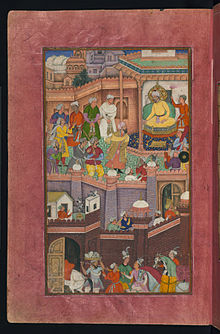
Khorasan ( Persian خراسان - Xorâsân - “where does the sun come from”) is a historical region located in Turkmenistan and in Eastern Iran . The name "Khorasan" has been known since the time of the Sassanids . Khorasan is known worldwide for the production of saffron and barberry [1] , which grow in the southern cities of the region (production - more than 170 tons annually). Khorasan is also known for its famous carpets and tombs of Firdousi , Omar Khayyam and Imam Reza .
Content
- 1 Administrative Division
- 2 History of Khorasan
- 3 Ethnic groups
- 4 See also
- 5 notes
Administrative Division
Khorasan was the largest province in Iran until it was divided into three provinces on September 29, 2004 . Provinces approved by Parliament (May 18, 2004) and Board of Trustees ( May 29, 2004):
- North Khorasan , center: Bojnurd , other districts: Shirvan , Jajarm, Meinh and Samlagan, Esfarayen.
- South Khorasan , center: Birjend , other districts: Sarayan, Nakhbandan, Sarbishekh
- Khorasan Rezavi , center: Mashhad , other districts: Gouchan, Dargaz, Chenaran, Sarakhs, Fariman, Torbate Jam, Teibad, Ferdous, Geyen, Khaf and Rashthar, Kashmar , Bardaskan, Nishapur , Sabzevar , Gonabad , Kalat, Bosh Hashal .
The History of Khorasan
Greater Khorasan included parts that are currently in Iran, Tajikistan , Afghanistan , Uzbekistan and Turkmenistan . Some of the main historical cities of Persia are located in Greater Khorasan: Nishapur (now in Iran), Merv and Sanjan (now in Turkmenistan), Herat . Over its long history, Khorasan knew many conquerors and empires: Greeks , Turks , Arabs , Seljuks , Mongols , Safavids and others.
In the XIV - XV centuries Khorasan was the most important center of sciences and arts. Here (mainly in the city of Herat ), poets Lutfi , Jami , Alisher Navoi , Fegani Baba , Sultan Hussein Baykara (who wrote poetry under the pseudonym Husaini ) lived and worked, the artist Behzad .
In 1524, the main centers in Khorasan were Herat (the capital), Mashhad (the site of the especially revered tomb of the 8th Imam, Rza) and Balkh . The peripheral regions of Astrabad , Kandahar and Kabul should be added to them, since while technically they may not have been parts of Khorasan, their history at that time was inextricably linked with the events in Khorasan itself.
The possession of the province during this period was divided between the Safavids holding Herat, Mashhad and Astrabad, and the last of the Timurids - Babur , who owned Kabul, Kandahar and Balkh. However, this political division was not at all permanent, since it arose recently, and, as we will see soon, the situation in Khorasan was unstable. In fact, the two Turkic states of Khorezm and Maverranahra (Transoxania) have already revived their claims to the region and sent raiders and armies south through the Karakum desert and Amu Darya, respectively, already in the year Tahmasp I ascended the throne.
Part of Khorasan, which was under the control of the Safavids, was integrated into the Kyzylbash system by Shah Ismail I as a result of a series of wars in 1510-1513 with the Turks who had been torn out of the region. The governors of the First Administration appointed after that (919-921 / 1513-1515) were Zeynal Khan Shamlu in Herat and Div Divine Sultan Rumlu in Balkh. The period was marked by a serious famine in Khorasan, the raids of the Turks through Amu, and the loss of Balkh to the Timurids.
Then, the Second Administration was appointed by the Shah to counter these disasters (921-927 / 1515-1521). At that time, the beginning of the tradition that was observed before Shah Abbas I was laid, according to which the prince of blood was appointed the nominal ruler in Khorasan with the kyzylbash guardian, who in reality controlled the province on behalf of the prince. The local army or garrisons were recruited mainly from their own Oymak Lala. The residence of the governors was Herat. It is quite curious that the first Shah ruler of Khorasan was the future Shah Tahmasp himself , who was at the time of his appointment a 2-year-old baby. His lala was Amir Khan Turkman. This administration was eventually ousted by Shah Ismail for corruption, for the political assassination of Sadr Khorasan, and for his inability to deal with the Turkic siege of Herat in 1521 and the threat of Babur Kandahar. Among the Kyzylbashi in Herat during this period was Sufiyan Khalifa Rumlu, who will play an important role in Khorasan during the period of Shah Tahmasp.
When ascending the throne of Tahmasp, we will meet the Third Administration, which was formed at the end of 1521. The Safavid Khorasan then extended from the borders of Mazendaran to Amu and to the south up to (ta) Gur and Gardzhistan and Sistan.
The nominal governor then was the seven-year-old Sam Mirza, the younger brother of Shah Tahmasp; his lala, the real ruler, was Durmush khan Shamlu. Along with the new Shamlu administration, such kizilbash personalities as Khalifa Muhammad Sultan, Sirajaddin bey, Khalkhal Bahadur and Khizr bey arrived. Among the officials sent by the court along with the shamlu were Khoja Muzaffar Tabakchi and Khoja Habibullah, who became the vizier of the province.
Durmush Khan himself appointed the following individuals as sub-governors in the Khorasan district outside of Herat:
Zeynal Khan Shamlu in Astrabad (Gorgan); Zeynaddin Sultan Shamlu in Isfarain and Nishapur; Burun of Sultan Tekelu (who previously held the post of Governor Isfarain) in Tus and Mashhad; Chakirge Sultan Shamlu was reappointed by the Governor of Sebzevar; Ahmed Bek Afshar (former Governor of Mashhad), after being offended and personally intervened by Shah Ismail, was appointed to Farah and the valley of the Heratrud River ...
Thus, it can be seen that by 1523, western Khorasan was a fully integrated province of Safavid Iran. He had his own dynastic representative - Mirza herself, his own oymak - mainly shamlu, and an impressive number of Tajik officials [2] . Prior to the reign of Muhammad Khudabende , the governor of Khorasan was his guardian Mohammed Khan Tekeli [3] .
Ethnic groups
The main ethnic groups in this area are Persians , but Khorasan, as a result of its complex history, is inhabited by a wide variety of ethnic groups: Turkmens , Khorasan Turks in the northwest, Kurds around Bojnurd and Kachan, Teymuri and Jameshids (members of the Cheher Aymak association) in the east, some of which are still nomads ( ilat ), further to the southwest - heidaris, and to the southeast - balochis. There is also a large Afghan community in the area due to the influx of refugees from Afghanistan in recent years. There are Khorasan Arabs , gypsies and Jews in cities. Languages of Khorasan: Khorasan-Turkic , Persian and Kurdish .
The grave of Kamal al-Mulk in Nishapur
Attara's grave in Nishapur
See also
- Khorezm
- Afsharids
Notes
- ↑ Barberry production in Khorasan
- ↑ MB Dickson. "Shah Tahmasp & the Uzbeks (The Duel for Khurasan with Ubayd Khan: 930-940 / 1524-1540)."
- ↑ M. Szuppe, “Kinship Ties between the Safavids and the Qizilbash Amirs in Late Sixteen-Century Iran: a Case Study of the Political Career of Members of the Sharaf al-Din Oghli Tekelu Family”