White poplar , or Silver poplar ( lat. Pópulus álba ) - a type of deciduous tree from the genus Poplar ( Populus ) of the family Willow ( Salicaceae ).
| White poplar | |||||||||||||||||||||
 General view of an adult plant | |||||||||||||||||||||
| Scientific classification | |||||||||||||||||||||
|---|---|---|---|---|---|---|---|---|---|---|---|---|---|---|---|---|---|---|---|---|---|
| |||||||||||||||||||||
| International scientific name | |||||||||||||||||||||
Populus alba L. , 1753 | |||||||||||||||||||||
| Synonyms | |||||||||||||||||||||
| |||||||||||||||||||||
| Area | |||||||||||||||||||||
| |||||||||||||||||||||
Content
Distribution and Ecology
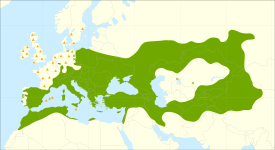
It grows wild in North Africa ( Algeria , Morocco , Tunisia , the Canary Islands ), almost throughout Europe (except for Scandinavia ), Asia Minor , Middle and East [2] .
The culture is grown in Europe (northern border at 68 ° N), Asia , North America .
It grows in floodplains on fertile and fairly moist soils , forming forests , groves or solitary trees. It tolerates prolonged flooding, resistant to slight salinization of the soil.
Botanical Description
A tree up to 30–35 m high and a trunk diameter of up to 2 m. The crown is wide, hipped, starts low from the ground, with a single development. The bark of the trunk and large branches is gray-green, smooth; young shoots white-felt; in old age, the bark is dark gray or black, with deep cracks.
The kidneys are small up to 0.5 cm long, ovoid, shiny, not sticky. The leaves are ovoid-rounded or ovoid-triangular, dense; dark green, shiny, silvery above; pubescent, white-felt below. Leaves on long shoots are 3-5-palmate-lobed, 4-12 cm long, 2.5-10 cm wide; on short shoots - round, lobed or 3-5-angled. Petioles are cylindrical, pubescent, often 2-3 times shorter than the leaf blade. In autumn, most of the leaves fall green, the smaller - is painted in lemon yellow.
Stamen earrings thick, 3-7 cm long; bracts reddish-brownish, glabrous, eight to ten stamens. Pestle earrings 10-12 cm long; stigmas yellowish or whitish.
It has a powerful root system that extends beyond the crown projection , consisting of both deep-lying and superficial roots , which produce abundant root offspring, often at a considerable distance from the mother tree.
It grows rapidly, by the age of 30-40 it reaches a height of 20-25 m and a trunk diameter of up to 0.5 m.
Meaning and Application
The wood is coarse-grained, glossy, with a yellowish core and white sapwood , soft, light, with a macroscopic structure and physicomechanical properties, it is close to the wood of poporida ( Populus nigra ). It is used in the production of flooring , various lumber, carpentry (doors, windows) and turning products.
Leaves go to livestock feed.
Bark is used in the tanning industry.
It is cultivated in many areas as a garden plant.
Taxonomy
White poplar species is a member of the genus Poplar ( Populus ) of the Willow family ( Salicaceae ) of the order Malpighiales ( Malpighiales ).
| 36 more families (according to APG II System ) | another 25–35 species | ||||||||||||
| order Malpigh | clan Poplar | ||||||||||||
| Department of Flowering, or Angiosperms | family willow | view White poplar | |||||||||||
| 44 more order flowering plants (according to APG II System ) | about 57 more births | ||||||||||||
Notes
- ↑ For the conventionality of specifying the class of dicotyledons as a superior taxon for the plant group described in this article, see the APG Systems section of the Dicotyledonous article .
- ↑ According to the GRIN website (see plant card).
Literature
- Lyrics on Populus alba in Wikisource
- Komarov V. L. Genus 357. Poplar - Populus L. // Flora of the USSR : in 30 tons / chap. ed. V.L. Komarov . - M .; L .: Publishing House of the Academy of Sciences of the USSR , 1936. - T. 5 / ed. volumes V. L. Komarov. - S. 225—226. - 762, XXVI p. - 5175 copies.
- Sokolov S. Ya., Shipchinsky N.V., Yarmolenko A.V. Genus 3. Populus L. - Poplar // Trees and Shrubs of the USSR. Wild, cultivated and promising for introduction. / Ed. volumes S. Ya. Sokolov . - M. - L .: Publishing House of the Academy of Sciences of the USSR , 1951. - T. II. Angiosperms. - S. 187-188. - 612 p. - 2500 copies.