Karl Vogt or Karl Vogt ( German: Carl Vogt ; July 5, 1817 , Giessen - May 5, 1895 , Geneva ) - German naturalist, zoologist , paleontologist , doctor (a significant part of his career worked in Switzerland and France ). Also known as a philosopher, a representative of vulgar materialism (Vogt's philosophical views are set forth in his natural-scientific works).
| Karl Focht | |
|---|---|
| him. Carl Vogt | |
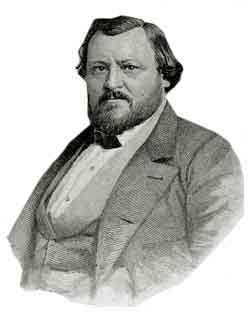 Karl Focht (1817-1895) | |
| Date of Birth | |
| Place of Birth | |
| Date of death | |
| Place of death | |
| A country | German Union, German Empire |
| Scientific field | zoology, paleontology, philosophy |
| Place of work | |
| Famous students | Alexander Alexandrovich Herzen |
| Known as | representative of vulgar materialism |
Content
Biography
He was brought up in Giessen , where his father occupied the department of medicine, and immediately received his first university education, listening to medical lectures from 1833 and studying at the Liebig chemical laboratory. In 1835 , when his father was invited by a professor to Bern , Voigt also transferred to this university; engaging in anatomical and physiological studies under the direction of Valentine, in 1839 he was awarded the degree of Doctor of Medicine. Soon after, Focht moved to Neuchatel and, together with Dezor and Agassis, carried out a number of studies in the field of zoology and geology in the newly established Agassis zoological and geological laboratory. The main subject of research during this period of his life was the history of development, anatomy and paleontology of fish, the history of the development of midwives, the origin of the so-called. red snow (the cause of which he saw in the presence of tardigrades and one species of rotifers ) and, finally, geology and especially the origin of glaciers . From 1844 to 1846 He lived in Paris , and partly in Nice , continuing his research on zoology and geology; here he wrote his famous Physiological Letters, translated into almost all European languages, and a textbook of geology and paleontology, originally compiled from the lectures of Ely de Beaumont .
In 1847 , while in Nice, he received an invitation to occupy the department of zoology in his hometown of Giessen , but the following year he was forced to flee to Switzerland : taking a lively part in the revolutionary events of 1848 (he was a deputy of the left wing in the National Assembly in Frankfurt and one of the five regents of the Empire), was dismissed from service and was eventually sentenced to death. During this period of activity, Fogt published the popular science work “Ocean and the Mediterranean Sea ”, which contained the results of studies carried out during his first stay in France and on the Mediterranean coast. In this essay, as well as in his Physiological Letters, Focht for the first time showed outstanding talent in portraying nature in a popular scientific form. In Bern , where Focht fled from Germany, he did not live long and from 1850 to 1852 . he again began to study the fauna of the Mediterranean Sea in Nice, and at the same time compiled a zoology textbook, excellent for its time, under the title “Zoological Letters”; in 1852 received an invitation to give lectures on zoology in Geneva , and after the death of Pictet (Pictet) took up the department of zoology, comparative anatomy and paleontology. Here, after a long period of wandering, he remained until his death, doing first zoological research, then anthropology, and in the eighties he returned again to purely zoological works. During this period of scientific activity, his Lectures on a Man appeared, in which he became an ardent defender of the polyphyletic origin of man and provoked a lively polemic with an article on microcephalus ; in the last years of his life he undertook two more capital works, namely, the natural history of mammals and the textbook of comparative anatomy. He served as rector of the University of Geneva .
Focht, who early drew attention to the importance of ontogenetic research, was an ardent admirer of Darwinism , although in particular his views sometimes diverged from Darwin's ; he is considered one of the most fervent German advanced fighters for the idea of materialism in the natural sciences. He was a brilliant teacher and speaker both in the field of science and in his political activities, taking an ardent participation in all public and state affairs.
According to the historian and sociologist B.F. Porshneva : the famous statement that “man descended from a monkey” doesn’t belong to C. Darwin, since this thesis was discovered and fundamentally substantiated by Voigt in public lectures delivered by him in 1862 in Neuchâtel and thus: “... priority K should be recognized Fohta in creating a theory of the origin of man from the monkey " [5] .
Major works
Of the many works, the most outstanding:
- "Zur Anatomie der Amphibien" (Bern, 1839);
- “Beiträge zur Neurologie der Reptilien” (Bern, 1840);
- “Embryologie des Salmones” (comp. 1st volume op. L. Agassis, “Histoire naturelle des Poissons d'eau douce de l'Europe centrale”, Neuchatel, 1842);
- “Untersuchungen über die Entwicklungsgeschichte der Geburtshelferkröte (Alytes obstetricans)” (Soloturn, 1842);
- "Im Gebirg und auf den Gletschern" (ibid., 1843);
- “Anatomie des Salmones” (together with Agassis , “Mem. Soc. Sc. Nat.”, Neuchatel, 1845);
- “Lehrbuch der Geologie und Petrefactenkunde” (2 vol., Braunschweig, 1846, 5th ed. 1879);
- "Recherches sur l'embryogénie des Mollusques gastéropodes" ("Ann. Sc. Nat." 1846);
- Physiologische Briefe (3 div., Stuttgart, 1845-1846; 4th ed. Giessen, 1874);
- Ocean und Mittelmeer (2 vol., Frankfurt, 1848);
- “Zoologische Briefe” (2 vols., Ibid., 1851);
- “Naturgeschichte der lebenden und untergegangenen Thiere etc.” (2 vols., Ibid., 1851);
- Untersuchungen über die Thierstaaten (ibid., 1851);
- “Bilder aus dem Thierleben” (ibid., 1852);
- “Mémoire sur les Hectocotyles etc.” (together with Verani, “Ann. Sc. Nat”, 1852);
- Köhlerglaube und Wissenschaft. Eine Streitschrift gegen Rudolph Wagner "(4th ed., Giessen, 1856);
- “Mémoire sur les Syphonophores de la mer de Nice” (Mem. Inst. Genevois, 1853);
- "Altes und Neues aus Thier- und Menschenleben" (Frankfurt, 1859);
- Die Künstliche Fischzucht (Lp., 1859; 2nd ed. 1875);
- Vorlesungen über nützliche und schädliche Thiere (ibid., 1865);
- “Vorlesungen über den Menschen” (2 vols., Giessen, 1864);
- “Mémoires sur les microcéphales ou hommes singes” (“Mém. Inst. Nat. Genevois”, 1867);
- "Atlas der Zoologie" (33 tablets, Lpts., 1875);
- Die Herkunft der Eingeweidewürmer des Menschen (Basel, 1877);
- “Die Säugethiere in Wort und Bild” (Munich, 1883);
- “Lehrbuch der praktischen vergleichenden Anatomie” (together with E. Jung, 2 vol., Braunschweig, 1888-1894);
- "Aus meinem Leben, Erinnerungen und Rückblicke" (Stuttgart, 1895). Most of the works, with the exception of monographs, have been translated into Russian.
Works on Karl Vogt
- Karl Marx "Mr. Vogt" , 1860
- Alexander Ivanovich Herzen , “The Past and Thoughts,” Volume II, “The Story of Family Drama”
Notes
- ↑ 1 2 3 German National Library , Berlin State Library , Bavarian State Library , etc. Record # 118769014 // General regulatory control (GND) - 2012—2016.
- ↑ BNF ID : 2011 Open Data Platform .
- ↑ 1 2 SNAC - 2010.
- ↑ Voigt Karl // Great Soviet Encyclopedia : [in 30 vol.] / Ed. A. M. Prokhorov - 3rd ed. - M .: Soviet Encyclopedia , 1969.
- ↑ Boris Fedorovich Porshnev, Boris Didenko. On the beginning of human history: problems of paleopsychology . - FERI-V, 2006 .-- 648 p.
Literature
- Porshnev B.F. About the beginning of human history (problems of paleopsychology). S-Pb., 2007. (Restored. O. Vite original original text.) The first edition - 1974, the second - M .: FERI-V, 2006. - 640 pp.