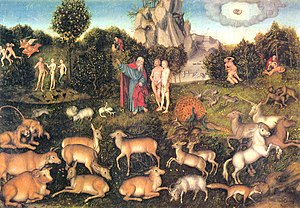
The Bible mentions many animal creatures. The identification of a number of animals, their names and features are a debatable issue of translating the original text of the Bible into various languages.
Content
- 1 Bible Talking Animals
- 2 Mysterious and mythical creatures
- 3 Cara animals
- 4 Animal sculptures
- 5 Birds in the Bible
- 6 Other Bible Animals
- 7 See also
- 8 Notes
- 9 References
Bible Talking Animals

- The snake ( Heb. נחש ) is the first animal appearing in the Old Testament . The serpent was the tempter of Eve and led the ancestors of the people to the fall and expulsion from paradise .
 | The serpent was more cunning than all the animals of the field, which the Lord God created. And the serpent said to his wife: Did God truly say: Do not eat from any tree in paradise? And the wife said to the snake: we can eat the fruits of the trees, only the fruits of the tree, which in the midst of paradise, God said, do not eat them and do not touch them, lest you die. And the serpent said to his wife: No, you will not die, but God knows that on the day that you taste them, your eyes will be opened, and you will be like gods who know good and evil. ( Genesis 3: 1-5 ) |  |
| And the Lord God said to the serpent: because you did this, you are cursed before all cattle and before all beasts of the field; you will walk on your womb, and you will eat dust all the days of your life; And I will put enmity between you and the woman, and between your seed and her seed; it will hit you in the head, and you will sting him in the heel. ( Genesis 3: 14-15 ) | |
- Balaam’s donkey ( Hebrew אתון ) is the donkey of the prophet Balaam , on which he rode to the king of Moab, Balak , to curse the Israelites.
| And the donkey saw the angel of the Lord standing on the road with a drawn sword in his hand, and the donkey turned off the road, and went into the field; and Balaam began to beat the donkey in order to return it to the road. And the angel of the Lord stood on a narrow road, between the vineyards, [where] on one side is a wall and on the other side is a wall. The donkey, having seen the Angel of the Lord, pressed itself against the wall and pressed Balaam's leg against the wall; and again he began to beat her. The angel of the Lord again crossed and stood in a cramped place where there was nowhere to turn, neither right nor left. The donkey, having seen the Angel of the Lord, lay under Balaam. And the anger of Balaam was kindled, and he began to beat the donkey with a stick. And the Lord opened the mouth of the donkey, and she said to Balaam: what have I done to you, that you have been beating me for the third time? Balaam said to the donkey: because you had a fight with me; if I had a sword in my hand, I would now kill you. But the donkey said to Balaam: Am I not your donkey, whom you rode first to this day? did I have a habit of doing this to you? He said no. And the Lord opened the eyes of Balaam, and he saw the angel of the Lord standing on the road with his sword drawn in his hand, and bowed himself, and fell on his face. And the angel of the Lord said unto him, Why have you beaten your donkey three times now? I went out to prevent [you], because [your] path is not right before Me; and the donkey, seeing Me, turned away from Me three times already; if she had not turned away from Me, I would have killed you, but I would have left her alive. ( Num. 22: 23–33 ) |
Mysterious and mythical creatures
The Bible mentions creatures whose identification is difficult or impossible at the current level of development of science. The words used by translators for these animals sometimes coincide with the names of mythical creatures ( Dragons , unicorns , etc.).
- Hippopotamus - The biblical word "hippopotamus" was assigned to a mammal now known under this name in the 19th century .
- Dragons - The Psalter speaks of the captivity of Jews in Egypt, which is figuratively called the “land of dragons” ( Psalm 43:20 ). [1] In the Old Testament, “dragons” are allegorically used to describe poison: “their wine is the poison of dragons and the fatal poison of aspids” ( Deut. 32:33 ). The book of Daniel contains a story about how in Babylon Daniel killed a “dragon” in a temple with a ball of tar, fat and hair ( Dan. 14: 23–28 ). The dragon is most often mentioned in the book of Revelation of St. John the Evangelist ( Rev. 12-13 , 16:13 , 20: 2 , see Beast of the Apocalypse ).
- Unicorn - it is allegorically used to describe the speed of God’s action: “God led them out of Egypt, the speed of the unicorn is with him;” ( Num. 23:22 ). And it is also referred to as an existing animal: “Will the unicorn want to serve you and spend the night with your manger? Can you tie the unicorn with a rope to the furrow, and will he harrow the field for you? Do you rely on him because he has great power, and will you give him your work? Do you believe him that he will return your seeds and put them on your threshing floor? ” ( Job 39: 9-12 )
- Leviathan is a sea monster ( Heb. לווייתן ) from the Book of Job ( Job 40: 20–41: 26 , Job 7:12 ).
Animal
- Ten executions of Egyptian (invasion of frogs, invasion of midges, invasion of wild animals, invasion of locusts)
- Damnatio ad bestias # Perception of death from animals in religion
- The killing of 42 children with two bears: “And he went from there to Bethel. When he walked along the road, small children left the city and mocked him and said to him: go, bald! go bald! He looked around and saw them and cursed them with the name of the Lord. And two she-bears came out of the forest and tore apart from them forty-two children. ” ( 2 Kings 2: 23-24 )
Animal Sculptures
- Golden Taurus
- Copper serpent
Birds in the Bible
Birds in the Bible served as a source of food ( Esau hunted them), some species of birds were forbidden to eat. Also, birds were sacrificed. Often birds play a symbolic role.
- Sparrow ( Prov. 26: 2 )
- raven ( Job 38:41 )
- dove ( Genesis 8: 8 , Matt. 3:16 , 10:16 )
- vulture ( Lev. 11:13 )
- ibis ( Deut. 14:16 )
- kite ( Deut. 14:13 )
- Gyrfalcon ( Deut. 14:13 )
- swallow ( Prov. 26: 2 )
- the swan ( Deut. 14:16 )
- the eagle ( Deut. 14:12 , Job. 39:27 )
- peacock ( Job 39:13 )
- Pelican ( Deut. 14:17 , Sof. 2:14 )
- angler ( Deut. 14:17 )
- the owl ( Deut. 14:15 )
- ostrich ( Deut. 14:15 )
- hoopoe ( Deut. 14:18 )
- eagle owl ( Deut. 14:16 )
- heron ( Deut. 14:18 )
- seagull ( Deut. 14:15 )
- hawk ( Deut. 14:15 , Job. 39:26 )
Other Bible Animals
The names of animals as well as birds are listed in chapter 11 of the book of Leviticus, which explains which animals and birds can be eaten, and which cannot. In the texts of the Septugintes , Vulgates , Masoretic , Slavic and in the synodal, the listed animals and birds differ [2] [3] [4] .
Some animals:
B
- Bars ( dr. Greek πάρδαλις - Jer. 5: 6 )
- The Bull ( Greek Greek βοῦς, βόες - 34:28 , Gen. 41:18 , Job 1: 3,14 , 42:12 )
AT
- The Camel ( Dr. Greek κάμηλος - Genesis 24:61 , 31:17 , 37:25 , 1 Sam. 30:17 , Isa. 21: 7 , 21: 7 )
- Wolf ( dr. Greek λύκος - Gen. 49:27 ). Description of the Wolf - Jer. 5: 6 , Hab. 1: 8 , Sof. 3: 3 , Ezek. 22:27 , Matt. 7:15 , 10:16 , Acts. 20:29 .
E
- Egyptian cobra (asp) ( dr. Greek ἀσπίδος - Isa. 59: 5 )
Yo
- Hedgehog ( dr. Greek ἐχῖνος - Soph. 2:14 )
3
- Hare or Rabbit ( other Greek δασύ-πους - literally: “ bore feet ” - Lev. 11: 6 , Deut. 14: 7 ). Biblical decrees regarding animals allowed for food say that you must not eat “a hare because he chews gum, but his hooves are not bifurcated, he is unclean for you” ( Lev. 11: 6 ). In the original - Hebrew. וְאֶת־הָאַרְנֶבֶת כִּי־מַעֲלַת גֵּרָה הִוא וּפַרְסָה לֹא הִפְרִיסָה טְמֵאָה הִוא לָכֶם . The word “Parsa” ( Hebrew פרסה ) can be translated as “ hoof, foot, horseshoe, human foot size, sole ” and this phrase is sometimes understood only as an indication that the hare does not belong to artiodactyls. [5]
- Snake ( Greek: ἔχιδνα - Matt. 3: 7 , Luke 3: 7 )
TO
- Goat ( dr. Greek αἶξ - Gen. 15: 9 , 30:35 , 31:38 , Ex. 12: 5 , Lev. 4:23 , Num. 28:15 )
- Whale ( Greek: κῆτος - Genesis 1:21 )
- Cow ( dr. Greek μόσχος - Lev. 22:28 , Ex. 23:19 , Deut. 22: 6,7 )
- Crocodile - Is. 51: 9 )
- Mole ( Dr. Greek ἀσπάλαξ - Lev. 11:30 )
L
- Weasel ( dr. Greek γαλῆ - Lev. 11:29 )
- The Bat ( Dr. Greek νυκτερίδα - Lev. 11:19 , Deut. 14:18 ). The Bible is referred to as “bat” and is referred to as birds.
- The horse ( Greek: ἵππῳ, ἵππος - Isa. 28:28 , Job 39: 19-25 ).
- Loshak or Mule ( dr. Greek ἡμί-ονος - literally: “semi donkey ” - Psalm 31: 9 )
- Leopard ( Dr. Greek πάρδαλις - Isa. 11: 6 , Jer. 5: 6 , 13:23 , Hab. 1: 8 , Dan. 7: 6 , Rev. 13: 2 )
- Leo ( dr. Greek λέων - Gen. 49: 9 , Judgment 14: 5-6 , 14:18 , 1 Samuel 17: 34-35 , 2 Samuel 17:10 , 3 Samuel 13: 24-25 , 4 Samuel 17: 25-26 , Amos 3:12 )
- The Frog ( Dr. Greek βάτρᾰχος - Exodus 8: 2-14 , Psalm 78:45 , 105:30 , Rev. 16:13 )
- Fox ( dr. Greek ἀλώπηξ - Ezek. 13: 4 , Luke 13:32 , Judgment 15: 4-5 )
M
- The Bear ( Dr. Greek ἄρκος - 1 Sam. 17: 34–37 , 4 Sam . 2:24 )
- The mouse ( Greek Greek μῦς - Lev. 11:29 )
- Field mouse ( dr. Greek. Μυγάλη - Lev. 11:30 )
ABOUT
- Monkey ( church glory. пίθикъ from other Greek πίθηκος ; lat simia - 3Kings 10:22 ).
- Sheep ( Greek: πρόβατον - Ex. 29: 38–42 , Numbers 28: 9,11 , Lev. 9: 3 , 12: 5 , –25 , –20 , 1 Ch . 29:21 , 2 Ch. 29 : 21 )
- Deer ( Greek: ἔλᾰφος - Psalm 103: 18 )
- Donkey ( Dr. Greek ὄνος - Gen. 12:16 , 45:23 , Numbers 22:23 , 1 Sam. 9: 3 , Gen. 49:14 )
R
- Fish ( other Greek ἰχθύς - Gen. 9: 2 , Num. 11: 22-28 ), John. 2: 1.10 )
FROM
- Dog ( other Greek: κύων, κυνός - 1 Sam. 14:11 , 16: 4 ,, 23 , 22:38 , Psalm 59: 6.14 )
- Elephant ( other Greek ἐλέφας, ἐλέφαντος ) - in the Jewish canon of the Bible, as in Homer's poems, is not mentioned as an animal, but other Greek is mentioned . ἐλεφάντινον - ivory ( Rev. 18:12 , 1 Kings 10:22 , 2 Chronicles 9:21 ). Mentioned in the Orthodox and Catholic canons of the Bible ( 1Mak. 3:34 , 6:46 , 11:56 , 2Mak. 11: 4 , 3Mak. 5: 1-6: 19 [6] )
T
- Calf ( dr. Greek μόσχος - Gen. 12:16 )
- Triton ( dr. Greek καλαβώτης - Lev. 11:30 )
- Jerboa ( dr. Greek χοιρογρύλλιον - Lev. 11: 6 )
X
- Chameleon ( Greek: χαμαιλέων - Lev. 11:30 )
I AM
- Lizard ( dr. Greek κροκόδειλος χ χερσαῖος - literally: "land crocodile" - Lev. 11:29 ; dr. Greek. Σαύρα - Lev. 11:30 )
See also
- Bible plants
Notes
- ↑ In Slavic translations, “land of dragons” is replaced by “place of bitterness”
- ↑ The Bible in 5 languages: Slavic, Russian, Ancient Greek, Latin, Hebrew. Leviticus Chapter 11
- ↑ Torah with commentary by Rashi Waiikro Book Shmini Weekly Chapter 11
- ↑ Interlinear translation of the Leviticus chapter 11
- ↑ Ruminant Bunny with Hooves
- ↑ The third book of Maccabees is included in the Orthodox canon, but is not included in the Catholic canon of the Bible