
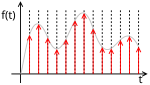
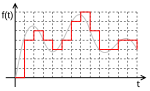
Quantization ( Engl. Quantization ) - in signal processing - dividing the range of reference signal values into a finite number of levels and rounding these values to one of the two levels closest to them [1] . In this case, the signal value can be rounded to the nearest level, or to the smaller or larger of the nearest levels, depending on the encoding method [2] . Such quantization is called scalar. There is also vector quantization — dividing the space of possible values of a vector quantity into a finite number of regions and replacing these values with the identifier of one of these regions [3] .
Quantization should not be confused with discretization (and, accordingly, the quantization step with the sampling rate ). During sampling, a time-varying quantity (signal) is measured at a given frequency (sampling frequency), so sampling divides the signal by the time component (horizontally on the graph). Quantization leads the signal to the given values, that is, it rounds the signal to the levels closest to it (in the graph — vertically). In the ADC, rounding can be done to the nearest lower level. A signal to which discretization and quantization is applied is called digital .
Quantization is often used in signal processing , including compression of sound and images.
When a signal is digitized , the number of bits encoding one quantization level is called the quantization depth or bit depth . The greater the quantization depth and the greater the sampling frequency, the more accurately the digital signal corresponds to the analog one. In the case of uniform quantization, the quantization depth determines the dynamic range , measured in decibels (1 bit per 6 dB) [4] .
Content
Quantization Types
Uniform (homogeneous) quantization - splitting the range of signal samples into segments of equal length and replacing these values with the nearest quantization level . In this case, two quantization options are possible [5] :
1. If the signal values are in the range where - quantization step, then they are rounded to the level (midrise - quantization characteristic with zero at the border of the quantization step):
2. If the signal values are in the range , then they are rounded to the zero level (midtread is the quantization characteristic with zero in the center of the quantization step):
- ,
Where - rounding to the nearest smaller integer .
After sampling and quantization, a digital signal is obtained. Then quantization level replaced by a set of numbers. For quantization in binary code, the range of the signal from the minimum value to the maximum value divided by quantization levels where - bit quantization. The value of the resulting interval between levels (quantization step):
Each level is assigned -bit binary code - level number written in binary number. Each signal reference is assigned a code of the level closest to it. Thus, after sampling and quantization, the analog signal is represented by a sequence of binary numbers corresponding to the signal values at certain points in time, that is, a binary signal. Moreover, each binary number is represented by a sequence of pulses of high (1) and low (0) level. Bit quantization of sound is usually chosen equal to from 8 to 32 bits ( comparison of digital audio formats ), but usually 16 or 24 bits [6] .
Unequal quantization - quantization in which the splitting of the range of signal values is performed into segments of unequal length. It is used to improve the accuracy of quantization in the case when the distribution of signal values is uneven, for example, when quantizing sound. Moreover, quantization levels should be located more often in those areas where signal values are more likely. When quantizing speech signals, a compressor is used more often, increasing small signal values and decreasing large values, and subsequent uniform quantization.
Quantization Methods
- Pulse Code Modulation
- Delta modulation
- Sigma-delta modulation
Notes
- ↑ Solonina A. I. Algorithms and processors of digital signal processing. - C. 8
- ↑ Solonina A. I. Fundamentals of Digital Signal Processing: Lecture Course. 2nd ed. - 2012. - C. 299
- ↑ Pramod Jain. A Vector Quantization Multistart Method for Global Optimization. - University of California, 1989 .-- P. 37.
- ↑ Smirnov S.V. Means and systems of technical support for the processing, storage and transmission of information. - MGIU, 2011 .-- S. 260
- ↑ William A. Pearlman, Amir Said. Digital Signal Compression: Principles and Practice. - Cambridge University Press, 2011 .-- P. 83
- ↑ Peter Kirn. Digital sound. Real world. - 2008. - S. 65
See also
- ADC and DAC
- Digitization
- Sampling
- Secondment