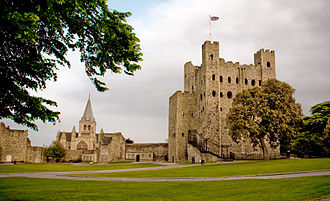
Rochester Castle ( English Rochester Castle ) - a castle on the east bank of the River Medway in the city of Rochester , Kent , South East England . The brightest part of the castle is the 12th century donjon , which is the best preserved compared to other castles in England .
| Castle | |
| Rochester Castle | |
|---|---|
| English Rochester castle | |
| |
| A country | Great Britain |
| City | Rochester ( Kent ) |
| Founding date | 1087 year |
| Building | 1089 - 1127 years |
| Status | Protected by the organization " English Heritage " |
| Material | and |
| condition | Dilapidated |
| Site | english-heritage.org.uk/… |
The location of the castle was an important strategic object for the royal family. The first wooden structure was founded after the Norman Conquest , and then placed under the control of Bishop Odo , one of the supporters of King William the Conqueror . During the uprising of 1088 , Odo supported Robert Kurtgöz , the eldest son of William the Conqueror, against William Rufus . Because of this, Rochester Castle first experienced hostilities - Odo made him one of the centers of the uprising, and then the city and the castle were taken under siege. After the surrender of the garrison , the castle was briefly abandoned.
Around 1089, Rufus asked Gandalf of Rochester to rebuild the wooden fortification in Rochester into a stone castle. So its modern look. Despite the fact that from that time the walls were rebuilt and rebuilt several times, the main work of Gandalf reached our days. In 1127, King Henry I transferred the castle to the property of the Archbishops of Canterbury indefinitely. Wilhelm de Corbeil built a massive donjon that still dominates the castle. During the 12th century, the building remained under the care of the archbishops.
During the First Baronial War (1215–1217) against King John , baronial troops seized the castle, at the time ruled by Archbishop Stephen Langton . After the siege of the castle by the king, contemporaries noted that "there had never been such strong resistance during the siege." The defense lasted about seven weeks, during which the external walls were damaged, and one of the sides of the donjon collapsed. The defenders of the castle surrendered only under the threat of starvation. However, John did not celebrate long - in 1216, the future king of France , Prince Louis , who was the new baronial leader, took control of Rochester Castle. After the death of John, his son, Henry III , took the throne. A year later, with the end of the war, the castle was returned to the royal power.
The third time Rochester Castle was besieged during the Second Baronial War (1264-1267). The royal constable of the castle, Roger de Layborne , led the defense in support of King Henry III. The rebel forces, led by Simon de Montfort and Gilbert de Claire , entered the city and wanted to take possession of the castle. The siege lasted about a week, but with a different result. The attacking troops independently lifted the siege, in connection with the escape of the king from captivity. However, the construction still suffered significantly and was not restored until the next century.
The castle was last attacked in 1381, during the peasant uprising of Wat Tyler . This time he was captured and plundered. Rochester Castle and its territory were opened to the public in the 1870s as a park. During the 19th and 20th centuries, it was repaired several times, and nowadays it is protected by the English Heritage organization as a monument with a high degree of importance.
Content
History
Foundation
The construction of castles (type motte and bailey ) in England began with the Normans in the XI century after the Norman conquest. Housing and defensive buildings helped them to strengthen in this area. Archaeologist Tom McNeil suggested that the first castles of England were used only for military purposes, as a place for the maintenance of large troops in a hostile area. Since the XI century, the castle near the city has become a prerequisite in England [1] .
Rochester was an important city, built on the site of an old Roman fortress, located at the junction of the River Medway and Watling Street Road . According to the Last Judgment book , the Bishop of Rochester received land in the village of Aylesford in Kent, as compensation for the land that was allocated to Rochester Castle. Of the 48 castles mentioned in the survey, the land of this was the only one compensated [2] . A garrison with a large number of knights was often recruited into castles of similar types. The wooden castle of Rochester had a standing army of 60 paid knights, which made it a particularly important fortification [3] .
It is likely that William the Conqueror himself handed over the castle to the custody of Bishop Odo, his brother. After the death of William in September 1087, the royal territory was divided between his two sons. Robert, the eldest of them, received the title of Duke of Normandy , and William Rufus became king of England. A significant number of barons were opposed to the division of Normandy and England, after which Bishop Odo supported Robert in his claims to the English throne. Rochester Castle was prepared for war and became one of the central centers of the uprising. Its location in Kent was very convenient for attacks on London and the royal troops in the district. In response, the king decided to besiege the castle, but it was rumored that Odo was not in Rochester, but in Pevensey Castle , which was under the control of Robert, Count de Morten . After the capture of Pevensey and Odo, the bishop agreed with the king on the terms of the surrender of Rochester. However, during the negotiations, Odo managed to cross into the rebel camp (it is possible that he was captured by them). The siege of Rochester began in May 1088 - the castle and the city were swept from two sides in order to cut off the supply lines of the defenders and prevent their possible sorties. The defense lasted for several months, during which diseases aggravated by high temperatures raged in the city. As a result, the garrison surrendered under the threat of famine, and the seized organizers of the uprising were amnestied. Some of them had the opportunity to save land ownership, while others, including Odo, were deprived of all titles and expelled from England [4] .
After the capture of the city, Rochester Castle was briefly abandoned [5] . Archbishop Lanfranc and Bishop Gandalf , who owned the territory of Rochester from the time of William the Conqueror, asked the new king to confirm their right to rule. Wilhelm II in return demanded payment for a permit, but since the amount was large for religious figures, a compromise was found - Gandalf had to build a new castle and replace the wooden fortifications with stone ones in the south-west corner of the city walls. New constructions were founded between 1087 and 1089, while some of them have survived to this day, turned out to be built into the city wall, which remains from the time of the Roman Empire . Initially, the bishops were concerned that the construction would be even more expensive than paying for permission to manage the territory, and after the construction of the castle they will be responsible for its maintenance. However, Heinrich de Beaumont convinced them that the castle is very necessary for the king, costs will be less than expected, and after construction it can be transferred to someone else [6] . Gandalf was a very skilled architect and oversaw the construction of the White Tower of the Tower and the Castle of Heingham [7] . In addition, after Odo it was necessary to restore the Rochester Cathedral , the location of which shows one of the best examples of connectedness of the castle and religious buildings. Archaeologist Oliver Crichton argues that if the castle was located close to the cathedral, both of them could belong to the same bishop [8] .
In 1127, King Henry I transferred the castle under the control of Wilhelm de Corbeil and his successors for an unlimited period. During the transfer, there was one condition - to make “a fortification or a tower that would be held forever and ever” ( eng. “Fortification or tower” ). Thus, Wilhelm de Corbeil became responsible for creating the dungeon , which rises majestically over the whole castle and has survived to our time, albeit in a slightly modified form [9] . The tower acted as the best residence in the castle, and during hostilities was the main stronghold of the garrison. This important part of the fortress became a symbol of the city and in the XIII century was depicted on its seal [10] .
Construction proceeded at a speed of about three meters per year. Most likely, it was completed after the death of Corbeil in 1138 and, of course, before the year 1141, when Robert, the 1st Earl of Gloucester , was kept under arrest in the castle [11] [12] . Despite the fact that the building was under the control of the archbishops, the king himself provided financial support for its maintenance [9] . After Philip II seized Normandy in 1204, King John increased spending on locks in Southeast England, preparing for a possible invasion [13] . Among them was the Rochester Castle, whose funding included the creation of ditches in front of fortifications and the improvement of the donjon with adjacent structures [14] . In this situation, Rochester Castle became one of the most important [15] .
Under King John of the Landless
Until the end of the XII century, the castle remained under the control of the archbishops of Canterbury . Despite the acquisition of power by John in 1199, rights to control the castle by Hubert Walter were not approved until July 1202. It is possible that the king wanted to get direct power over the strategically important object [14] . The crisis of his reign began in 1212, when a conspiracy of the barons was ripe [16] . The defeat at the Battle of Buvin in 1214 further aggravated the situation in England. A group of barons abandoned their oaths to the king in May 1215, and then they captured London, Lincoln and Exeter [17] . After these events, up to the signing of John Magnaire of Liberties in June 1215, Stephen Langton and the King themselves owned the Rochester Castle in turn [14] . Soon, the First Baronial War broke out and the king demanded that the Archbishop pass on the castle. Despite the fact that Langton refused, the events around Rochester were unclear, which is why the rebels took control of the city. From this moment on, the archbishops of Canterbury no longer held the castle permanently [18] .
At this time, John, located in South-East England, accepted the intention to organize a siege of Rochester, using troops recruited mercenaries for this purpose. The city blocked the direct route to London, which was also occupied by the rebels. Rebel troops in Rochester were led by William d'Obigny, and the size of the garrison was, according to various estimates, from 95 to 140 knights supported by crossbowmen, archers, sergeants and other soldiers. The royal troops seized Rochester on October 11, 1215, after which the castle was laid siege, and the main bridge was destroyed to prevent the arrival of rebel reinforcements from London. The siege that has begun will be the longest of all that existed up to this point — it will last almost two months [19] .
According to the chronicler Barnwell, five trebuchets fired Rochester castle with a barrage of stones day and night, and volleys of bows and crossbows periodically supported them. The same chronicler claimed that it was possible to bring down the wall thanks to throwing machines. However, the English chronicler Roger Wendoorsky argued that the siege weapons were not effective and John came up with a different method of breaking through defenses. A letter of October 14 indicates that he was going to mine the walls of the castle. The king sent a message to Canterbury , where he asked him to find as many pigs as possible for him and send them to Rochester [20] . On October 26, a detachment of 700 cavalrymen was sent from London, who did not make it to the besieged castle because of rumors about the king being nominated to meet them [21] .
When a hole was breached in the outer wall, the defenders retreated to the donjon, which was also able to withstand shelling from throwing machines. John used the same method - a tunnel was dug under the southeast corner of the tower, inside which 40 pigs were set on fire. As a result, one of the corners of the donjon was collapsed, but the defenders managed to hide behind the transverse partition, which divided the building into two parts [21] .
Conditions inside the castle deteriorated and the garrison had to eat the meat of its own horses. To save reserves, some of the rebels began to surrender to the enemy, starting with those who could not fight. On November 30, the rebels surrendered completely and were taken prisoner. Angry at the seven-week siege, John first wanted to execute all the prisoners, but Savary de Mauleon convinced the king of the opposite. The only one who was executed by hanging was the crossbowman, who had been in the service of the king since his early years. Other rebels were thrown into custody in various castles - for example, Korf [22] . The chronicler Barnwell wrote that "before our century, such difficult sieges with such resistance were not yet known" ( eng. "). [23] . In 1216, the future king of France, Prince Louis , was invited by the barons to become the new king of England in the event of victory. It is known that he was able to seize Rochester Castle, but no documentary records have been preserved about this event [24] .
Under King Henry III
John Landless died in 1216, and the throne went to his 9-year-old son, Heinrich . With no prospect of becoming king, Louis returned to France. Rochester Castle was returned to royal control in 1217. Considering the damage done by John, the fortifications were in great need of restoration. Repairs took place between 1217 and 1237, when the wall towers were strengthened, a moat was added, and the southeastern part of the donjon was built in a circular shape [24] . At the same time, a chapel was built. In 1226, work was carried out to recreate the hall, pantry and hospital. Between 1230 and 1231 another wall was built, which has not survived to this day [25] . A new stone fortification divided the castle into two parts. Simultaneously with the repair, Henry III financed the construction of residential and other buildings in the castle. In 1244, a second chapel appeared next to the royal apartments. Stables and a place for alms were added in 1248. The main gatehouse was rebuilt between 1249 and 1250. Redecoration of the fortress was made in 1256. At the end of this decade, special attention was paid to the methods of the castle’s defense, possibly due to the deterioration of the relationship between Henry III and the barons [26] .
The decline of the king's rule began in 1258. The reasons for this were defeat in Wales , problems of agriculture leading to hunger, and deterioration of relations with the Pope . In June of the same year, a parliament of 15 royal advisers and several committees were formed, which tried to limit the power of the king. In 1260, Heinrich declared his unwillingness to execute these orders, and in June 1261, presented the papal bull exempting him from this oath. This was the reason for the start of the Second Baronial War in 1264. Simon de Montfort raised an uprising, uniting the disgruntled barons against the subjects loyal to the king [27] .
The constable of the castle in 1264 was Roger de Leyborn , who led the defense in favor of the king. The Baronian army, led by Gilbert de Claire , laid siege to Rochester on April 17 of the same year, trying to bypass the city and cross the river in order to attack the castle from the south or west. By this time, the royalist garrison had set fire to the neighborhood and burned the royal hall (although it is not clear why). Simon de Montfort’s army approached the city from London, awaiting prospects for an assault from the opposite flank. Gilbert de Kler’s squad attempted to cross the river twice, but both attempts failed. Only the next day it was possible to implement it, although the method used remains uncertain. It is known that a burning ship was used, which may have been intended to create a smoke screen. In a coordinated attack, Rochester was captured in the evening. The next day, the outer wall of the castle was taken, after which the garrison retreated into the donjon. As in 1215, the main tower was resistant to missiles, and did not succumb to destruction after a week-long shelling. The besiegers wanted to try to bring down the wall by mining the mine under the tower, but the siege was lifted on April 26, when the counts received news of the king's escape from captivity [28] .
After the thirteenth century
Although the garrison managed to hold out in the castle, the stone structures suffered serious damage. Not a single attempt was made to restore the buildings until the beginning of the reign of Edward III (1327-1377). It is worth noting that until this moment the castle was not only not repaired, but was even more damaged - the stone from the castle was reused for buildings in other places. Weather conditions and constant winds also accelerated the destruction of protective structures. Nevertheless, until 1369, many parts of the castle were still preserved: the donjon, the gatehouse, the hall, the kitchen, the stable were the only structures that remained, albeit in a deplorable state [29] .
Repair of the Rochester Castle was carried out between May 1367 and September 1370. Reports show that external walls and two towers were restored, which are located to the north-east of the donjon and are still preserved in a dilapidated form [30] . The royal apartments were never recreated, possibly due to the fact that in the XIV century, when significant sums were spent on repairs in other places, the importance of the Rochester Castle as a residence weakened, and therefore the building was used only to house soldiers [31] . During the reign of Richard II , investments were made for the castle to build a tower in the northern part of the castle, which provided a good view of the River Medway and the guarded bridge [32] . The last battles at the castle took place during the peasant uprising in 1381, when the rebels seized and ransacked Rochester, and captured the castle garrison. The siege, as such, was not at all - the constable guarding the castle let the rebels in without a fight [33] .
The decline of the military significance of the castle of Rochester became especially noticeable in 1564, when the moats surrounding it began to fall asleep. Between 1599 and 1601, a stone from a castle was used to build another artillery fort - Apnor Castle on the banks of the River Medway [34] .
Samuel Pips in his diary in great detail described the disastrous condition of the castle. It is possible that in the XVII century it was already used as a tourist attraction [35] . During the civil war, the Rochester Castle was controlled by supporters of Parliament . When in 1648 the city was captured by gentlemen , the castle did not participate in the course of the defense, most likely due to the unsuitability of the fortifications for this. The owners of the castle in the XVIII century destroyed part of the outer wall for the sale of building material. In 1743 there were prisoners in the castle who, apparently, were content with small huts [36] . The dilapidated castle inspired William Turner to paint the picture at the end of the 18th century [37] .
In the 19th century, a park was created in Rochester Castle [38] . Charles Dickens , who lived for some time in Rochester, mentioned the castle in the novels “The Death Pieces of the Pickwick Club ” and “ The Mystery of Edwin Drude ”. He described it as a "glorious pile of threatening walls, shaky arches, dark corners, crumbling stones" ( English glorious pile - frowning wall - tottering arches - dark nooks - crumbling stones ) [39] . Many historic buildings in England acquired myths and legends, while the Rochester Castle is no exception. According to rumors, this place does not give rest to the “white lady” [40] .
The XIX century is significant for the castle because at that time efforts were made to preserve it. In 1826 significant repairs were carried out. In 1870, the castle was rented by a private person for use as a public place, and in 1872 opened to the public. The territory of the monument was planted with trees, and the stone walls are covered with ivy. In 1884, the castle was fully redeemed for the equivalent of 3.4 million British pounds in 2009 [41] [42] . In the first quarter of the 20th century, a German field gun and a tank of the First World War were displayed in the castle. In 1961, the exhibits were removed. The ivy was removed between 1919 and 1931 [43] . In 1960, the castle was investigated by archaeologists , but the excavations could not provide an accurate elucidation of some dates [44] .
In 1965, the castle was taken care of by the Ministry of Labor [45] , and in 1984 it became protected by the organization “ English Heritage ”. Since 1995, the Rochester City Authority has also been responsible for the castle [46] . Currently, the castle is a monument of the highest degree of importance and is recognized as an internationally important monument [47] [48] . Now Rochester Castle is open to the public.
Castle Overview
According to the military historian Allen Brown, the donjon of Rochester Castle is one of the best and oldest in all of England [49] . When it was used as a residence, it was richly decorated with utensils, portraits and furniture [50] . From the outside, it looks like a square, the side length of which is 21 meters, and at its base there is an additional extension. Pilasters were created on each side. During the creation of the donjon in the southern part of the castle, the main building material was the Kent tuff , but also a Cana stone imported from Normandy was used [51] . The height of the main tower is 34 meters, and the angular elevations are 4 meters higher. Earlier on these extensions were gurditsii . The thickness of the walls at the base - about 4 meters, and above - 3.3 meters [52] . In the northeast corner is a spiral staircase that provides access to any floor [53] . Each of their floors is divided by a transverse wall built from west to east.
The entrance is located in the northern part of the donjon at the level of the first floor, in a special extension. Previously, the entrance was in the western part of the tower and was defended by a descending grid . To get from the old entrance to the spiral staircase on the second floor, it was first necessary to go around the northwest corner of the tower. Near the turn could be used a lifting bridge with a width of 2.7 meters. At some point, the western entrance was dismantled [54] .
The premises of the donjon were divided into separate zones for titled persons, their retinues, and soldiers [55] . The ground floor was used as storage . On the second floor was the best room of the castle with the most sophisticated decoration, with a height of 8.2 meters. On the same floor was a chapel measuring 8.5 by 4.6 meters. The third floor had a second chapel and here was the access to the roof, and also, possibly, included additional rooms [56] .
Access to the entrance to the underground corridor was located in the north-western tower, built at the end of the XIV century in the outer wall. He led to the river, but not preserved to this day [57] . A fragment of the preserved western wall was built from the same material as the donjon kent tuff. This wall has remained since the construction of the very first version of the stone fortress, which was developed by Bishop Gandalf (although it was restored several times). The height of the structure is 6.7 meters, the thickness at the base is 1.4 meters, and the thickness at the top has a narrowing to 0.61 meters. Four embrasures were added in the 13th century, although the builders tried to imitate the Norman style of architecture [58] .
The southeastern wall of the castle was also built under the control of Gandalf, but was largely reconstructed in the 19th century. The round two-story tower on this site of fortifications has a diameter of 9.1 meters. Built in the XIII century, it filled a hole in the wall that appeared after the siege of the castle by John Landless. The remaining two towers of the surviving, also have two floors in height and were built of tuff. The closest to the donjon of them, is considered carefully thought out for defense. The last tower was used as a residence and in our time was converted into a small house [59] .
In culture
Films:
- " Iron Knight " (2011)
- "Iron Knight - 2" (2014)
See also
- List of castles in England
Notes
- ↑ McNeill, 1992 , p. 33.
- ↑ Harfield, 1991 , p. 379.
- ↑ Brown, 1969 , p. 6
- ↑ Brown, 1969 , pp. 6-8.
- ↑ Creighton, 2002 , p. 56.
- ↑ Brown, 1969 , pp. 7-8.
- ↑ Allen Brown's English Castles, 1976 , p. 44.
- ↑ Creighton, 2002 , p. 110.
- ↑ 1 2 Brown, 1969 , pp. 10-11.
- ↑ Creighton, 2002 , p. 68
- ↑ Understanding and Significance, 2009 , p. 26
- ↑ Hulme, 2008 , p. 213.
- ↑ Royal castle-building in England 1156–1216, 2003 , p. 139.
- ↑ 1 2 3 Brown, 1969 , p. eleven.
- ↑ Drage, 1987 , p. 123.
- ↑ Drage, 1987 , p. 189.
- ↑ Turner, 2009 , pp. 174, 179.
- ↑ Brown, 1969 , p. 12.
- ↑ Brown, 1969 , pp. 12-13.
- ↑ Brown, 1969 , p. 13.
- ↑ 1 2 Brown, 1969 , p. 14.
- ↑ Brown, 1969 , pp. 14–15.
- ↑ Coulson, 2003 , p. 160
- ↑ 1 2 Brown, 1969 , p. 15.
- ↑ Understanding and Significance, 2009 , p. 45.
- ↑ Brown, 1969 , pp. 15-17.
- ↑ Ridgeway, 2004 .
- ↑ Brown, 1969 , pp. 17-19.
- ↑ Brown, 1969 , pp. 18-19.
- ↑ Brown, 1969 , p. nineteen.
- ↑ Understanding and Significance, 2009 , p. 52.
- ↑ Brown, 1969 , pp. 19-20.
- ↑ Issues and Policies, 2009 , pp. 54—56.
- ↑ Issues and Policies, 2009 , p. 58.
- ↑ Brown, 1969 , p. 60
- ↑ Issues and Policies, 2009 , pp. 59-62.
- ↑ Cust, 1912 , p. 110.
- ↑ Issues and Policies, 2009 , p. 64.
- ↑ Hull, 2008 , p. 50.
- ↑ Marsden, 2006 , pp. 10–13.
- ↑ Issues and Policies, 2009 , pp. 65-70.
- ↑ Officer, Lawrence H .; Williamson, Samuel H. Financial Distribution Based On Average Earnings // http://www.measuringworth.com/index.php Measuring Worth Is a Complicated Question. - MeasuringWorth.
- ↑ Issues and Policies, 2009 , pp. 71-72.
- ↑ Creighton, 2002 , p. 62.
- ↑ Brown, 1969 , p. 21.
- ↑ Issues and Policies, 2009 , p. 73.
- ↑ Images of England. Rochester Castle // English Heritage .
- ↑ Images of England. Frequently asked questions // English Heritage .
- ↑ Brown, 1969 , p. five.
- ↑ Brown, 1969 , pp. 38–41.
- ↑ Brown, 1969 , pp. 30-35.
- ↑ Brown, 1969 , pp. 30–31.
- ↑ Brown, 1969 , p. 37.
- ↑ Brown, 1969 , pp. 31-35.
- ↑ McNeill, 1992 , pp. 48-50.
- ↑ Brown, 1969 , pp. 36-44.
- ↑ Brown, 1969 , pp. 22-23.
- ↑ Brown, 1969 , pp. 23-27.
- ↑ Brown, 1969 , pp. 25-28.
Literature
- Brown, Reginald Allen. Rochester Castle. - London: Her Majesty's Stationery Office, 1969.
- Brown, Reginald Allen. Allen Brown's English Castles. - Boydell Press, 1976. - ISBN 1-84383-069-8 .
- Brown, Reginald Allen. The Architecture of Castles: A Visual Guide. - London: BT Batsford, 1984. - ISBN 0-7134-4089-9 .
- Brown, Reginald Allen. Royal castle-building in England 1156–1216. - Woodbridge: Boydell Press, 2003. - ISBN 978-0-85115-904-1 .
- Coulson, Charles. Castles in Medieval Society: Fortresses in England, France, and Ireland in the Central Middle Ages. - Oxford: Oxford University Press, 2003. - ISBN 0-19-927363-4 .
- Coulson, Charles. The Castles of The Anarchy. - Woodbridge: Boydell Press, 2003. - ISBN 978-0-85115-904-1 .
- Creighton, Oliver. Castles and Landscapes: Medieval England. - Sheffield: Equinox, 2002. - ISBN 978-1-904768-67-8 .
- Cust, Lionel. JMW Turner, RA - An Episode in Early Life. - 1912.
- Drage, C. Urban castles. - CBA Research Report, 1987. - ISBN 0-906780-59-4 .
- Harfield, CG A Hand-List of Castles Recorded in the Domesday Book. - 1991.
- Holt, James Clarke. Magna Carta. - Cambridge: Cambridge University Press, 1992. - ISBN 978-0-521-27778-5 .
- Hull, Lise. Great Castles of Britain & Ireland. - London: New Holland Publishers, 2008. - ISBN 978-1-84773-130-2 .
- Hulme, Richard. Twelfth Century Great Towers - The Case for the Defense. - The Castle Studies Group Journal, 2008.
- King, David James Cathcart. The Castle in England and the Wales: an Interpretative History. - London: Croom Helm, 1988. - ISBN 0-918400-08-2 .
- Liddiard, Robert. Introduction. - Woodbridge: Boydell Press, 2003. - ISBN 978-0-85115-904-1 .
- Lyon, Bryce Dale. A Constitutional and Legal History of Medieval England. - New York: Norton, 1980. - ISBN 0-393-95132-4 .
- Marsden, Simon; Horsler, Val; Kelleher, Susan. This Spectred Isle: A Journey Through Haunted England. - London: English Heritage, 2006. - ISBN 978-1-905624-17-1 .
- McNeill, Tom. English Heritage Book of Castles. - London: English Heritage and BT Batsford, 1992. - ISBN 0-7134-7025-9 .
- Parnell, Geoffrey. The Tower of London. - London: BT Batsford, 1993. - ISBN 978-0-7134-6864-9 .
- Ridgeway, HW Henry III (1207–1272). - Oxford: Oxford University Press, 2004.
- The Paul Drury Partnership. Rochester Castle Conservation Plan Part 1: Understanding and Significance. - Teddington: The Paul Drury Partnership, 2009.
- The Paul Drury Partnership. Rochester Castle Conservation Plan Part 2: Issues and Policies. - Teddington: The Paul Drury Partnership, 2009.
- Thompson, Michael. The Decline of the Castle. - Cambridge: Cambridge University Press, 1987. - ISBN 0-521-32194-8 .
- Turner, Ralph V. King John: England's Evil King ?. - Stroud: History Press, 2009. - ISBN 978-0-7524-4850-3 .
- Warren, W. Lewis. King John. - London: Methuen, 1991. - ISBN 0-413-45520-3 .
- Waugh, Scott L. Warenne, John de, Sixth Earl of Surrey (1231-1304). - Oxford: Oxford University Press, 2004.
- Ayers, T .; Tatton-Brown, T. Medieval art, architecture and archaeology at Rochester. - Leeds: British Archaeological Association and Maney Publishing, 2006. - ISBN 978-1-904350-76-7 .
- Rowlands, IW King John, Stephen Langton and Rochester Castle, 1213–15. - 1989.
- Volkov A.V. Music in stone. History of England through architecture. - Veche, 2012. - ISBN 978-5-9533-6578-9 .