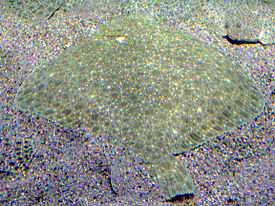
Turbo [2] , or large rhombus [3] ( lat. Scophthalmus maximus ), is a species of lacquer fish of the Kalkan family (Scophthalmidae) of the flatfish order. Distributed in the eastern Atlantic Ocean, including the Baltic and Mediterranean Seas. Sea bottom fish. Maximum body length 100 cm. Valuable commercial fish. The object of aquaculture .
| Turbo |
 |
| Scientific classification |
|---|
| No rank : | Bilateral symmetrical |
|
| International scientific name |
|---|
Scophthalmus maximus ( Linnaeus , 1758 ) |
| Synonyms |
|---|
- according to FishBase [1] :
- Pleuronectes cyclops Donovan, 1806
- Pleuronectes maximus Linnaeus, 1758
- Pleuronectes turbot Lacépède, 1802
- Psetta maxima (Linnaeus, 1758)
- Psetta maxima maxima
(Linnaeus, 1758) - Rhombus aculeatus Gottsche, 1835
- Rhombus magnus minding, 1832
- Rhombus maximus (Linnaeus, 1758)
|
|
Turbo was first described in 1758 by the Swedish naturalist Karl Linnaeus in the classical monograph Systema naturae under the Latin binomen Pleuronectes maximus [4] . In 1810, the American naturalist, zoologist and botanist Constantine Samuel Rafinesque ( English Constantine Samuel Rafinesque 1783-1840) identified the genus Scophthalmus , in which the turbo was placed. For a century and a half it was classified under various Latin names. From the mid-1990s to the beginning of the 2010s, among taxonomists, disputes over the tribal affiliation of the turbo continued. A number of authors attributed this species to the genus Scophthalmus , while others placed it in the genus Rhombus (family Bothidae) [5] or in the monotypic genus Psetta . A detailed analysis of all available sources on this subject is provided by Nicolas Bailly and Bruno Chanet in 2010. The authors concluded that the generic name Scophthalmus is valid [6] . And now, in almost all authoritative sources, only this generic name is used.
Until now, taxonomists have not come to a consensus on the taxonomic status of the turbo and Black Sea kalkan. Some authors consider them different species. The main differences are in the size and location of the tubercles on the body of the fish. It is believed that in turbo tubercles are always substantially smaller than the diameter of the eye and are located only on the ocular side of the body, and in the Black Sea Kalkan, tubercles are larger than the diameter of the eye and are developed both on the ocular and the blind side. However, it was shown that in fish from the Sea of Azov only the ocular side is covered with bone tubercles. In the Baltic Sea, individuals are found with both large and small tubercles located on both sides of the body. The described differences in the number of rays in the dorsal and anal fins are unreliable. Genetic studies also did not show species differences between the turbo and the Black Sea Kalkan. Thus, Scophthalmus maeoticus should be considered as a subspecies of Scophthalmus maximus maeoticus [7] .
Nevertheless, in the domestic literature there are both taxonomic variants [2] [8] </ref> [9] .
The turbo smooth rhombus ( Scophthalmus rhombus ) is closely related .
The body is diamond-shaped, strongly compressed from the sides, the height of the body is only 1.5 times less than the length of the body. Scales are missing. The ocular side of the body and the head is covered with small pointed tubercles, their diameter is less than the diameter of the eye (sometimes there are tubercles on the blind side). The upper profile of the head in the region of the anterior margin of the upper eye is concave. Snout relatively short, slightly longer than eye diameter. The eyes are located on the left side of the body, wide apart; the interorbital distance is about 2 times the diameter of the eye in adults, in juveniles no more than the diameter of the eye. The mouth is large, terminal, strongly oblique, the posterior edge of the upper jaw reaches the vertical passing through the middle of the lower eye. The lower jaw protrudes somewhat forward. The teeth are small, pointed, arranged in several rows. There are teeth on the opener . On the lower half of the first branchial arch 10-12 branchial stamens . The dorsal fin begins on the head, its beginning is on the vertical, passing far in front of the edge of the eye. The dorsal fin contains 57–80 soft unbranched rays. The front rays do not exceed the length of the remaining rays of the dorsal fin. The distal parts of the rays are not interconnected by a membrane. In long anal fin 43-58 soft rays. The ends of the dorsal and anal fins reach the beginning of the caudal peduncle, do not connect to the caudal fin. The rays of the dorsal and anal fins in the middle part are slightly longer than the others. Middle rays of fins on both sides of the body without scales. In the pectoral fin on the ocular side of the body 11-12 rays; rays in the pectoral fin on the blind side of the body are much shorter than on the ophthalmic. The bases of the ventral fins are equal in length, elongated. The fins are located asymmetrically, the first ray of the right ventral fin is opposite the second or third ray of the left fin. The caudal fin is rounded. The lateral line is well developed on both sides of the body, with a sharp bend over the pectoral fin. The vertebrae are 30–31, of which 19–20 are in the caudal region of the spine [10] [8] .
The maximum body length is 100 cm, usually 40–70 cm, body weight up to 25 kg [11] .
The color of the ocular side of the body varies greatly depending on the color of the surrounding substrate, but in general, from light gray or yellowish to dark gray or dark brown with numerous dark and light round dots. The blind side is usually whitish, sometimes with scattered, blurry dark spots. The fins are dark brown, dotted with light dots and spots [10] .
Sea bottom fish. They live on a sandy, shell or pebble bottom at a depth of 2 to 80 meters. Juveniles under the age of one year stay near the coast in desalinated areas of bays and bays. Adult individuals withstand significant fluctuations in water salinity, occur in the Baltic Sea at salinity up to 2 ‰ [8] .
Reproduction, Development, and Growth
Males turbot reach puberty at the age of 3 years, and females at the age of 4-5 years. In the Mediterranean Sea spawning from February to April; in the North and Baltic Seas from April to August, in the more southern regions of the Atlantic in May - July. Portion spawning, individual portions of caviar are washed out every 2-4 days. Spawning is observed at a depth of 10-80 m above the pebble soils. The fertility of female turbot varies from 5 to 10 million eggs. Caviar pelagic, spherical in shape with one drop of fat, with a diameter of 0.9-1.2 mm. The duration of embryonic development depends on the temperature of the water and is 7–9 days. Upon hatching, the length of the larvae varies from 2.2 to 2.8 mm [10] [8] [12] [13] .
The larvae have a symmetrical body; they lead a planktonic lifestyle for several months. Upon reaching a length of 25–27 mm, metamorphosis is completed, the eye moves to the left side of the body, and juveniles move to the bottom lifestyle [8] .
Turbo grows quite slowly. By the end of the first year of life, females and males in the Baltic Sea reach a length of 20 cm. Subsequently, females grow faster than males. At the age of 3 years, the body length of females reaches 36 cm, and males 31.5 cm [8] .
The maximum life expectancy according to different authors is from 15 years [8] to 25 years [11] .
Nutrition
The juveniles feed on invertebrates ( calanuses , euphausids , larvae of balyanus and gastropod mollusks ). Adult individuals switch to feeding on fish ( gerbils , European sprats , horse mackerel , merlang , Esmarka cod , young haddock , flounder; sea bream and others). Sometimes in the stomachs there are mollusks and polychaetes [8] .
Distributed in the eastern Atlantic Ocean from Norway ( range extends beyond the Arctic Circle ); in the North Sea , in most of the Baltic Sea ; along the western coast of Europe , including the British Isles , and south to Bujdur ( Western Sahara ); in the Mediterranean Sea . Off the coast of Iceland is rare. Off the coast of Greenland and North America is absent. If we consider the Black Sea Kalkan as a subspecies of the turbo, then the range extends to the Black and Azov Seas.
Turbo is a valuable commercial fish. The main fishing area is the central part of the North Sea. World catches peaked at 11.5 thousand tons in the 1990s. In 2000-2010, catches ranged from 9.3 to 5.5 thousand tons. Caught by Denmark, Belgium , France, Germany, the Netherlands , Turkey . Fisheries are mainly carried out by trawls , nets, longlines and ugly fishing gears are also used [14] .
Commodity cultivation of turbot began in the 1970s in Scotland . Then appeared in Spain and France . Initially, the volume of cultivation was small due to the lack of planting material. In the early 1990s, biotechnology was developed to produce offspring in artificial conditions and improved methods for producing viable turbo juveniles. In Spain at that time 16 production farms were already operating. In 2000, turbo aquaculture products reached 5 thousand tons. Commodity cultivation of turbot began to engage in new countries. And since 2004, aquaculture products have exceeded catch in vivo. Spain remains the largest producer of turbo commodity products. Significant successes in commodity cultivation of turbot were achieved by Portugal , France, Denmark , Germany , Iceland , Ireland , Italy , Norway , and Great Britain . Turbo was introduced in Chile and China [15] .
Turbo Aquaculture Products [15]| Year | 2007 | 2008 | 2009 | 2010 | 2011 | 2012 | 2013 | 2014 | 2015 | 2016 |
| Aquaculture production, thousand tons | 58.5 | 64,4 | 64 | 54.9 | 60.6 | 77.8 | 82.5 | 75.8 | 69.2 | 59.6 |
Turbot meat has excellent taste. It is realized in fresh and frozen form [8] .
Mentioned as a dish in the novel " Anna Karenina " and the story " The Story of a City ", in the novel " Arc de Triomphe ", as well as in "Count of Monte Cristo" (part two, chap. X) and Flaubert’s novel “Education of feelings”.
- ↑ Synonyms of Scophthalmus maximus (Linnaeus, 1758) in the FishBase database (English) (Retrieved April 14, 2019) .
- ↑ 1 2 Parin N.V., Evseenko S.L., Vasilieva E. D. Fishes of the seas of Russia: annotated catalog. - Collection of works of the Zoological Museum of Moscow State University. - M .: Partnership of scientific publications of KMK, 2014. - V. 53. - S. 523-524. - 733 s. - 500 copies. - ISBN 978-5-87317-967-1 .
- ↑ Reshetnikov Yu.S. , Kotlyar A.N. , Russ T.S. , Shatunovsky M.I. The Bilingual Dictionary of Animal Names. Fish. Latin, Russian, English, German, French. / edited by Acad. V. E. Sokolova . - M .: Rus. Yaz., 1989 .-- S. 401 .-- 12,500 copies. - ISBN 5-200-00237-0 .
- ↑ Linnaeus C. 1758 Systema Naturae per regna tria naturae, secundum classes, ordines, genera, species, cum characteribus, differentiis, synonymis, locis. Editio decima, reformata. Laurentius Salvius: Holmiae. ii, 824 pp.
- ↑ Andriyashev A.P. Fishes of the North Seas of the USSR. - Keys to the fauna of the USSR, published by the Zoological Institute of the Academy of Sciences of the USSR, 53. - M.-L .: Akad. Sciences of the USSR, 1954. - S. 470-471. - 567 p.
- ↑ Bailly N., Chanet B. Scophthalmus Rafinesque, 1810: The valid generic name for the turbot, S. maximus (Linnaeus, 1758) [Pleuronectiformes: Scophthalmidae ] // Cybium. - 2010 .-- Vol. 34, No. 3 . - P. 257-261.
- ↑ N. Suzuki, M. Nishida, K. Yoseda, C. ÜstÜndaǧ, T. Şahi̇n, K. Amaoka. Phylogeographic relationships within the Mediterranean turbot inferred by mitochondrial DNA haplotype variation. - 2004. - Vol. 65, No. 2 . - P. 580-585. - DOI : 10.1111 / j.0022-1112.2004.00433.x .
- ↑ 1 2 3 4 5 6 7 8 9 Commercial fish of Russia. In two volumes / Ed. O.F. Gritsenko, A.N. Kotlyar and B.N. Kotenev. - M .: publishing house of VNIRO, 2006. - V. 2. - S. 909-910. - 624 p. - ISBN 5-85382-229-2 .
- ↑ Vasilieva E. D. Fish of the Black Sea. Key to marine, brackish-water, euryhaline and migratory species with color illustrations collected by S. V. Bogorodsky. - M .: VNIRO, 2007 .-- S. 187-188. - 238 p. - 200 copies. - ISBN 978-5-85382-347-1 .
- ↑ 1 2 3 Munroe, 2016 , p. 2967-2968.
- ↑ 1 2 Scophthalmus maximus (English) in the FishBase database. (Retrieved April 14, 2019)
- ↑ Fishes of the NE Atlantic and the Mediterranean .
- ↑ H. Murua, F. Saborido-Rey. Female Reproductive Strategies of Marine Fish Species of the North Atlantic // J. Northw. Atl. Fish Sci .. - 2003. - Vol. 33. - P. 23-33. - DOI : 10.2960 / J.v33.a2 .
- ↑ FAO Capture Production of Psetta maxima in the FishBase database (English) (Retrieved April 14, 2019) .
- ↑ 1 2 Psetta maxima (Linnaeus, 1758) FAO, Cultured Aquatic Species Information Program (Retrieved April 14, 2019)
- Munroe TA SCOPHTHALMIDAE Turbots, megrims, brills // The living marine resources of the Eastern Central Atlantic. Volume 4: Bony fishes part 2 (Perciformes to Tetradontiformes) and Sea turtles / Carpenter, KE & De Angelis, N., eds .. - FAO Species Identification Guide for Fishery Purposes. - Rome: FAO, 2016 .-- P. 2960-2972. - 2343-3124 p.
- Bjørndal T., Øiestad V. Turbot - production, technology and markets. - Globefish Res. Program. - Rome: FAO, 2011 .-- Vol. 103. - 31 p.
- Species Scophthalmus maximus (English) in the World Register of Marine Species . (Retrieved April 14, 2019)
- Turbot ( Psetta maxima ) . Fishes of the NE Atlantic and the Mediterranean. Marine Species Identification Portal . Date of appeal April 12, 2019. (Retrieved April 14, 2019)
