
The era of militarists is a period in the history of the Republic of China (1916-1928), during which the country was divided between military rulers ( dujuns ).
The era of the militarists began with the death of General Yuan Shikai and nominally ended in 1928 with the completion of the Northern Campaign (1926-1927) and the unification of China under the Kuomintang flag, after which the Nanking Decade began. However, after the victory over the old militarists, such as Wu Peifu and Sun Chuanfang , in 1930-1940 new rebel generals appeared who did not want to recognize the power of the central government, which created great problems for the Kuomintang during the Second World War and the subsequent civil war .
Origins
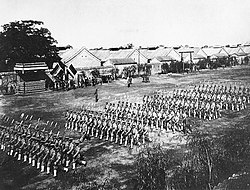
The dynasty of the last Manchu Qing emperors did not have a regular army, and in defense it used the armies of its provinces and militias , which did not have standard uniforms and weapons. The most powerful of them was the army of Beian militarists stationed in the north under the leadership of Yuan Shikai , who at one time received an excellent military education. The officers were loyal to their superiors and united in cliques on a geographic basis or as classmates for military academies. Units were formed from immigrants from some provinces. A similar principle helped to avoid understanding problems associated with a large number of dialects in the Chinese language, but this principle encouraged centrifugal tendencies.
After the Xinhai Revolution of 1911, military riots spread widely in the south of the Qing Empire. The following year, the rebels established an interim government in Nanjing led by Dr. Sun Yat-sen . However, the revolutionaries did not have the strength to crush the Beian Army and the resistance was doomed to failure. Sun Yat-sen agreed with Yuan Shikai to overthrow the Manchu dynasty and "unite China" within the borders of the Qing Empire. At the same time, Yuan Shikai became president . Yuan Shikai assumed the presidency, but refused to move to Nanjing and remained in the capital, Beijing , where nothing threatened his military power.
The southern provinces opposed the growing authoritarianism of Yuan Shikai and rebelled in 1913, but the uprisings were crushed by the forces of the Beiyang Army. Civilian governors were replaced by the military. In December 1915, Yuan Shikai made it clear that he intended to become Emperor of China . The southern provinces rebelled again, but this time it was much more serious, since most of the Beiyang commanders left Yuan Shikai. He tried to abandon the idea of a monarchy in order to regain the disposition of officers, but in June 1916 he died and left the new country in a state of political fragmentation. The division of China into North and South continued throughout the era of militarists.
North
The death of Yuan Shikai divided the Beiyang army into two parts: the Anhui clique led by Duan Qizhuya and the Zhili clique led by Feng Guozhang . The Fengtian clique , located in Manchuria and subordinate to Zhang Zolin , was a fusion of Beiyang and local divisions. Diplomatic recognition was usually received by any government that succeeded in capturing Beijing, since it could collect customs duties and receive foreign loans. All the northern cliques of the militarists recognized the Beijing government, even if they actually opposed it. They did not dispute his legality, but believed that he lacked authority to dictate his will to the provinces. The Beiyang government in Beijing issued decrees from time to time with respect to territories that did not actually submit to it, in order to accuse local militarists of treason. Of course, these decrees were ignored and the government received a formal reason for attack. This practice was suspended in 1923 when Cao Kun bought the right to be president of China. Other northern cliques refused to acknowledge his rule.
Board of the Anhui clique (1916-1920)
President Li Yuanhong was effectively pushed into the background by Beiyang generals. Premier Duan Qijui held a dominant position in politics, but was forced to cooperate with the Zhile clique in order to maintain stability. Many provinces refused to recognize their government and demanded that Bayan generals be expelled from politics. The clumsy attempts by Duan Qijuya to drag China into the First World War and his secret loans from Japan led to the fact that in May 1917, Li Yuanhong was forced to resign. Knowing that Duan Qijui was plotting against him, Li Yuanhong asked influential General Zhang Xun to protect the government. Instead, Zhang Xun attempted to restore the monarchy in July 1917. Duan Qijui suppressed the coup and was proclaimed the savior of the republic. This gave him the opportunity to finally declare war on Germany . Representatives of the Entente insisted on this to force the Germans out of the country (they had strong concessions in China and competed with the British, American and French capitalists).
Duan Qijuya's next task was to subjugate the rebellious southern provinces, but disagreements with the Zhili clique, which preferred the negotiation path, led to his resignation in order to maintain the unity of the Beiyang generals. However, under pressure from the Anhui clique, President Feng Guozhang was forced to call Duan Qizhuya back. In October 1918, he again resigned, but did everything possible to sabotage the peace negotiations between south and north. The fact that he supported Japan weakened his position during the events of May 4, 1919. The Zhile clique entered into an alliance with the Feng clique Zhang Zolin and in July 1920 defeated Duan Tsizhuya during the Zhili-Anhui war .
The reign of the Zhili clique (1920-1924)
After the death of Feng Guozhang in 1919, the Cao Kun led the Zhile clique. The shaky alliance with the Fengtian clique broke up and in 1922 the First Zhili-Fengtian war began , during which the forces of the Zhilian clique drove the troops of Zhang Zolin back to Manchuria. The next step was to strengthen the status of the Zhili militarists and the unification of the country. To this end, Cao Kun invited Li Yuanhong to the presidency and reassembled the National Assembly . Xu Shichang and Sun Yat-sen were asked to hand over their presidency to Li Yuanhong at the same time. When Sun Yat-sen set forth tough demands that the Zhiliki clique could not fulfill, it provoked the betrayal of General Kuomintang Chen Junming , recognizing him governor of Guangdong . Sun Yat-sen was forced to leave Canton and the Zhili clique nominally restored the constitutional government that existed before the coup Zhang Xun . In 1923, Cao Kun acquired the presidency, despite strong protests from the Kuomintang, the Fengtian and Anhui cliques, some of their officers and public opinion. In the fall of 1924, the Zhilian group almost achieved victory in the Second Zhili-Fengtian War , but at that time Feng Yuxiang betrayed the clique, captured Beijing and sent Cao Kun to prison. The Zhilian militarists were utterly defeated in the north of the country, but managed to keep the center.
The reign of the Fengtian clique (1924-1928)
The alliance between Zhang Zolin and Feng Yuxiang was weak. Feng Yuixiang formed his own clique called the KMT (People’s Army), which supported an ideology similar to the KMT. As a compromise, he handed over the northern government to Duan Qijuy, whose Anhui clique was close to decay. The Fengtian clique was much stronger, as the KMT forces were extended over considerable distances. Negotiations on the reunification of the north and the south have come to a standstill: Zhang Zolin and Duan Chihui had little in common with Sun Yat-sen. The latter died in March 1925.
In the same year, the general of the Fengtian clique Guo Songlin , yielding to the promises of Feng Yuxiang, went over to his side and began a campaign against his former commander Zhang Zolin, which led to the outbreak of the Anti-Fentian War . General Wu Peifu , a member of the Zhili clique, decided to support Zhang Zolin in the fight against the traitor. Gominjun troops were driven northwest. Later they joined Chiang Kai-shek's Northern Campaign . In June 1927, Zhang Zolin became the head of the northern government, but at the same time, troops of the National Revolutionary Army (NRA) invaded its territory. On June 2, 1928, Zhang Zolin lost to the Beijing NRA. On June 4, while trying to escape to Manchuria, he died from a bomb explosion. Five days later, the NRA captured the capital. Zhang Zolin's son and heir, Zhang Xueliang , recognized the nationalist government on December 31.
South
A revolutionary movement was ripening in southern China. There, the opposition to the Beiyang generals was especially strong. Southerners rebelled against the Qing Dynasty in 1911, and against Yuan Shikai in 1913 (" Second Revolution ") and 1916 (" War in Defense of the Republic "). After an attempt to restore the monarchy in Beijing, several southern provinces led by Tang Jiyao and Lu Zhongtin refused to recognize the parliament and the new government of Duan Qijuya . Sun Yat-sen gathered prominent politicians, members of the Kuomintang from the dissolved National Assembly , as well as southern militarists, and at the end of July 1917 formed his own government in Canton , known as the Constitution Defense Government . The southern cliques recognized Canton as the legitimate capital, despite the fact that the international community refused to do the same. As in the north, in the south, local uprisings flared up, especially in Guangxi province.
Constitutional Movement (1917-1922)
In September, Sun Yat-sen was proclaimed commander in chief of the military government, whose goal was to defend the interim constitution of 1912 . The southern militarists supported him only in order to gain a foothold in their estates and challenge Beijing. To achieve international recognition, they also declared war on the Central Powers , but recognition was never received. In July 1918, the southern militarists concluded that Sun Yat-sen was endowed with excessive powers and forced him to join the government committee. Unable to endure constant interference in his affairs, Sun Yat-sen set off on a voluntary exile. During this period, he was actively engaged in the reconstruction of the Kuomintang party . In 1920, during the Guangdong-Guangsi War, with the help of Kuomintang General Chen Jungyang , committee members General Tsen Chunxuan , Admiral Lin Baoyi and General Lu Rongting were expelled. In May 1921, despite the protests of Chen Junming and Tang Shaoyi , Sun Yat-sen was elected an incomplete parliament as the "extraordinary president." After this, Tang Shaoyi withdrew from business, and Chen Junming began negotiations with the Zhile clique in order to deprive Sun Yat-sen of power in exchange for the governor in Guangdong (which was done in 1922).
Reorganization (1923-1925)
In March 1923, the loyalists secured the expulsion of Chen Junming and brought Sun Yat-sen back to power. He reorganized the Kuomintang in accordance with Marxist-Leninist democratic centralism and entered into an alliance with the Chinese Communist Party , which became known as the First United Front . The southern government abandoned attempts to defend the 1912 constitution, as parliamentarians made concessions to the north to join the puppet government of Cao Kun. Instead, his goal was to create a revolutionary one-party state . To replace the unreliable opportunist generals at the Wampu Military Academy , new officer cadres were being trained for the future Kuomintang army. After the Zhili clique lost its former influence in 1924, Sun Yat-sen went to Beijing to negotiate with the leaders of the Gominjun , Anhui and Fengtian cliques. However, in March 1925 he died of liver cancer, which not only put an end to all peace negotiations, but also exacerbated the already tense relations between the north and the south. Tang Jiyao declared himself heir to Sun Yat-sen and tried to take control of the southern government during the Yunnan-Guangxi war , but was defeated.
Northern Campaign (1926-1928)
The leader of the National Revolutionary Army was General Chiang Kai-shek . In the summer of 1926, after much doubt, he finally ordered the start of the Northern Campaign . The NRA crushed the armies of Wu Peifu and Sun Chuanfang in central and eastern China. One of the KMT leaders, a militarist from Shanxi province , Yan Xishan joined the KMT and opposed the Fengtian clique. In 1927, the alliance between the Kuomintang and the Chinese Communist Party broke up after the destruction of the workers' guard in Shanghai. This incident marked the beginning of the Chinese Civil War .
Chiang Kai-shek chose Nanjing as the capital, but in order to gain international recognition, he still needed to take Beijing. The allied forces of Yan Xishan entered the capital after the death of Zhang Zolin . Zhang Xueliang , the new leader of the Fengtian clique, recognized the Kuomintang power on condition that he remained the ruler of Manchuria . His reign came to an end after the Japanese occupied the northeast of China in 1931 .
Nominee Association
Moving the capital to Nanjing , Chiang Kai-shek announced the unification of China in 1928 . Not all militarists were defeated, and although many of them agreed to cooperate with the new government, the struggle between the cliques continued. In 1930, Feng Yuxiang and Yan Xishan revolted, which marked the beginning of a new war . Ma Zhongying fought the Xinjiang clique from 1931 to 1937. Chiang Kai-shek was forced to crush the uprising in Fujian in 1933 . Zhang Xueliang spoke in 1936 during the Xi'an incident . In remote areas, Communists, petty field commanders, bandits, and the militia of national minorities acted with might and main. Among the Kuomintang leaders, friction now and then began: so Wang Jingwei and Hu Hanming rebelled against the power of Chiang Kai-shek. By and large, he controlled only the provinces close to Jiangsu . Thus, the militaristic freemen did not end, but acquired other forms. Until the end of the Civil War in 1950, China did not know a single centralized government.
Main fractions
Northern Clicks
Key Clicks
Anhui clique皖系
| Zhilean clique直系
| Fengtian clique奉系
|
Minor Clicks
Gominjun國民 軍
Shanxi clique晉 系
Xinjiang clique
| Clique Ma馬家軍
|
Newest Factions
Hebei
Henan
| Jehe
Shaanxi
| Suyuan
Shandong
|
Southern Clicks
Yunnan clique滇 系
| Guangxi Old Clique桂系
Guangxi new clique新 桂系
| Kuomintang中國 國民黨
| Sichuan clique川 系
Sichuan / Kam
|
Small Southern Factions
Guangdong
| Fujian
Guizhou
| Chinese Communist Party
| Hunan
| Jiangxi
Hebei
|
See also
- National Revolutionary Army
- Wampu Academy
- History of the Republic of China
- German-Chinese cooperation (1911-1941)
- Kuomintang
- Chinese nationalism
- Armed Forces of the Republic of China
- Politics of the Republic of China
Literature
- in Russian
- Selivanov I.N. § 5 China in 1914-1925 // Recent history of the countries of Asia and Africa, XX century: Textbook for students of higher educational institutions: In 2 hours. Part 1: 1900-1945 / Ed. A.M. Rodriguez . - M .: Humanitarian Publishing Center Vlados, 2001. - S. 88-101. - 368 p. - ISBN 5-691-00644-4 , ISBN 5-691-00645-2 .
- in other languages
- McCord EA The Power of the Gun, The Emergence of Modern Chinese Warlordism . - Berkeley: University of California Press , 1993. - 436 p. - ISBN 978-0-520-08128-4 .
- Waldron A. . From War to Nationalism: China's Turning Point, 1924-1925 . - Cambridge: Cambridge University Press , 1995 .-- 416 p.
Links
- 陈贤庆 (Chen Xianqing), 民国 军阀 派系 谈 (The Republic of China warlord cliques discussed), 2007 revised edition
- Volynets Alexey. “There are more rifles than cartridges ...” General “feudalism” - private armies and civil wars in China in the 1910-1920s
- Volynets Alexey. Masters of the Celestial Empire: "Old Marshal" against the "Jade General". The feudal generals who divided China in the 1920s
- Volynets Alexey. Masters of the Celestial Empire: exchange Beijing for Shanghai. A new round of Chinese civil wars in the mid 20-ies of the XX century
- Volynets Alexey. Masters of the Celestial Empire: the game of General Guo. Chinese generals “elect” a new president and start new feuds
- Volynets Alexey. Masters of the Celestial Empire: "soldier of Christ" in alliance with the Bolsheviks. Russian military specialists appear on both sides of the Chinese civil war front
Fiction
- Elvira Baryakina. White Shanghai. - M .: Ripol-Classic , 2010 .-- ISBN 978-5-386-02069-9
- Andre Malraux . The destiny of man. (La Condition humaine, 1933)