Alexander Evstafievich Baranov (von Baranhoff) ( German: Alexander Ludwig Gustav von Baranoff ; January 9, 1837 - December 27, 1905 ) - Lieutenant General, participant in the Caucasian War and Turkestan campaigns.
| Alexander Evstafievich Baranov | |
|---|---|
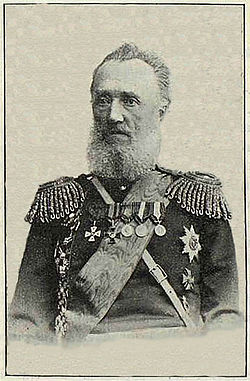 General A.E. Baranov | |
| Date of Birth | January 9, 1837 |
| Date of death | December 27, 1905 (68 years old) |
| Affiliation |  Russian empire Russian empire |
| Type of army | cavalry, infantry |
| Years of service | 1857-1905 |
| Rank | lieutenant general |
| Commanded | 3rd Orenburg Line Battalion , 61st Infantry Reserve Battalion, 158th Infantry Kutaisi Regiment |
| Battles / wars | Caucasian war , Turkestan campaigns , Russo-Turkish war of 1877-1878 |
| Awards and prizes | Order of St. Stanislav 3rd Art. (1862), Order of St. George , 4th art. (1862), Golden weapon “For courage” (1864), Order of St. Anne , 3rd art. (1866), Order of St. Stanislav , 2nd art. (1866), Order of St. Anne , 2nd art. (1869), Order of St. Vladimir , 4th art. (1873), Order of St. Vladimir , 3rd art. (1877), Order of St. Stanislav 1st Art. (1881), Order of St. Anne , 1st art. (1884), Order of St. Vladimir , 2nd art. (1890), Order of the White Eagle (1896), Order of St. Alexander Nevsky (1905). |
Biography
Born in the family of the head of the 11th Infantry Division, Lieutenant General Evstafy Evstafievich Baranov and Zhaneta Egorovna. Rod von Barangof came from the old Russian noble family of the Baranovs , part of which in the 17th century moved to the Baltic states and was completely Germanized (recorded in the nobles of the Estland province ). Alexander Evstafievich Baranov (von Barangof) was an evangelical Lutheran religion .
He was educated in the Page Corps , from which he was released on June 6, 1857 as an ensign in the Life Guards Preobrazhensky Regiment .
In 1860, Baranov was transferred to the Caucasus as a lieutenant in the Nizhny Novgorod Dragoon Regiment, and immediately upon arrival, June 11, joined the Shapsug detachment. During 1860, 1861, 1862 and 1863, Baranov took part in many shootings and affairs with the highlanders . November 23, 1862 he was awarded the Order of St. Stanislav 3rd degree, and on December 23 for the case under the village of Abadzekh was awarded the Order of St. George 4th degree (No. 10216 according to the cavalier list of Grigorovich - Stepanov). Here is what was said in the script for this order:
 | Commanding 1 squadron of His Royal Highness the Crown Prince of the Wirthemberg Regiment of the Nizhny Novgorod Dragoon and being on August 18, 1862 on a forage in a convoy sent from the Dakhov detachment, at a time when horsemen, up to a thousand people, rapidly attacked and surrounded on all sides the infantry, consisting of only 137 people, rushed to the wagon train cut off from the cover - you quickly gathered a foraging squadron, attacked the highlanders on the flank when they were already near the wagon train, and despite the fact that the enemy was ten p they were stronger, they cut into the very crowd of highlanders on the flank, who, unable to withstand such a bold, unexpected attack, fled to their foot reserves, pursued by dragoons; when the fresh crowds of highlanders arrived, up to about a thousand people, in a hurry of dragoons, you and the infantry courageously defended the position until reinforcements arrived from the camp. Your resourcefulness and bold timely attack against the strongest enemy defended the entire convoy, consisting of 30 wagons, and rescued the infantry, which had already suffered a significant loss, from a complete defeat, giving it time to settle down and restore order. In retaliation of such an excellent feat, We graciously mercifully granted you the Decree on the 23rd day of December 1862 to the Capitul given by the Knight of the Imperial Order of Our Holy Great Martyr and Victorious George the fourth degree |
.
On August 6, 1863, Baranov was transferred back to the Preobrazhensky Life Guards Regiment, as a second lieutenant; the regiment was at that time in Poland , on the occasion of the suppression of the rebellion . Arriving in Poland on September 7, Baranov, however, did not participate in cases against the Poles. On November 1, the regiment returned to St. Petersburg .
He was sentenced on November 13, 1863, with seniority on May 19 of the same year. May 15, 1864 [1] Baranov was awarded a gold saber with the inscription "for courage" for the distinction shown in cases against mountaineers during the military operations of the Dakhov detachment in the winter of 1862-1863.
On June 6, 1865, Baranov was appointed at the disposal of the military governor of the Turkestan region , with enlistment by the army cavalry as captain.
The following year, hostilities began against the Bukhara Khanate ; From May 20, Baranov participated in the siege of the city of Khojent and took it by storm on May 24 (during the assault he commanded a separate convoy), for the distinction he was awarded the Order of St. Anne is of the 3rd degree (November 4, 1866) and promoted to majors (November 12, with seniority on May 29). November 12, Baranov took command of the 3rd Orenburg Line Battalion .
In September of the same year, Baranov, being a member of the detachment of Major General Romanovsky , marched on Ura-Tyube and Dzhizak , then participated in the assault on Ura-Tyube (October 2, commanded the main assault squad and was the first to cross the fortress wall) and Dzhizak (October 18 ) November 21 Baranov for the difference in battle at the tract Murza-rabat received the Order of St. Stanislav 2nd degree with swords, for taking Ura-Tyube on October 17, 1867 he received the rank of lieutenant colonel , and for the difference in the assault on Jizzakh on February 20, 1868 he was granted the imperial crown to the Order of St. Stanislav 2nd degree.
On June 5, 1868, for the difference in the battle with the Bukhara on the Chapan-Ata heights near Samarkand, Baranov was promoted to colonel (with seniority on May 1). After the occupation of Samarkand, Baranov, along with the main army of Kaufman, moved further to Bukhara and participated in the occupation of Katta-Kurgan by Abramov and in a general battle with the army of the Bukhara emir on the Zerabulak heights. For the difference against the Bukharaites near Katta-Kurgan (May 27 and 28, 1868) Baranov was awarded the Order of St. Anne of the 2nd degree with swords (June 30, 1869); for the battle on July 2, 1868, on the Zerabulak heights, Baranov received the imperial crown to this order.
On September 25 of the same year, he surrendered command to the battalion on the occasion of his dismissal on a four-month vacation; by Highest permission, this vacation on March 25, 1869 was extended for another 11 months and at the same time Baranov was enlisted in the army infantry.
On January 8, 1870, Baranov was appointed commander of the 61st infantry reserve (personnel) battalion, and on November 17, 1872, he was appointed commander of the 158th infantry regiment of Kutaisi . He entered command of the regiment on February 25, 1873, and on August 6 of the same year he was awarded the Order of St. Vladimir 4th degree, and May 2, 1877 - the same order of the 3rd degree.
With the Kutaisi regiment, Baranov participated in the Russian-Turkish war of 1877-1878 at the Caucasian Theater. In a battle with the Turks on the Aladzhin Heights on September 20, 1877, he was wounded in the left leg by a bullet right through.
November 8, 1877 Baranov was promoted to major general , with the appointment of being a member of the Caucasian Army. January 1, 1880 he was appointed Simbirsk provincial military commander [2] with the abandonment of the army infantry; On February 18 of that year, he was granted the Red Cross badge.
May 19, 1880 Baranov was enlisted in the lists of the 158th Kutaisi Infantry Regiment, with the same positions in the army infantry. March 30, 1881 Baranov was awarded the Order of St. Stanislav 1st degree, and on September 24 of the same year he was appointed head of the 21st (later Perm) local brigade. In this position, Baranov was awarded the Order of St. Annes of the 1st degree (May 6, 1884) and St. Vladimir 2nd degree (August 30, 1890) and promoted to lieutenant general (August 30, 1886). May 14, 1896 awarded the Order of the White Eagle . The last awards of the general were a golden snuffbox decorated with diamonds and the Order of St. Alexander Nevsky (12/06/1905). As the senior general in the district, he repeatedly served as commander of the troops of the Kazan Military District. At this official post, he died on December 27, 1905 [3] .
Baranov was married to Ekaterina Ivanovna Lenartzen, daughter of a mining engineer, state adviser; their children: Plato, Vladimir, Catherine, Nikolai, Anna, Elena, Peter.
His brother Nikolai was a lieutenant general and commanded the Life Guards 2nd Tsarskoye Selo Rifle Battalion and 35th Infantry Division.
Notes
- ↑ According to Ismailov - December 19.
- ↑ Volkov mistakenly said that Baranov held the post of Simbirsk governor.
- ↑ Volkov mistakenly stated “from 1881 to Sep. 1905 Head of the Perm Local Brigade ”(vol. 1, p. 105).
Sources
- Perm Provincial Gazette of 01/08/1906. No. 6.
- Volkov S.V. Generality of the Russian Empire. Encyclopedic dictionary of generals and admirals from Peter I to Nicholas II. Volume II L — I. M., 2009
- Ismailov E.E. Golden weapon with the inscription "For courage." Lists of gentlemen 1788-1913. M., 2007
- List to the generals by seniority . Done on September 1, 1896.
- Starchevsky A. A. Monument of the Eastern War of 1877-1878 SPb., 1878
- Stepanov V.S., Grigorovich P.I. In memory of the centennial of the imperial Military Order of the Holy Great Martyr and Victorious George. (1769-1869). SPb., 1869
- Terentyev M. A. History of the conquest of Central Asia. T. 1. St. Petersburg, 1903
- Freiman, O.R. Page in 183 (1711-1984). Biographies of former pages with portraits. Friedrichshamn, 1894
- Lieutenant General A. E. Baranov (Obituary)