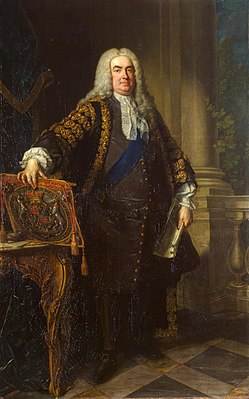
Robert Walpole, 1st Earl of Orford ( U. Walpole , English; Robert Walpole ; August 26, 1676 - March 18, 1745 ) - British statesman, Knight of the Order of the Garter and Knight companion of the Order of the Baths , the most powerful figure in British political life of the 1720s and 1730s. The father of the writer and founder of the "Gothic" novel by Horace Walpole . The first kings of the Hanover House found loyal support in Walpole. He avoided getting the country into European wars and saved military and economic forces to repel possible Jacobi invasions .
| Robert Walpole, Earl of Orford | |||||||
|---|---|---|---|---|---|---|---|
| Robert Walpole | |||||||
 | |||||||
| Monarch | George I George II | ||||||
| Predecessor | position established | ||||||
| Successor | Spencer Compton, Earl Wilmington | ||||||
| |||||||
| Monarch | George I George II | ||||||
| Predecessor | Sir John Pratt | ||||||
| Successor | Samuel Sandis | ||||||
| |||||||
| Monarch | George I | ||||||
| Predecessor | Sir Richard Onslow | ||||||
| Successor | James Stanhope | ||||||
| Birth | |||||||
| Death | |||||||
| Burial place | |||||||
| Father | |||||||
| Mother | |||||||
| Spouse | and | ||||||
| Children | , and | ||||||
| The consignment | Whigs | ||||||
| Education | |||||||
| Religion | |||||||
| Autograph |  | ||||||
| Awards |
| ||||||


In 1721, he became the first Lord of the Treasury , and from 1730 , after the resignation of Lord Townsend , he remained the head of government until 1742 . He led the government longer than anyone in British history, and is considered the first British prime minister . This term was not used then, but Walpole had an influence on the cabinet , similar to the later prime ministers.
Content
The early years
Walpole was born on the Houghton Hall estate in the Colonel’s family. Studied at Eton and Cambridge . After the death of his father, he inherited a place in the House of Commons from one of the rotten places , which he had kept for forty years. Throughout his career, he remained faithful to the Whig party, rallied a circle of writers - adherents of the Hanover House ( Kit-Cat Club ), which became the prototype of subsequent political clubs in Europe.
As a politician, he advanced during the years of the War for the Spanish Succession , first in the naval department. In February 1708 he was appointed Minister of War, in 1710 - Treasurer of the Navy. After coming to power, the Tories in 1711 were removed from business, at the instigation of the Viscount Bolingbrook, convicted of bribery and imprisoned in the Tower . After his release, he entered the fight against Bolingbroke for supremacy in the political life of the country.
The path to power
The coming to power of the Hanover House in the person of George I (1714) meant the return of the monarchy of mercy to pro-Hanoverian politicians, including Walpole. He led a secret committee investigating the allegations of high treason by Bolingbrook and other Tory leaders. In 1715 he was appointed first lord of the treasury.
In the years 1716-1717, Walpole, with his son-in-law, Viscount Townsend, clashed on foreign policy issues with the party of the Earl of Sunderland . The former insisted on maintaining neutrality in relation to continental conflicts, the latter demanded armed defense of the king’s possessions in Hanover .
Walpole and Townsend left the office and went into opposition. Their patrons, they chose the "young court" - the Prince of Wales and his wife, Caroline Ansbach . With the mediation of Walpole in 1720, the prince reconciled with the king. From this moment, Walpole became sovereign.
First Minister
The first problem Walpole had to face as the “prime minister” (he himself did not approve of this unofficial term at the time, seeing it as a mockery) was the collapse of the financial pyramid known as the South Sea Company . Walpole himself enriched himself, participating in its activities. To calm the wrath of those who lost their savings, he removed the head of the treasury from his affairs and took up this post himself.
In the early 1720s, supporters of the Hanover House formed a kind of triumvirate : John Carteret took the place of the dead Earl of Sunderland, Walpole headed the Ministry of Finance (as Chancellor of the Treasury in 1721-1742), Townsend was in charge of foreign policy (as Secretary of State). In 1724, Walpole succeeded in removing Carteret to Ireland, in 1730 he secured Townsend's resignation, thus gaining full power.
Walpole's government policy was based on two pillars - low taxation in domestic politics and the avoidance of war in foreign policy. These goals fully met the aspirations of an influential layer of rural squires , but they displeased large landowners who demanded an increase in colonial possessions with weapons in their hands.
Opposition
During Walpole's rule, the Tories were squeezed out of political life, and their leader, Bolingbroke, admitting defeat, went abroad in 1735. However, the Whig camp was divided into a number of warring parties. In politics, the patronage system dominated: each major dignitary sought to put forward his young relatives and proteges .
Hence the accusations of corruption and corruption of the state apparatus, which were put forward against Walpole by his opponents of all stripes. Pamphlets , plays and poetic messages regularly ridiculed the love of the first minister appeared regularly in the press. Some of them belonged to the pen of such large figures as Jonathan Swift , Henry Fielding and Alexander Pope ; the government’s struggle with freemen on the stage was especially outrageous. The abode of all dissatisfied with Walpole's rule was The Craftsman .
Opponents of Walpole explained his unwillingness to fight the French, if not by bribery, then by natural passivity. His commitment to peaceful foreign policy led to the neutrality of Britain in the War of the Polish Succession . The conflict with the Spaniards around Gibraltar was also resolved peacefully.
In 1733, Walpole was forced to yield to the pressure of the merchants and to cancel his excise taxes on wine and tobacco. In 1739, under pressure from the planters, he reluctantly declared war on the Spaniards . The 1734 election reflected a fall in his popularity. Young aristocrats (such as William Pitt ), foreseeing the imminent fall of Walpole, sought the protection of his opponents and grouped around the young prince of Wales .
Retirement
In February 1742, Walpole's adversaries finally managed to achieve his resignation. He received the title of Earl of Orford and a substantial pension, but could not prevent the House of Commons from initiating an investigation into the abuses associated with his name. The elderly minister retired to his Houghton Hall estate, from where he continued to give advice to the king and influence state affairs through his protege Henry Pelham (who served as prime minister).
Houghton Collection
Walpole spent his huge fortune on the acquisition of works of art. His art gallery was considered the best in the country, including the works of Rubens , Rembrandt , Van Dyck , Frans Hals , Velazquez , Veronese . Despite the opposition of the youngest son of Orais (the famous writer), the Houghton Hall art collection after the death of Earl Orford was sold in 1778 by his grandson Catherine II , who put him at the heart of the Hermitage created by her. The Houghton Collection is considered Britain's largest cultural loss.
Bibliography
- Black, Jeremy . (2001). Walpole in Power. Stroud: Sutton Publishing.
- Browning, Reed. The Duke of Newcastle . Yale University Press , 1975.
- Dickinson, Harry T. (1973). Walpole and the Whig Supremacy. London: English Universities Press.
- Field, Ophelia. The Kit-Cat Club: Friends who Imagined a Nation . Harper Collins, 2008.
- Hill, Brian W. (1989). Sir Robert Walpole: “Sole and Prime Minister.” London: Hamish Hamilton.
- Morley, John. (1889). Walpole. London: Macmillan and Co.
- Pearce, Eward. The Great Man: Sir Robert Walpole Pimlico, 2008.
- Plumb, John Harold. (1956-1960). Sir Robert Walpole. (2 volumes). London: Cresset Press.
- Plumb, John Harold. (1967). The Growth of Political Stability in England 1675-1725. London: Macmillan and Co.
- Rodger, NAM Command of the Ocean: A Naval History of Britain 1649-1815 . Penguin Books, 2006.
Notes
- ↑ 1 2 BNF identifier : Open Data Platform 2011.
- ↑ http://www.robinsonlibrary.com/history/britain/england/1714/walpole.htm
- ↑ Find a Grave - 1995. - ed. size: 165000000
- ↑ http://www.historyofparliamentonline.org/volume/1690-1715/member/walpole-robert-ii-1676-1745
Links
- Walpole, Robert // Brockhaus and Efron Encyclopedic Dictionary : in 86 volumes (82 volumes and 4 additional). - SPb. , 1890-1907.
- Walpole, Robert // Encyclopedia " Around the World ."